

| Home | Log In | Register | Our Services | My Account | Contact | Help |
You are NOT currently logged in
Register now or login to post to this thread.
THE TALK TO YOURSELF THREAD. (NOWT)
goldfinger

 - 09 Jun 2005 12:25


Thought Id start this one going because its rather dead on this board at the moment and I suppose all my usual muckers are either at the Stella tennis event watching Dim Tim (lose again) or at Henly Regatta eating cucumber sandwiches (they wish,...NOT).
Anyway please feel free to just talk to yourself blast away and let it go on any company or subject you wish. Just wish Id thought of this one before.
cheers GF.
Anyway please feel free to just talk to yourself blast away and let it go on any company or subject you wish. Just wish Id thought of this one before.
cheers GF.
Fred1new
- 29 Dec 2012 20:14
- 19748 of 81564
Tanker,
How many times did you read the DailyTails article?
-----------
P 19749
Having difficulties, but agree.
How many times did you read the DailyTails article?
-----------
P 19749
Having difficulties, but agree.
cynic
- 30 Dec 2012 08:55
- 19749 of 81564
to change the subject somewhat .... we should be very thankful indeed that we (uk) does not suffer from the insane american system ...... there, a strident, hard-line minority (t party) can hold its own party (republicans) to ransom, and thus bring the country close to ruin ...... additionally, it makes america a complete laughing stock.
here, the lords can and does monitor, debate vociferously, and filters out a good proportion of the excesses of acts that are proposed by parliament
that said, the lords can only block a bill twice (i think) ...... after that, parliament calls the shots.
as individuals, we may not like the result and indeed parliament assuredly gets things (badly) wrong on occasion, but at least a decision is made.
here, the lords can and does monitor, debate vociferously, and filters out a good proportion of the excesses of acts that are proposed by parliament
that said, the lords can only block a bill twice (i think) ...... after that, parliament calls the shots.
as individuals, we may not like the result and indeed parliament assuredly gets things (badly) wrong on occasion, but at least a decision is made.
Fred1new
- 30 Dec 2012 10:30
- 19750 of 81564
Cynic,
Yes.
I think the American system developed as a "protection" against a new "dictatorship" taking over.
Ours as an attempt to protect a "dictatorship".
Both "systems" have failings.
Reform in UK is necessary, but the replacement of the "Lords" probably needs a reviewing chamber with the ability to refer back to Parliament, but not to block administrative actions.
Those “co-opted”, or “coerced” into that body should in general be non-political, (if possible,) and have “expertise” and be representative of the various areas of a “modern” society and have a limited tenure of “office”, before re-appointment.
Membership of the body could be on a rotating overlapping of 3-5 year basis.
Preferably, the body should be small in number and by appointment rather than “election”.
(Similar to the civil service. 8-))
Yes.
I think the American system developed as a "protection" against a new "dictatorship" taking over.
Ours as an attempt to protect a "dictatorship".
Both "systems" have failings.
Reform in UK is necessary, but the replacement of the "Lords" probably needs a reviewing chamber with the ability to refer back to Parliament, but not to block administrative actions.
Those “co-opted”, or “coerced” into that body should in general be non-political, (if possible,) and have “expertise” and be representative of the various areas of a “modern” society and have a limited tenure of “office”, before re-appointment.
Membership of the body could be on a rotating overlapping of 3-5 year basis.
Preferably, the body should be small in number and by appointment rather than “election”.
(Similar to the civil service. 8-))
cynic
- 30 Dec 2012 10:38
- 19751 of 81564
why "small in number" and by that, how many?
i think the lords is much less partisan than their individual labels may imply, and there are certainly many more with wide experience in business and/or politics than in the commons.
for that reason, i would be reluctant to make the lords "rotating" which implies that once you'd served your term, you are out, regardless of your "quality"
i think the lords is much less partisan than their individual labels may imply, and there are certainly many more with wide experience in business and/or politics than in the commons.
for that reason, i would be reluctant to make the lords "rotating" which implies that once you'd served your term, you are out, regardless of your "quality"
Fred1new
- 30 Dec 2012 11:28
- 19752 of 81564
Cyn,
If they are being paid, then in view of "austerity" policies the smallest number possible.
(You and me.) 8-)
But a review body, could consist of "consultancies of the greater and good" with broader based overview body.)
I don't see why the total number should be more that 100 individuals with the "authority" to draw in necessary "advisers", if necessary.
By rotating did not mean that one could not be re-appointed, but "tenure" could be reviewed at 3-5 year intervals.
I agree about the house of lords having many talented and socially minded individuals , but they also have a lot "disconnected" buffoons, collecting their "expenses" without any positive input and any valid reasons for being there other than their "said" genes.
If they are being paid, then in view of "austerity" policies the smallest number possible.
(You and me.) 8-)
But a review body, could consist of "consultancies of the greater and good" with broader based overview body.)
I don't see why the total number should be more that 100 individuals with the "authority" to draw in necessary "advisers", if necessary.
By rotating did not mean that one could not be re-appointed, but "tenure" could be reviewed at 3-5 year intervals.
I agree about the house of lords having many talented and socially minded individuals , but they also have a lot "disconnected" buffoons, collecting their "expenses" without any positive input and any valid reasons for being there other than their "said" genes.
cynic
- 30 Dec 2012 11:38
- 19753 of 81564
you are in danger of creating the civil servants dream ..... an organisation full of quangos and other nonsense, all of which will require a hoard of helpers, researchers and other support staff
i think you are a bit harsh on some of the incumbents ..... they may well be just bone-idle!
i think you are a bit harsh on some of the incumbents ..... they may well be just bone-idle!
Fred1new
- 30 Dec 2012 12:37
- 19754 of 81564
Born idle! Most appropriate!
The reason for 100 and ability to take short term advisers.
The reason for 100 and ability to take short term advisers.
cynic
- 30 Dec 2012 12:40
- 19755 of 81564
do the civil service mandarins pay you a retainer?
Fred1new
- 30 Dec 2012 12:42
- 19756 of 81564
They don't even recognise me any longer.
Fred1new
- 30 Dec 2012 16:15
- 19757 of 81564
I think Dave must have written his last speech in the The Bullingdon Club. Wonder if George was with him.
He is getting more and more detached from reality.
It is pity that he didn’t stumble in the current rather than on the economy.
------
Hays,
Good picture of your leader. Wet all over, out of touch and looking running scared.

He is getting more and more detached from reality.
It is pity that he didn’t stumble in the current rather than on the economy.
------
Hays,
Good picture of your leader. Wet all over, out of touch and looking running scared.
TANKER - 30 Dec 2012 16:45 - 19758 of 81564
UKIP DOWN UP TO 20% AND GROWING BY THE DAY
GOOD BYE LAB,LIBS .AND THE CON PARTY
GOOD BYE LAB,LIBS .AND THE CON PARTY
Fred1new
- 30 Dec 2012 17:05
- 19759 of 81564
Did he have a "quick fix" before or after he made his lauded speech?
Why know mention of Europe?
Why know mention of Europe?
Fred1new
- 30 Dec 2012 17:05
- 19760 of 81564
Did he have a "quick fix" before or after he made his lauded speech?
Why know mention of Europe?
Why know mention of Europe?
cynic
- 30 Dec 2012 17:36
- 19761 of 81564
you're a great armchair critic fred, but i don't recollect you ever proposing any alternative policies or what you would have done differently before and not after the event ...
for that matter, how good are you at running your own share portfolio and how often do you own up to making some lousy calls? ...... i merely ask
nor should you forget that if a week is a long time in politics (ask maggie thatcher), try to envisage how long 2 years is and what may or may not happen in that time
for that matter, how good are you at running your own share portfolio and how often do you own up to making some lousy calls? ...... i merely ask
nor should you forget that if a week is a long time in politics (ask maggie thatcher), try to envisage how long 2 years is and what may or may not happen in that time
Fred1new
- 30 Dec 2012 19:02
- 19762 of 81564
Cyn,
I have been responsible for making many portfolio lousy calls. Don't deny them and frequently have admitted them and others, but I don't see the need to boast about them, or the luckier calls I make sometimes.
But, when I do make bad mistakes, it seems sufficient to curse to myself and try to avoid repeating them too frequently. (I am the learning process.)
------
However, I think that there were many of us who thought back in 2004-06 that there were problems ahead, jumpy about the market and by 2008 many had got out of the market.
(I would have been wiser to have left a little less "invested in the market at that time.)
But the "armchair critic" remark could be applied to the tory mantras at the last election and carried on, by the coalition up until now, about labour's economic incompetences and lack of "oversight" of the "financial institutions", while they themselves are doing little to put in the necessary restraints into practice in orderto prevent similar problems further down the road.
This government is being cowardly in ducking its responsibilities on Financial Reforms, as seemingly Media Abuses reforms, etc..
Granted, a government is not fully in control of all future events, whether they be "two weeks or two years", but should be able to think further ahead than the end of its own nose.
This government is reactive rather than proactive and thinking of their own needs and ambitions, not that of the country as a whole.
That is why I keep chuntering on.
Also, it amuses me to do so.
Have a good night, and don't fall off the fiscal cliff.
I have been responsible for making many portfolio lousy calls. Don't deny them and frequently have admitted them and others, but I don't see the need to boast about them, or the luckier calls I make sometimes.
But, when I do make bad mistakes, it seems sufficient to curse to myself and try to avoid repeating them too frequently. (I am the learning process.)
------
However, I think that there were many of us who thought back in 2004-06 that there were problems ahead, jumpy about the market and by 2008 many had got out of the market.
(I would have been wiser to have left a little less "invested in the market at that time.)
But the "armchair critic" remark could be applied to the tory mantras at the last election and carried on, by the coalition up until now, about labour's economic incompetences and lack of "oversight" of the "financial institutions", while they themselves are doing little to put in the necessary restraints into practice in orderto prevent similar problems further down the road.
This government is being cowardly in ducking its responsibilities on Financial Reforms, as seemingly Media Abuses reforms, etc..
Granted, a government is not fully in control of all future events, whether they be "two weeks or two years", but should be able to think further ahead than the end of its own nose.
This government is reactive rather than proactive and thinking of their own needs and ambitions, not that of the country as a whole.
That is why I keep chuntering on.
Also, it amuses me to do so.
Have a good night, and don't fall off the fiscal cliff.
Fred1new
- 30 Dec 2012 19:23
- 19763 of 81564
PS,
Cynic :-
With apologies, this cartoon sums up my feelings:-
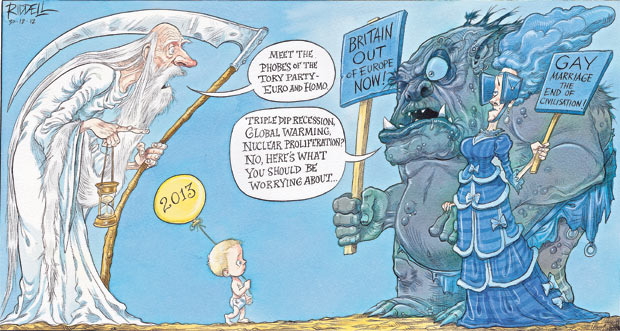
Cynic :-
With apologies, this cartoon sums up my feelings:-
cynic
- 30 Dec 2012 20:34
- 19764 of 81564
you have of course ducked the question of what YOU, as the hypothetical pro-active PM, would have done differently
pretty difficult, with hindsight(!!), to argue that the last gov't were anything other than a bunch of nincompoops in all sorts of areas, but especially when it came to managing the economy
pretty difficult, with hindsight(!!), to argue that the last gov't were anything other than a bunch of nincompoops in all sorts of areas, but especially when it came to managing the economy
Fred1new
- 30 Dec 2012 22:23
- 19765 of 81564
Cyn.
Go back and read earlier postings on this thread and also thread with epic ELEC.
You will gather what I thought at that time.
=======
By the way I hope the habits learnt at The Bullingdon Club, have not continued into trashing of the UK's economy now.
It is strange how patterns of behaviour began in youth, repeat in later periods of life.
--------------------------------
BDYOH.
Go back and read earlier postings on this thread and also thread with epic ELEC.
You will gather what I thought at that time.
=======
By the way I hope the habits learnt at The Bullingdon Club, have not continued into trashing of the UK's economy now.
It is strange how patterns of behaviour began in youth, repeat in later periods of life.
--------------------------------
BDYOH.
niceonecyril - 30 Dec 2012 23:07 - 19766 of 81564
Chris Carson
- 31 Dec 2012 06:39
- 19767 of 81564
Another fine mess left by Freddies hero's
Britain hit by £10bn tax credit fraudsters, claims Duncan Smith
Taxpayers have lost at least £10 billion to illicit welfare claimants and fraudsters from “around the world” targeting Britain’s tax credit system, the Work and Pensions Secretary claims.
Iain Duncan Smith Photo: Geoff Pugh
By Robert Winnett, Political Editor
9:58PM GMT 30 Dec 2012
Comments
In an article for The Telegraph, Iain Duncan Smith accuses Labour of establishing a system of tax credits for the lower-paid that is “wide open to abuse”.
HM Revenue and Customs conducts just 34,000 checks a year on tax credit claims deemed to be “high risk” – less than a tenth of the number of investigations into benefits fraudsters, he writes. As a result public finances have been pushed to “breaking point”.
Mr Duncan Smith’s attack on tax credits represents a new assault by ministers on Britain’s welfare system. Previously, ministers have focused on the abuse of benefits but George Osborne has insisted that further savings need to be found to help repair the public finances.
Tax credits were introduced by Gordon Brown to top up the incomes of the lower-paid, particularly those with children, and are regarded by Labour as one of the party’s proudest achievements. They are overseen by the Treasury rather than Mr Duncan Smith’s department.
A low-paid family with two children in child care can receive more than £10,000 annually from the tax credit system. But official figures show that about one in 12 tax credit claims is incorrect or fraudulent – compared with fewer than one in 25 benefit claims.
Related Articles
Iain Duncan Smith: we’ve brought back fairness to welfare
30 Dec 2012
In his article, Mr Duncan Smith describes a “story of dependency, wasted taxpayers’ money and fraud”. He says the system, which largely benefits those in work, is out of control and unfair for “hard-working taxpayers”. Today’s article continues: “In the years between 2003 and 2010, Labour spent a staggering £171 billion on tax credits, contributing to a 60 per cent rise in the welfare bill.
“Far too much of that money was wasted, with fraud and error under Labour costing over £10 billion.”
He writes that the ease by which the system could be abused meant it was “no surprise” that fraudsters from other countries were tempted to come to Britain, where they could claim the benefit.
Senior Conservative sources said they had been “shocked” by the level of fraud and illicit claims that had been either permitted or ignored within the tax credit system.
The system works by people providing an estimated income for the year ahead, either based on the previous year’s earnings or a projected salary. At the end of the year, HMRC is supposed to analyse the earnings and reclaim any overpayments.
Initially, people could earn £2,500 more than they had predicted before HMRC would attempt to reclaim overpayments. However, this was increased to £25,000 in 2008. This meant that people could legally keep overpayments – worth thousands of pounds a year. People could also continue to claim the credits for up to four weeks after leaving employment.
Even those breaking the rules have often not repaid the money. The Treasury has already written off more than £1 billion in unpaid debts from tax credit claimants — and it is estimated that without reform the unpaid debts could rise to £6.5 billion by the next election.
Mr Duncan Smith says: “In the year before the last general election only 34,000 checks were carried out on what were deemed 'high risk awards’. In the DWP today, we carry out around 30,000 checks a month on what we would consider high risk claimants. Even for those in genuine need of support, tax credits were not fit for purpose.
“The system was haemorrhaging money while at the same time trapping people in a system where those trying hard to increase the amount of hours they worked weren’t necessarily better off.”
Mr Duncan Smith accuses Labour of sharply increasing taxpayer expenditure on the credits in the run-up to the 2005 and 2010 general elections in “an attempt to gain short-term popularity”. He said payments had risen by 58 per cent in 2005 and by more than 20 per cent in the two years before the 2010 election.
He writes: “At the most basic level, Labour used spending on tax credits as an attempt to gain short-term popularity. They knew what they were doing – it was a calculated attempt to win votes.”
In the coming months, the Coalition will reduce the so-called income disregard from £25,000 to £5,000 – which will lead to far more people being pursued for overpayments of tax credits. About 80,000 families claiming for childcare will also have to provide proof of payments – replacing the current system of self-certification.
More than 500,000 families with teenagers aged between 16 and 19 – who are eligible to continue claiming tax credits – will have to provide proof that their offspring are in full-time education.
In total, the Treasury believes that more than £300 million can be recouped in the next three years by reducing fraud and error. It will also seek to recover more than £400 million in unpaid debts.
In the longer-term, the administration and policing of tax credits will be transferred from the Treasury to the Department of Work and Pensions – where it will be rolled into the new universal credit.
Labour is trying to block Coalition plans to freeze benefits and tax credits for the next three years.
Ed Miliband, the Labour leader, has alleged that the move announced by Mr Osborne in this month’s Autumn Statement is an attack on “strivers” as most of those affected are lower-paid workers rather than the unemployed.
Politics
News »UK News »Comment »Robert Winnett »Editor's Picks »Elsewhere
Britain hit by £10bn tax credit fraudsters, claims Duncan Smith
Comments
New Year Honours
In Politics
Autumn Statement 2012: as it happened
Autumn Statement: family tax bombshell over new black hole
Police commissioner election: live results map
Mitchell 'felt he had no choice but to go'
Debt crisis: live
Britain hit by £10bn tax credit fraudsters, claims Duncan Smith
Taxpayers have lost at least £10 billion to illicit welfare claimants and fraudsters from “around the world” targeting Britain’s tax credit system, the Work and Pensions Secretary claims.
Iain Duncan Smith Photo: Geoff Pugh
By Robert Winnett, Political Editor
9:58PM GMT 30 Dec 2012
Comments
In an article for The Telegraph, Iain Duncan Smith accuses Labour of establishing a system of tax credits for the lower-paid that is “wide open to abuse”.
HM Revenue and Customs conducts just 34,000 checks a year on tax credit claims deemed to be “high risk” – less than a tenth of the number of investigations into benefits fraudsters, he writes. As a result public finances have been pushed to “breaking point”.
Mr Duncan Smith’s attack on tax credits represents a new assault by ministers on Britain’s welfare system. Previously, ministers have focused on the abuse of benefits but George Osborne has insisted that further savings need to be found to help repair the public finances.
Tax credits were introduced by Gordon Brown to top up the incomes of the lower-paid, particularly those with children, and are regarded by Labour as one of the party’s proudest achievements. They are overseen by the Treasury rather than Mr Duncan Smith’s department.
A low-paid family with two children in child care can receive more than £10,000 annually from the tax credit system. But official figures show that about one in 12 tax credit claims is incorrect or fraudulent – compared with fewer than one in 25 benefit claims.
Related Articles
Iain Duncan Smith: we’ve brought back fairness to welfare
30 Dec 2012
In his article, Mr Duncan Smith describes a “story of dependency, wasted taxpayers’ money and fraud”. He says the system, which largely benefits those in work, is out of control and unfair for “hard-working taxpayers”. Today’s article continues: “In the years between 2003 and 2010, Labour spent a staggering £171 billion on tax credits, contributing to a 60 per cent rise in the welfare bill.
“Far too much of that money was wasted, with fraud and error under Labour costing over £10 billion.”
He writes that the ease by which the system could be abused meant it was “no surprise” that fraudsters from other countries were tempted to come to Britain, where they could claim the benefit.
Senior Conservative sources said they had been “shocked” by the level of fraud and illicit claims that had been either permitted or ignored within the tax credit system.
The system works by people providing an estimated income for the year ahead, either based on the previous year’s earnings or a projected salary. At the end of the year, HMRC is supposed to analyse the earnings and reclaim any overpayments.
Initially, people could earn £2,500 more than they had predicted before HMRC would attempt to reclaim overpayments. However, this was increased to £25,000 in 2008. This meant that people could legally keep overpayments – worth thousands of pounds a year. People could also continue to claim the credits for up to four weeks after leaving employment.
Even those breaking the rules have often not repaid the money. The Treasury has already written off more than £1 billion in unpaid debts from tax credit claimants — and it is estimated that without reform the unpaid debts could rise to £6.5 billion by the next election.
Mr Duncan Smith says: “In the year before the last general election only 34,000 checks were carried out on what were deemed 'high risk awards’. In the DWP today, we carry out around 30,000 checks a month on what we would consider high risk claimants. Even for those in genuine need of support, tax credits were not fit for purpose.
“The system was haemorrhaging money while at the same time trapping people in a system where those trying hard to increase the amount of hours they worked weren’t necessarily better off.”
Mr Duncan Smith accuses Labour of sharply increasing taxpayer expenditure on the credits in the run-up to the 2005 and 2010 general elections in “an attempt to gain short-term popularity”. He said payments had risen by 58 per cent in 2005 and by more than 20 per cent in the two years before the 2010 election.
He writes: “At the most basic level, Labour used spending on tax credits as an attempt to gain short-term popularity. They knew what they were doing – it was a calculated attempt to win votes.”
In the coming months, the Coalition will reduce the so-called income disregard from £25,000 to £5,000 – which will lead to far more people being pursued for overpayments of tax credits. About 80,000 families claiming for childcare will also have to provide proof of payments – replacing the current system of self-certification.
More than 500,000 families with teenagers aged between 16 and 19 – who are eligible to continue claiming tax credits – will have to provide proof that their offspring are in full-time education.
In total, the Treasury believes that more than £300 million can be recouped in the next three years by reducing fraud and error. It will also seek to recover more than £400 million in unpaid debts.
In the longer-term, the administration and policing of tax credits will be transferred from the Treasury to the Department of Work and Pensions – where it will be rolled into the new universal credit.
Labour is trying to block Coalition plans to freeze benefits and tax credits for the next three years.
Ed Miliband, the Labour leader, has alleged that the move announced by Mr Osborne in this month’s Autumn Statement is an attack on “strivers” as most of those affected are lower-paid workers rather than the unemployed.
Politics
News »UK News »Comment »Robert Winnett »Editor's Picks »Elsewhere
Britain hit by £10bn tax credit fraudsters, claims Duncan Smith
Comments
New Year Honours
In Politics
Autumn Statement 2012: as it happened
Autumn Statement: family tax bombshell over new black hole
Police commissioner election: live results map
Mitchell 'felt he had no choice but to go'
Debt crisis: live
| About MoneyAM | Ts and Cs | Privacy Policy | Investment Warning | Content Standards | Corporate Solutions | Advertise With Us | Site Map | © 2026 MoneyAM |
Register now for FREE
Share Prices,
Stock Quotes,
Charts, Bulletin Boards, Indices, Watchlists, Portfolio, Market News, Research
or see our Premium Services including Level 2, Terminal and much more.
 Follow us on Twitter