

| Home | Log In | Register | Our Services | My Account | Contact | Help |
You are NOT currently logged in
Register now or login to post to this thread.
THE TALK TO YOURSELF THREAD. (NOWT)
goldfinger

 - 09 Jun 2005 12:25


Thought Id start this one going because its rather dead on this board at the moment and I suppose all my usual muckers are either at the Stella tennis event watching Dim Tim (lose again) or at Henly Regatta eating cucumber sandwiches (they wish,...NOT).
Anyway please feel free to just talk to yourself blast away and let it go on any company or subject you wish. Just wish Id thought of this one before.
cheers GF.
Anyway please feel free to just talk to yourself blast away and let it go on any company or subject you wish. Just wish Id thought of this one before.
cheers GF.
aldwickk
- 11 Oct 2013 22:52
- 30953 of 81564
chris
The trouble with a 3 day game is that your opponent can cheat by having the time to use a Chess software program like Fritz to make his move
The trouble with a 3 day game is that your opponent can cheat by having the time to use a Chess software program like Fritz to make his move
Chris Carson
- 11 Oct 2013 23:36
- 30954 of 81564
ald - never thought of that, really? If you get a chance look up my user name and pick one of the guys I have played and challenge them. I would never have won a single game against them if they had cheated.
MaxK - 11 Oct 2013 23:42 - 30955 of 81564
"The government has the assets of the pension scheme to cover part of the cost of the scheme."
What does it take?
What does it take?
Haystack
- 11 Oct 2013 23:44
- 30956 of 81564
About 30+ billion.
MaxK - 11 Oct 2013 23:49 - 30957 of 81564
to do what?
Haystack
- 12 Oct 2013 00:56
- 30958 of 81564
It is around £37.5 billion to fund the pension of people already in it or collecting their pensions. There are approx 900,000 people in the scheme not yet at pensionable age. The government will get £28 billion of assets from the existing scheme. The difference will be funded in coming years as other civil service systems. The government already had around £5 trillion of pension liabilities for all of us to look after,
cynic
- 12 Oct 2013 07:58
- 30959 of 81564
DB4 - we are by no means out of the woods yet, though as i have posted previously, a longer term solution of some kind will be found, even if it is yet another fudge
MaxK - 12 Oct 2013 09:44 - 30960 of 81564
It's election time again....
Boomtime: Britain bounces back
Share prices, house prices, luxury cars... The recession is over and the country has started spending again

Plasterers and joiners are, he adds, also seeing a return to the glory days – echoes of a time when Harry Enfield, with his 'Loadsamoney' character, parodied the seemingly endless cash being earned by tradesmen Photo: REX
Harry Wallop
By Harry Wallop, and Theo Merz
8:48PM BST 11 Oct 2013
A mere 20 yards from the London Stock Exchange, workers on their lunch break are in buoyant mood. Oysters are being shucked in the Paternoster Chop House (£12.50 for half a dozen), while pints are being poured in the neighbouring pubs that shelter in the great shadow of St Paul’s Cathedral.
And no wonder. The Royal Mail share sell has been met with an enthusiasm not seen since the bonanza days of Thatcherite privatisations. Some 730,000 private investors tried to buy stock – with a minimum order size of £750 – pointing to an army of optimistic ordinary savers, desperate to invest their money. After manic trading, the shares closed up 38 per cent yesterday, presenting an immediate paper profit of £285 to those 690,000 retail investors who got their hands on an allocation.
Five years after the devastating collapse of Lehman Brothers, which almost overnight sucked hope out of the Square Mile, things are looking bright once again, as City workers relate over their lunch.
“I travel in from Luton, and by Harpenden people are really struggling to get a seat,” says Steve Victor, an IT services manager who works for an investment firm. “Just a few months ago that didn’t happen until St Albans [seven miles down the line]. That shows how many more people have got jobs.”
His colleague, Christopher, an IT consultant for a City recruitment company, has a similar story. “There was just no spending for two or three years. But apparently they’ve now been given a blank cheque – in the last few weeks, they suddenly have a big pot of dollars to spend.”
More feelgood ramping here: http://www.telegraph.co.uk/finance/economics/10372896/Boomtime-Britain-bounces-back.html
Boomtime: Britain bounces back
Share prices, house prices, luxury cars... The recession is over and the country has started spending again
Plasterers and joiners are, he adds, also seeing a return to the glory days – echoes of a time when Harry Enfield, with his 'Loadsamoney' character, parodied the seemingly endless cash being earned by tradesmen Photo: REX
Harry Wallop
By Harry Wallop, and Theo Merz
8:48PM BST 11 Oct 2013
A mere 20 yards from the London Stock Exchange, workers on their lunch break are in buoyant mood. Oysters are being shucked in the Paternoster Chop House (£12.50 for half a dozen), while pints are being poured in the neighbouring pubs that shelter in the great shadow of St Paul’s Cathedral.
And no wonder. The Royal Mail share sell has been met with an enthusiasm not seen since the bonanza days of Thatcherite privatisations. Some 730,000 private investors tried to buy stock – with a minimum order size of £750 – pointing to an army of optimistic ordinary savers, desperate to invest their money. After manic trading, the shares closed up 38 per cent yesterday, presenting an immediate paper profit of £285 to those 690,000 retail investors who got their hands on an allocation.
Five years after the devastating collapse of Lehman Brothers, which almost overnight sucked hope out of the Square Mile, things are looking bright once again, as City workers relate over their lunch.
“I travel in from Luton, and by Harpenden people are really struggling to get a seat,” says Steve Victor, an IT services manager who works for an investment firm. “Just a few months ago that didn’t happen until St Albans [seven miles down the line]. That shows how many more people have got jobs.”
His colleague, Christopher, an IT consultant for a City recruitment company, has a similar story. “There was just no spending for two or three years. But apparently they’ve now been given a blank cheque – in the last few weeks, they suddenly have a big pot of dollars to spend.”
More feelgood ramping here: http://www.telegraph.co.uk/finance/economics/10372896/Boomtime-Britain-bounces-back.html
doodlebug4 - 12 Oct 2013 11:07 - 30961 of 81564
NEW YORK — The stock market wrapped up a volatile week with its biggest two-day rally since the start of the year on hopes divided lawmakers are close to striking a deal that will enable the U.S. to pay all of its bills on time and avoid a confidence-shattering default.
The Dow Jones industrial average rose 111 points, or 0.7%, to 15,237 on Friday, a day after shooting up 323 points for its biggest one-day point gain since December 2011. The Dow's two-day gain of 434 points, was its biggest back-to-back point jump since the so-called "fiscal cliff" was narrowly averted late last year, resulting in a two-day jump of nearly 475 points on the last trading day of 2012 and the first trading session of 2013.
But investors shouldn't get too overconfident until they see the details of the final deal hammered out between Republicans and Democrats, who are expected to keep talking over the weekend, Wall Street strategists say. The latest Republican proposal would only raise the debt ceiling by enough to last six weeks, nor would it end the 11-day-old government shutdown.
There's no denying that the perceived thaw in the icy relationship between the nation's two political parties suggests they are moving closer to a deal to raise the debt ceiling by the Oct. 17 deadline and avoid the first-ever U.S. default. But it's also clear the deal currently under discussion comes with its fair share of caveats.
For one, a temporary extension of the debt ceiling will simply push off the "crunch date," or new deadline, until later this year, creating yet another layer of uncertainty. What's more, not reopening the government soon also poses additional risks to the economy, which could further damage consumer confidence and corporate earnings. There's always a chance a deal doesn't get done.
All three of those scenarios will cause market volatility to return.
While the odds favor this current political crisis "winding down," a six-week debt-ceiling extension "means we might have to do this all over again in November," says Jim Paulsen, chief investment strategist at Wells Capital Management.
Investors expecting the Dow to jump another 300 points when a deal is finalized might be expecting too much, adds Alec Young, global equity strategist at S&P Capital IQ.
The stock market, he says, has already priced in a best-case scenario, including an extension of the debt ceiling by the Thursday deadline and an end to the shutdown.
"In the short term, the stock market has probably priced in more than politicians are likely to deliver," Young says.
If lawmakers extend the debt ceiling but don't reopen the government and the shutdown drags on for weeks, there is a risk that the economic fallout will take a bigger bite out of growth.
"Just because the market has enjoyed a relief rally doesn't mean we can take our eyes off Washington," Young says.
The Dow Jones industrial average rose 111 points, or 0.7%, to 15,237 on Friday, a day after shooting up 323 points for its biggest one-day point gain since December 2011. The Dow's two-day gain of 434 points, was its biggest back-to-back point jump since the so-called "fiscal cliff" was narrowly averted late last year, resulting in a two-day jump of nearly 475 points on the last trading day of 2012 and the first trading session of 2013.
But investors shouldn't get too overconfident until they see the details of the final deal hammered out between Republicans and Democrats, who are expected to keep talking over the weekend, Wall Street strategists say. The latest Republican proposal would only raise the debt ceiling by enough to last six weeks, nor would it end the 11-day-old government shutdown.
There's no denying that the perceived thaw in the icy relationship between the nation's two political parties suggests they are moving closer to a deal to raise the debt ceiling by the Oct. 17 deadline and avoid the first-ever U.S. default. But it's also clear the deal currently under discussion comes with its fair share of caveats.
For one, a temporary extension of the debt ceiling will simply push off the "crunch date," or new deadline, until later this year, creating yet another layer of uncertainty. What's more, not reopening the government soon also poses additional risks to the economy, which could further damage consumer confidence and corporate earnings. There's always a chance a deal doesn't get done.
All three of those scenarios will cause market volatility to return.
While the odds favor this current political crisis "winding down," a six-week debt-ceiling extension "means we might have to do this all over again in November," says Jim Paulsen, chief investment strategist at Wells Capital Management.
Investors expecting the Dow to jump another 300 points when a deal is finalized might be expecting too much, adds Alec Young, global equity strategist at S&P Capital IQ.
The stock market, he says, has already priced in a best-case scenario, including an extension of the debt ceiling by the Thursday deadline and an end to the shutdown.
"In the short term, the stock market has probably priced in more than politicians are likely to deliver," Young says.
If lawmakers extend the debt ceiling but don't reopen the government and the shutdown drags on for weeks, there is a risk that the economic fallout will take a bigger bite out of growth.
"Just because the market has enjoyed a relief rally doesn't mean we can take our eyes off Washington," Young says.
hilary
 - 12 Oct 2013 11:54
- 30962 of 81564
- 12 Oct 2013 11:54
- 30962 of 81564

OBC,
Re post 30949, the thing that you seem to be neglecting is that the market makers are simply matching limited supply with demand at £4.50 on a small amount of the RMG issued share capital. Sure, they're knocking out 500k slugs at £4.50, but that doesn't mean that the company as a whole would be worth that. When the guys who were organising the sale decided to price it at £3.30, they were selling the whole company in one hit and they priced it accordingly. Sure, they could've probably got away with another 20p or 30p because there's an army of sentimental pensioners sitting on a shedload of cash at the moment, but they'd have probably struggled if they'd priced it at a full quid higher because most of the institutions would have baulked at that price.
You drew a comparison with an estate agent selling a house, but estate agents generally have a benchmark to refer to. For instance, they can look at Land Registry records and say "next door sold for £500k last month, so we'll price this place at £520k". When was the last time a country sold off its nationalised mail delivery business for any kind of comparison? All the guys organising the sale had to go on with RM was some flakey fundamentals and a guess at Joe Public's appetite for risk on something they'd become sentimental about.
If you don't understand what I'm saying, I challenge you to stick 500m shares on the offer at £4.56 on Monday and see how many you actually sell at that price.
Re post 30949, the thing that you seem to be neglecting is that the market makers are simply matching limited supply with demand at £4.50 on a small amount of the RMG issued share capital. Sure, they're knocking out 500k slugs at £4.50, but that doesn't mean that the company as a whole would be worth that. When the guys who were organising the sale decided to price it at £3.30, they were selling the whole company in one hit and they priced it accordingly. Sure, they could've probably got away with another 20p or 30p because there's an army of sentimental pensioners sitting on a shedload of cash at the moment, but they'd have probably struggled if they'd priced it at a full quid higher because most of the institutions would have baulked at that price.
You drew a comparison with an estate agent selling a house, but estate agents generally have a benchmark to refer to. For instance, they can look at Land Registry records and say "next door sold for £500k last month, so we'll price this place at £520k". When was the last time a country sold off its nationalised mail delivery business for any kind of comparison? All the guys organising the sale had to go on with RM was some flakey fundamentals and a guess at Joe Public's appetite for risk on something they'd become sentimental about.
If you don't understand what I'm saying, I challenge you to stick 500m shares on the offer at £4.56 on Monday and see how many you actually sell at that price.
Haystack
- 12 Oct 2013 13:57
- 30963 of 81564
IPOs are always a risky business, Facebook being a good example. The share price tanked after the float partly due to a very high price. It has taken quite a time for it to return to the float price.
RM is certainly in the FTSE 250 and may make FTSE 100 when the lists are changed in December. The various funds have to have specific proportions invested in certain indexes. That is going to generate a lot of trades initially. I read that there were 48m buyers and 1.2m sellers. That's bound to make an impact on the price.
RM is certainly in the FTSE 250 and may make FTSE 100 when the lists are changed in December. The various funds have to have specific proportions invested in certain indexes. That is going to generate a lot of trades initially. I read that there were 48m buyers and 1.2m sellers. That's bound to make an impact on the price.
cynic
- 12 Oct 2013 14:36
- 30964 of 81564
I read that there were 48m sellers and 1.2m buyers
sounds like a misquote of my post 126 on RMG thread..... IG L2 shows bid/offer of 55m to 3m (at 08:50 on 10/11)
sounds like a misquote of my post 126 on RMG thread..... IG L2 shows bid/offer of 55m to 3m (at 08:50 on 10/11)
Haystack
- 12 Oct 2013 15:20
- 30965 of 81564
cynic
- 12 Oct 2013 16:16
- 30966 of 81564
doh! just read it and you have it back to front!!
Haystack
- 12 Oct 2013 16:20
- 30967 of 81564
Exactly! I thought the right way round, but wrote it wrong and forgot to read it back. I got distracted by my son wanting food. Thanks. I will correct it.
aldwickk
- 12 Oct 2013 17:37
- 30968 of 81564
Haystack
- 12 Oct 2013 20:55
- 30969 of 81564
Public think benefit cap claimants should work or move
The vast majority (70%) of the public think people affected by the benefit cap should be prepared to find jobs or work more hours and two-thirds (65%) say they should be willing to move to a cheaper property.
Independent research published today (10 October 2013) shows that 60% support the cap even if it means that those affected have to take a job, regardless of the pay.
The Ipsos MORI report shows public attitudes towards the benefit cap and is published following the completion of its national rollout last month.
The Ipsos MORI report finds:
around three-quarters of the public support the benefit cap in principle
58% think that politicians needed to do more to reduce the welfare bill
50% think that benefits are too generous
11% think the benefits system is working effectively
Secretary of State for Work and Pensions Iain Duncan Smith said:
Today’s report makes it clear that the public support setting a limit on benefits and the successful delivery of the benefit cap shows we are committed to returning fairness to the welfare state.
Claimants affected by the cap need to make decisions about work and housing and what they can afford, just as hardworking families do.
We have made sure the support is there to help people back into work and the benefit cap and Universal Credit will ensure that work pays.
The benefit cap limits are set at £500 a week for couples, with or without children, and lone parent households, and at £350 a week for households of a single adult with no children. The cap is in place nationwide for existing appropriate claimants and all new claims are subject to the cap.
Since claimants were first notified of the benefit cap in April 2012, Jobcentre Plus have helped around 16,500 potentially capped claimants into work.
The vast majority (70%) of the public think people affected by the benefit cap should be prepared to find jobs or work more hours and two-thirds (65%) say they should be willing to move to a cheaper property.
Independent research published today (10 October 2013) shows that 60% support the cap even if it means that those affected have to take a job, regardless of the pay.
The Ipsos MORI report shows public attitudes towards the benefit cap and is published following the completion of its national rollout last month.
The Ipsos MORI report finds:
around three-quarters of the public support the benefit cap in principle
58% think that politicians needed to do more to reduce the welfare bill
50% think that benefits are too generous
11% think the benefits system is working effectively
Secretary of State for Work and Pensions Iain Duncan Smith said:
Today’s report makes it clear that the public support setting a limit on benefits and the successful delivery of the benefit cap shows we are committed to returning fairness to the welfare state.
Claimants affected by the cap need to make decisions about work and housing and what they can afford, just as hardworking families do.
We have made sure the support is there to help people back into work and the benefit cap and Universal Credit will ensure that work pays.
The benefit cap limits are set at £500 a week for couples, with or without children, and lone parent households, and at £350 a week for households of a single adult with no children. The cap is in place nationwide for existing appropriate claimants and all new claims are subject to the cap.
Since claimants were first notified of the benefit cap in April 2012, Jobcentre Plus have helped around 16,500 potentially capped claimants into work.
cynic
- 13 Oct 2013 09:04
- 30970 of 81564
an interesting comment yesterday that tightened unemployment benefit rules have resulted in a significant number of people "disappearing" from the register, with the implication being that they were already working in some capacity
MaxK - 13 Oct 2013 09:21 - 30971 of 81564
True scale of European immigration
An EU study has found 600,000 unemployed migrants are living in Britain - a 42 per cent rise
By Robert Mendick, and Claire Duffin
9:45PM BST 12 Oct 2013
More than 600,000 unemployed European Union migrants are living in Britain at a cost of £1.5 billion to the NHS alone, according to an EU report.
The authoritative study, obtained by The Sunday Telegraph, shows the number of jobless European migrants coming to Britain has risen dramatically in the past five years, intensifying demands for the Government to renegotiate EU membership.
Opponents of the EU seized on the figures to suggest Britain could not afford to allow European migrants to come here at will while continuing to provide a universal benefits system.
The 291-page report, to be published this week by the European commissioner in charge of employment and welfare, discloses:
• The number of “non-active” EU migrants in Britain has risen by 42 per cent between 2006 and 2012;
More: http://www.telegraph.co.uk/news/worldnews/europe/10375358/True-scale-of-European-immigration.html
An EU study has found 600,000 unemployed migrants are living in Britain - a 42 per cent rise
By Robert Mendick, and Claire Duffin
9:45PM BST 12 Oct 2013
More than 600,000 unemployed European Union migrants are living in Britain at a cost of £1.5 billion to the NHS alone, according to an EU report.
The authoritative study, obtained by The Sunday Telegraph, shows the number of jobless European migrants coming to Britain has risen dramatically in the past five years, intensifying demands for the Government to renegotiate EU membership.
Opponents of the EU seized on the figures to suggest Britain could not afford to allow European migrants to come here at will while continuing to provide a universal benefits system.
The 291-page report, to be published this week by the European commissioner in charge of employment and welfare, discloses:
• The number of “non-active” EU migrants in Britain has risen by 42 per cent between 2006 and 2012;
More: http://www.telegraph.co.uk/news/worldnews/europe/10375358/True-scale-of-European-immigration.html
MaxK - 13 Oct 2013 09:27 - 30972 of 81564
Is the EU exporting its unemployed to Britain? And will they bankrupt us?
By David Craig, on October 10th, 2013
Politicians and journalists will play around with the statistics around immigration - usually to try to claim that immigration is “under control”, “good for Britain”, “beneficial for our economy” and “an enrichment to our cultural life”. But they won’t ever talk about the real trends and costs in immigration – shortage of housing, pressure on schools, hospitals and policing and drain on our benefits system.
So I’ve started trying to see what the immigration figures are really telling us. To measure immigration I’ve used the Government’s figures for the number of foreigners registering for National Insurance (NI) numbers each year.
My first chart shows the overall number broken down by region of origin (click to see more clearly)
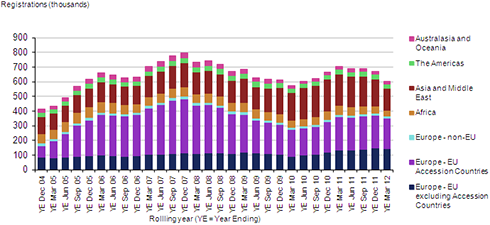
The first thing you’ll notice is that the number of migrants getting NI numbers went up from about 340,000 a year in 2002/03 to about 420,000 a year in 2004/05 - a rise of over 40,000 a year. Then the number shot up from 420,000 a year in 2004/05 to almost 800,000 a year by 2007/08 – a massive rise of about 130,000 a year. This was due to people from the A8 accession countries (Czech Republic, Estonia, Hungary, Latvia, Lithuania, Poland, Slovakia, Slovenia) moving to Britain.
Then the numbers of foreigners getting NI numbers “stabilised” at a fairly shocking 600,000 to 700,000 a year – that’s an incredible 12,000 to 14,000 a week (2,400 to 2,800 every working day). However, when the 29 million people from Romania and Bulgaria get full rights to move freely to Britain for work or benefits (or both), we can expect the number of migrants getting NI numbers to shoot up again to close to 900,000 or even 1,000,000 a year.
More: http://www.snouts-in-the-trough.com/archives/7007
By David Craig, on October 10th, 2013
Politicians and journalists will play around with the statistics around immigration - usually to try to claim that immigration is “under control”, “good for Britain”, “beneficial for our economy” and “an enrichment to our cultural life”. But they won’t ever talk about the real trends and costs in immigration – shortage of housing, pressure on schools, hospitals and policing and drain on our benefits system.
So I’ve started trying to see what the immigration figures are really telling us. To measure immigration I’ve used the Government’s figures for the number of foreigners registering for National Insurance (NI) numbers each year.
My first chart shows the overall number broken down by region of origin (click to see more clearly)
The first thing you’ll notice is that the number of migrants getting NI numbers went up from about 340,000 a year in 2002/03 to about 420,000 a year in 2004/05 - a rise of over 40,000 a year. Then the number shot up from 420,000 a year in 2004/05 to almost 800,000 a year by 2007/08 – a massive rise of about 130,000 a year. This was due to people from the A8 accession countries (Czech Republic, Estonia, Hungary, Latvia, Lithuania, Poland, Slovakia, Slovenia) moving to Britain.
Then the numbers of foreigners getting NI numbers “stabilised” at a fairly shocking 600,000 to 700,000 a year – that’s an incredible 12,000 to 14,000 a week (2,400 to 2,800 every working day). However, when the 29 million people from Romania and Bulgaria get full rights to move freely to Britain for work or benefits (or both), we can expect the number of migrants getting NI numbers to shoot up again to close to 900,000 or even 1,000,000 a year.
More: http://www.snouts-in-the-trough.com/archives/7007
| About MoneyAM | Ts and Cs | Privacy Policy | Investment Warning | Content Standards | Corporate Solutions | Advertise With Us | Site Map | © 2026 MoneyAM |
Register now for FREE
Share Prices,
Stock Quotes,
Charts, Bulletin Boards, Indices, Watchlists, Portfolio, Market News, Research
or see our Premium Services including Level 2, Terminal and much more.
 Follow us on Twitter