

| Home | Log In | Register | Our Services | My Account | Contact | Help |
You are NOT currently logged in
Register now or login to post to this thread.
THE TALK TO YOURSELF THREAD. (NOWT)
goldfinger

 - 09 Jun 2005 12:25


Thought Id start this one going because its rather dead on this board at the moment and I suppose all my usual muckers are either at the Stella tennis event watching Dim Tim (lose again) or at Henly Regatta eating cucumber sandwiches (they wish,...NOT).
Anyway please feel free to just talk to yourself blast away and let it go on any company or subject you wish. Just wish Id thought of this one before.
cheers GF.
Anyway please feel free to just talk to yourself blast away and let it go on any company or subject you wish. Just wish Id thought of this one before.
cheers GF.
Chris Carson
- 26 Jan 2014 06:44
- 35891 of 81564
By Harry Wilson, and Tim Ross
8:30PM GMT 25 Jan 2014
Labour's plan to bring back the 50p top rate of income tax was ridiculed by the party’s own former City minister on Saturday night, who said that the economics behind it would not even get “a pass at GCSE”.
Ed Balls, the shadow chancellor, promised on Saturday that Labour would reinstate the tax band for those earning more than £150,000, if the party won the next general election.
He insisted that increasing the rate from 45p to 50p — for “the richest one per cent” of earners — would make the tax system “fairer” and help cut the budget deficit.
However, Lord Myners, who served as City minister in Gordon Brown’s government, attacked the policy, saying it would take the party back to the days of “old Labour”.
“The economic logic behind his [Mr Balls’s] thinking would not get him a pass at GCSE economics,” he said. “By contrast to Ed Miliband’s recent interventions on energy and banking, which tried to reconcile competitive markets with Labour principles, Ed Balls takes us back to old Labour and the politics of envy.”
Related Articles
Ed Balls announces 50p tax rate pledge
25 Jan 2014
Balls defends speech on the economy
25 Jan 2014
Ed Balls: Labour will bring back 50p tax rate for rich
25 Jan 2014
Red Ed or Steady Eddy, which is it Miliband?
25 Jan 2014
Labour will clear £86bn deficit by 2020, Ed Balls says
24 Jan 2014
His intervention came as business leaders, economists and the Conservatives warned that reinstating a 50p tax bracket would jeopardise the recovery, drive away investment and prove a “disaster” for the economy.
Katja Hall, the chief policy director at the CBI, said such a move could even lead to the exodus of the brightest and best individuals.
“We don’t believe that introducing a 50p income tax rate is the right way to raise the money because this puts talented people off coming to the UK to invest and create jobs,” she said.
“There is some concern that a higher top rate of tax could lead talented people to leave Britain. These people operate globally and can base themselves anywhere, so a 50p rate would not help their decision to be in the UK.”
Sir Stuart Rose, chairman of Ocado and former boss of Marks & Spencer, said the decision would “put at risk all the good work that has been done to put the economy back on track”.
Sir Ian Cheshire, the chief executive of Kingfisher, the home improvement giant which owns brands including B&Q and Screwfix, added: “Raising the rate is bad economics and sends an anti-business message that may undermine investment plans and the recovery.”
Mr Brown introduced the 50p top rate of income tax, which came into force in April 2010. In 2012, Treasury analysis found that it raised just £1 billion a year — a third of the amount expected.
The level of tax avoidance as high-earners dodged the increased rate was so great that HM Revenue & Customs predicted that reducing the levy by 5p would only cost the Exchequer about £100 million.
In April last year, the Coalition cut the top rate of tax to 45p, with George Osborne, the Chancellor, arguing that the 50p band had damaged the economy and raised “next to nothing”.
On Saturday, Mr Balls seized on new government figures which he claimed called the Treasury’s earlier analysis into question.
According to the most recent HMRC data, those earning more than £150,000 actually paid £9.5 billion more in tax than previously thought during the three years in which the 50p rate was in place. Treasury sources insisted that the change simply reflected the fact that there were more workers earning higher salaries over the period than previously thought. A similar rise would be seen in revenue generated by the Coalition’s 45p tax rate, the source suggested.
Sajid Javid, the Conservative Financial Secretary to the Treasury, said Mr Balls’s pledge showed that Labour politicians “have no long-term economic plan”.
He added: “Labour would put the recovery at risk, drive away investment and put our economic security at risk.
“That would put the financial security of hard-working people and their families at risk.”
Simon Walker, head of the Institute of Directors, accused Mr Balls of reviving the “Socialist” policies that damaged Britain’s economy in the past. He said: “It was, and remains, an envy-driven political gesture designed solely to drive a wedge between voters.”
The Institute of Economic Affairs (IEA) said that the plans were “absurd” and would be a “disaster” for business and growth. It pointed out that those earning more than £150,000 already paid close to 30 per cent of all income tax and warned that the increase could “erode” the country’s tax base.
“The shadow chancellor need only look across the Channel to France to see the damage punitive levels of income tax can reap on the wider economy,” the IEA said.
Mr Balls set out his policy in a speech to Labour supporters at the Fabian Society in London. He promised that the party would run a budget surplus, cut the national debt and create a “fairer” tax system in which the richest paid more.
Mr Balls, the former chief adviser to Mr Brown, said that it was wrong for the Coalition to have cut the top rate.
“When the deficit is still high, when tough times are now set to last well into the next parliament, when for ordinary families their real incomes are falling and taxes have risen, it cannot be right for David Cameron and George Osborne to have chosen to give the richest people in the country a huge tax cut,” Mr Balls said. “That’s why for the next parliament the next Labour government will reverse this government’s top rate tax cut, so we can finish the job of getting the deficit down and do it fairly.”
If voters put Labour back in power next year, Mr Balls would also hope to introduce a 10p starting rate of income tax to cut levies for 24 million low-earners.
The policy comes ahead of new GDP figures this week which are expected to confirm that the recovery is gathering pace. The Prime Minister said last week that families were beginning to feel the benefit of a “recovery for all” as figures showed wages had started to rise faster than inflation.
Britain’s return to growth has presented a problem for Mr Balls, who made the “flatlining” economy Labour’s central criticism of the Coalition’s austerity measures.
The Unite trade union, Labour’s biggest donor, welcomed the policy, but warned: “This is a beginning; we would urge Labour to also tackle the disgraceful abuse of the system by the [tax] evaders and avoiders too.”
Chris Carson
- 26 Jan 2014 06:56
- 35892 of 81564
By Szu Ping Chan
9:30PM GMT 25 Jan 2014
Follow
CommentsComments
Britain grew at the fastest rate since 2007 last year, official data are expected to confirm this week, cementing its position as the fastest growing economy in Western Europe.
Economists expect the UK to have grown by 0.7pc in the three months to December, following growth of 0.8pc in the third quarter.
This represents an annual expansion of 2.8pc and equates to overall gross domestic product (GDP) growth in 2013 of 1.9pc – the strongest annual growth since 2007 - up from just 0.3pc in 2012.
Britain emerged as the fastest growing economy in Western Europe last year and Tuesday’s data are expected to confirm the UK grew four times faster than Germany, which expanded by 0.4pc in 2013.
Some economists believe fourth-quarter UK growth could match the 0.8pc seen in the previous three months, although others said a slightly lacklustre October performance by Britain’s dominant services sector suggested the economy saw a slowdown in the final three months of the year.
Related Articles
The process of rate rises has to start earlier, not later
25 Jan 2014
Carney: no need for an immediate rate rise
24 Jan 2014
Cameron: UK recovery remains 'fragile'
01 Jan 2014
UK economy: what French and German bosses think
15 Jan 2014
Britain 'will be biggest European economy'
26 Dec 0203
UK on course as 'fastest-growing G7 economy'
21 Dec 2013
How can SMEs get their products into stores? HP
“Services output was a modest 0.3pc higher in October compared to the Q3 average and would have to post decent rises in November and December to equal Q3’s performance,” said Jonathan Loynes, an economist at Capital Economics.
Michael Saunders, chief UK economist at Citigroup, said: “Partial data so far show solid growth in industrial production but a modest gain in retail sales and little change in construction output.
“We suspect some of these monthly activity readings understate the economy’s momentum but, unless the services output data released at the same time are very strong, we suspect growth will fall a little short of the 0.8pc pace seen in Q3.”
While Britain’s rapid growth rate is expected to continue this year, economists have raised concerns that the recovery is over-reliant on consumer spending and unsustainable without a significant increase in real wages, investment and export growth.
This was also stressed yesterday by Mark Carney, the Governor of the Bank of England, who told a session at the World Economic Forum in Davos that the recovery remained fragile and suggested it was not yet strong enough to withstand an interest rate rise.
“As good as the numbers have been in the last three quarters in the United Kingdom, we’re talking about three-quarters of household-led growth, an economy that’s running 20pc below pre-crisis trends, that has substantial spare capacity, that has not yet rebalanced and that faces significant headwinds from its major trading partner from overall monetary conditions,” he said.
“Exceptional stimulus remains very relevant to the environment.”
UK growth of 1.9pc in 2013 would also be lower than the pre-crisis average of around 2.5pc and nowhere near the growth seen in 2007, when the economy grew by 3.4pc. The economy would also remain 1.3pc smaller than its pre-crisis peak in the first quarter of 2008. By contrast, Germany has already recovered from its GDP slump.
Last week, Mr Carney admitted that the Bank’s “forward guidance” policy on increasing interest rates would “evolve” at its next inflation report in February because unemployment had fallen far faster than expected toward the 7pc threshold set by the Bank.
Last August, Mr Carney pledged that the Bank would not even consider raising rates from their record low of 0.5pc until unemployment fell below the threshold. At the time, the jobless rate was 7.8pc but it has since tumbled to 7.1pc.
Mr Saunders said he expected the Bank to move away from “forward guidance” towards “fuzzy” guidance.
“We expect the Bank to shift to a more fuzzy approach, emphasising that there is no immediate need to hike rates, and when rates do rise, they are likely to rise only gradually,” he said.
“This will represent a move towards a neutral stance rather than restraint.”
MaxK - 26 Jan 2014 08:30 - 35893 of 81564

Fred1new
- 26 Jan 2014 09:26
- 35894 of 81564
I hope Cameron and Osborne take responsibility for what they have done and are doing.
Fred1new
- 26 Jan 2014 09:31
- 35895 of 81564
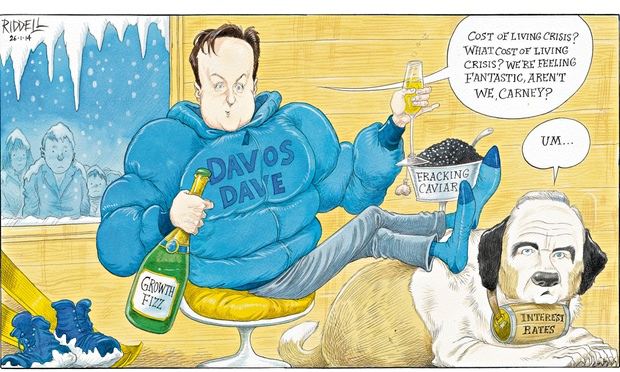
Haystack
- 26 Jan 2014 09:34
- 35896 of 81564
That radical new Balls policy: increase taxes. Don’t say the bosses of some of the largest employers in Britain didn’t warn you:
Rob Templeman, chairman of the British Retail Consortium, Gala Coral and the RAC: “this tax increase would be bad for business in Britain. It would put the recovery at risk, deter investment and ultimately cost jobs”
Sir Stuart Rose, former executive chairman of Marks and Spencer: “This will put at risk all the good work that has been done to put the economy back on track.”
Mike Lynch, co-founder of Autonomy Corporation and former Labour donor: “The proposed tax increase would put jobs and the economic recovery at risk and discourage investment into the UK.”
Ian Cheshire, chief executive of Kingfisher: ”Putting up the percentage rate is the wrong answer. When the rate was cut the total tax paid went up and the top 0.1% now pay over 30% of all income tax. Raising the rate is bad economics and sends an anti business message that may undermine investment plans and the recovery”
Dracula will be a vegetarian before Ed Balls balances a budget.
Rob Templeman, chairman of the British Retail Consortium, Gala Coral and the RAC: “this tax increase would be bad for business in Britain. It would put the recovery at risk, deter investment and ultimately cost jobs”
Sir Stuart Rose, former executive chairman of Marks and Spencer: “This will put at risk all the good work that has been done to put the economy back on track.”
Mike Lynch, co-founder of Autonomy Corporation and former Labour donor: “The proposed tax increase would put jobs and the economic recovery at risk and discourage investment into the UK.”
Ian Cheshire, chief executive of Kingfisher: ”Putting up the percentage rate is the wrong answer. When the rate was cut the total tax paid went up and the top 0.1% now pay over 30% of all income tax. Raising the rate is bad economics and sends an anti business message that may undermine investment plans and the recovery”
Dracula will be a vegetarian before Ed Balls balances a budget.
MaxK - 26 Jan 2014 09:39 - 35897 of 81564
Call Me Dave is hugely relieved.......until the election.
The great EU farce plays out in Westminster
How the machiavellian workings of certain politicians are stopping debate on Britain’s future in Europe

By Iain Martin
9:38PM GMT 25 Jan 2014
http://www.telegraph.co.uk/news/newstopics/eureferendum/10596705/The-great-EU-farce-plays-out-in-Westminster.html
"The Bill is sunk,” said a peer emerging from the House of Lords late on Friday afternoon. Although members of the upper chamber seated on the red benches were still discussing the piece of prospective legislation that aims to enshrine the promise of a referendum on Britain’s membership of the European Union, it had, as a veteran of Margaret Thatcher’s cabinets acknowledged, been holed below the water line.
For months, Tory MPs – backed by the Prime Minister – have been attempting to push through a Bill providing for an in-out vote on the EU by 2017. It was passed by the Commons and moved to the Lords for consideration. What followed last week were many hours of debate, with opponents of a referendum using blocking tactics in the Lords to get their way. There were long speeches aimed at talking the Bill out. At one point Lord Foulkes, the Labour peer, even spoke in Doric, the dialect that emanates from the north east of Scotland, to illustrate a point.
On Friday, eventually two amendments were passed, one recasting the terms of the question that would be posed in a referendum and the other stipulating that the Government conduct an “impact assessment” of the cost of leaving the EU. These changes effectively killed the Bill. It is, as the Eurosceptic Tory MP Bill Cash put it in a reference drawn from Monty Python, “a dead parrot”.
Due to parliamentary procedure, the amended Bill will now have to go back to the Commons for further consideration (after the Lords are expected to discuss it again on Friday).
However, it has very little chance of being discussed again in the Commons. Because it originated as a Private Members Bill – a Bill that is introduced by an individual member rather than the government of the day – it will go to the back of the queue, and may have to be picked up by another MP who will make a fresh attempt. It may not get more time later this year or it might, when the whole parliamentary merry-go-round can begin again.
Confused? It is extraordinary how difficult it is proving to arrange for British voters to get a simple referendum on whether or not the UK should stay in the EU. To those demanding such a vote perhaps it sounds as though it should be a relatively straightforward business. But at Westminster nothing is ever quite that easy.
At the root of the difficulties the Tories are having in attempting to secure a vote after the next election, and before the deadline of 2017 suggested by the Prime Minister, is the reality that Mr Cameron simply does not have an overall majority in the Commons. If he had, he could have made the introduction of a referendum Bill government business. In the Coalition, however, the Europhile Lib Dems would not allow it.
Instead, with his Eurosceptic backbenchers and Ukip on his tail, David Cameron had to look for another way in which to get a referendum on to the statute book. Last year, Tory backbencher James Wharton drafted a Bill and a Conservative-backed campaign – Let Britain Decide – was established to make the case outside Parliament.
Tory Eurosceptics hoped that mandating a future referendum by law would help counter the threat from Nigel Farage and Ukip before this spring’s European elections and next year’s general election, by showing that the Tories are committed to giving voters a chance to decide, at last, on the European question.
They also wanted to put pressure on Labour in the expectation that Ed Miliband would before the general election concede the offer of a referendum in the next parliament.
Mr Miliband has refused to say either way, and most of the Labour high command is desperate to avoid a commitment. If Labour wins the election, the pro-EU Mr Miliband does not want to spend the first two years preoccupied with an EU referendum which he could easily lose.
There always was a problem with the latest cunning Tory plan, however. Traditionally, one parliament cannot bind its successor, meaning that it cannot pass legislation that forces the next parliament, after the next election, to take a particular course of action. This is what critics of the Wharton Bill claimed was being attempted.
It meant that last week’s opposition to the Bill in the Lords came not just from Labour and Lib Dem MPs and peers. In the Lords many crossbenchers – the term for those not affiliated to a party – were agitated. Lord Armstrong, former Cabinet Secretary, the country’s most senior civil servant, was worried that the question in the Bill was badly framed and could lead to confusion on the part of voters. Other cross-bench peers raised similar concerns.
The result in the Lords on Friday, said a Tory peer who supported the Bill out of loyalty but had reservations about its provisions, was “a slaughter” as a succession of former senior civil servants and Labour grandees rose to pick it apart. Labour and Lib Dem peers had also been encouraged to turn out in heavy numbers to vote for the wrecking amendments.
The end result was humiliation for the Tory side. Said a Conservative peer: “It was as though someone had tried to drive a Mini into the path of a tank. At the end, all that is left of the Bill is a pile of mangled wreckage.”
Lord Kerr, a crossbencher who served as the UK’s ambassador to the EU and then to the US, compared the doomed efforts of Tory peers to the Charge of the Light Brigade.
The contributions to the debate by former mandarins served as another indication that the traditionally pro-EU British Establishment is mounting an increasingly determined effort to kill off the prospect of a referendum. There is also considerable pressure coming from outside Parliament.
At Davos – the annual event held in a Swiss ski-resort where the global business and political elite meet to discuss the economic situation – Sir Martin Sorrell, the advertising mogul, urged the Prime Minister to drop his commitment to an EU referendum.
Sir Martin, chief executive of WPP Group, said that although Ed Miliband had presented himself as anti-big business, he was encouraged that the Labour leader is at least opposed to a public vote on the EU. Describing a conversation with Mr Cameron about the general election, he said: “We told the PM, if he were to drop the referendum he would be a shoo-in.”
Mr Cameron rejected Sir Martin’s advice at Davos and said that he is committed to giving British voters a referendum on EU membership. But the Tory leader also faced criticism last week from the British Bankers Association, which said that the Government should dedicate more resources to representing British interests in Brussels. The UK should be closer to the EU, it said.
It was also reported that civil servants in the Treasury are readying themselves to warn of the economic risks of the UK leaving the EU if a referendum is called at any point. Sir Nicholas Macpherson, the Treasury’s Permanent Secretary, gave a speech recently in which he advocated the advantages of the EU single market.
If Labour does win the next election, or governs in coalition with the Lib Dems, it is all shaping up for the denial of an in-out referendum. Labour in particular hopes that the apparent passing of the Eurozone crisis and economic recovery in the UK will mean that public interest in a referendum fades. In this way, it could be quietly buried. Ukip and the Tories in opposition could complain loudly, but there is not much they could do in the next parliament if it is Labour-dominated.
James Wharton MP, the Tory MP behind the referendum Bill, acknowledged yesterday that it is in trouble although valiantly he pledged to fight on: “It’s not dead yet, but the process of killing it may have begun.”
He admits that without a Government commitment to find time for his Bill in the Commons – a commitment that Lib Dem leader Nick Clegg is likely to block – the Bill is indeed dead as a parrot. Mr Wharton said that if voters want to have their say on the EU then they should vote Conservative at the election.
Voters could be forgiven for thinking that, yet again, Westminster game-playing and Establishment machinations are combining to make an EU referendum less likely than ever.
The great EU farce plays out in Westminster
How the machiavellian workings of certain politicians are stopping debate on Britain’s future in Europe
By Iain Martin
9:38PM GMT 25 Jan 2014
http://www.telegraph.co.uk/news/newstopics/eureferendum/10596705/The-great-EU-farce-plays-out-in-Westminster.html
"The Bill is sunk,” said a peer emerging from the House of Lords late on Friday afternoon. Although members of the upper chamber seated on the red benches were still discussing the piece of prospective legislation that aims to enshrine the promise of a referendum on Britain’s membership of the European Union, it had, as a veteran of Margaret Thatcher’s cabinets acknowledged, been holed below the water line.
For months, Tory MPs – backed by the Prime Minister – have been attempting to push through a Bill providing for an in-out vote on the EU by 2017. It was passed by the Commons and moved to the Lords for consideration. What followed last week were many hours of debate, with opponents of a referendum using blocking tactics in the Lords to get their way. There were long speeches aimed at talking the Bill out. At one point Lord Foulkes, the Labour peer, even spoke in Doric, the dialect that emanates from the north east of Scotland, to illustrate a point.
On Friday, eventually two amendments were passed, one recasting the terms of the question that would be posed in a referendum and the other stipulating that the Government conduct an “impact assessment” of the cost of leaving the EU. These changes effectively killed the Bill. It is, as the Eurosceptic Tory MP Bill Cash put it in a reference drawn from Monty Python, “a dead parrot”.
Due to parliamentary procedure, the amended Bill will now have to go back to the Commons for further consideration (after the Lords are expected to discuss it again on Friday).
However, it has very little chance of being discussed again in the Commons. Because it originated as a Private Members Bill – a Bill that is introduced by an individual member rather than the government of the day – it will go to the back of the queue, and may have to be picked up by another MP who will make a fresh attempt. It may not get more time later this year or it might, when the whole parliamentary merry-go-round can begin again.
Confused? It is extraordinary how difficult it is proving to arrange for British voters to get a simple referendum on whether or not the UK should stay in the EU. To those demanding such a vote perhaps it sounds as though it should be a relatively straightforward business. But at Westminster nothing is ever quite that easy.
At the root of the difficulties the Tories are having in attempting to secure a vote after the next election, and before the deadline of 2017 suggested by the Prime Minister, is the reality that Mr Cameron simply does not have an overall majority in the Commons. If he had, he could have made the introduction of a referendum Bill government business. In the Coalition, however, the Europhile Lib Dems would not allow it.
Instead, with his Eurosceptic backbenchers and Ukip on his tail, David Cameron had to look for another way in which to get a referendum on to the statute book. Last year, Tory backbencher James Wharton drafted a Bill and a Conservative-backed campaign – Let Britain Decide – was established to make the case outside Parliament.
Tory Eurosceptics hoped that mandating a future referendum by law would help counter the threat from Nigel Farage and Ukip before this spring’s European elections and next year’s general election, by showing that the Tories are committed to giving voters a chance to decide, at last, on the European question.
They also wanted to put pressure on Labour in the expectation that Ed Miliband would before the general election concede the offer of a referendum in the next parliament.
Mr Miliband has refused to say either way, and most of the Labour high command is desperate to avoid a commitment. If Labour wins the election, the pro-EU Mr Miliband does not want to spend the first two years preoccupied with an EU referendum which he could easily lose.
There always was a problem with the latest cunning Tory plan, however. Traditionally, one parliament cannot bind its successor, meaning that it cannot pass legislation that forces the next parliament, after the next election, to take a particular course of action. This is what critics of the Wharton Bill claimed was being attempted.
It meant that last week’s opposition to the Bill in the Lords came not just from Labour and Lib Dem MPs and peers. In the Lords many crossbenchers – the term for those not affiliated to a party – were agitated. Lord Armstrong, former Cabinet Secretary, the country’s most senior civil servant, was worried that the question in the Bill was badly framed and could lead to confusion on the part of voters. Other cross-bench peers raised similar concerns.
The result in the Lords on Friday, said a Tory peer who supported the Bill out of loyalty but had reservations about its provisions, was “a slaughter” as a succession of former senior civil servants and Labour grandees rose to pick it apart. Labour and Lib Dem peers had also been encouraged to turn out in heavy numbers to vote for the wrecking amendments.
The end result was humiliation for the Tory side. Said a Conservative peer: “It was as though someone had tried to drive a Mini into the path of a tank. At the end, all that is left of the Bill is a pile of mangled wreckage.”
Lord Kerr, a crossbencher who served as the UK’s ambassador to the EU and then to the US, compared the doomed efforts of Tory peers to the Charge of the Light Brigade.
The contributions to the debate by former mandarins served as another indication that the traditionally pro-EU British Establishment is mounting an increasingly determined effort to kill off the prospect of a referendum. There is also considerable pressure coming from outside Parliament.
At Davos – the annual event held in a Swiss ski-resort where the global business and political elite meet to discuss the economic situation – Sir Martin Sorrell, the advertising mogul, urged the Prime Minister to drop his commitment to an EU referendum.
Sir Martin, chief executive of WPP Group, said that although Ed Miliband had presented himself as anti-big business, he was encouraged that the Labour leader is at least opposed to a public vote on the EU. Describing a conversation with Mr Cameron about the general election, he said: “We told the PM, if he were to drop the referendum he would be a shoo-in.”
Mr Cameron rejected Sir Martin’s advice at Davos and said that he is committed to giving British voters a referendum on EU membership. But the Tory leader also faced criticism last week from the British Bankers Association, which said that the Government should dedicate more resources to representing British interests in Brussels. The UK should be closer to the EU, it said.
It was also reported that civil servants in the Treasury are readying themselves to warn of the economic risks of the UK leaving the EU if a referendum is called at any point. Sir Nicholas Macpherson, the Treasury’s Permanent Secretary, gave a speech recently in which he advocated the advantages of the EU single market.
If Labour does win the next election, or governs in coalition with the Lib Dems, it is all shaping up for the denial of an in-out referendum. Labour in particular hopes that the apparent passing of the Eurozone crisis and economic recovery in the UK will mean that public interest in a referendum fades. In this way, it could be quietly buried. Ukip and the Tories in opposition could complain loudly, but there is not much they could do in the next parliament if it is Labour-dominated.
James Wharton MP, the Tory MP behind the referendum Bill, acknowledged yesterday that it is in trouble although valiantly he pledged to fight on: “It’s not dead yet, but the process of killing it may have begun.”
He admits that without a Government commitment to find time for his Bill in the Commons – a commitment that Lib Dem leader Nick Clegg is likely to block – the Bill is indeed dead as a parrot. Mr Wharton said that if voters want to have their say on the EU then they should vote Conservative at the election.
Voters could be forgiven for thinking that, yet again, Westminster game-playing and Establishment machinations are combining to make an EU referendum less likely than ever.
cynic
- 26 Jan 2014 09:47
- 35898 of 81564
i think the one thing that would really scuttle labour is if - it's actually a case of when - the average joe starts to feel better off
==========
just to revert to benefits and part-time working for a sec .....
no one has thought to mention that if a claimant works more than 16 hours a week, then their benefits get eaten away, so the incentive to work longer is often (can be) minimal to zero
it doesn't much matter where you set that bar, there will always be a point where that is so
==========
just to revert to benefits and part-time working for a sec .....
no one has thought to mention that if a claimant works more than 16 hours a week, then their benefits get eaten away, so the incentive to work longer is often (can be) minimal to zero
it doesn't much matter where you set that bar, there will always be a point where that is so
MaxK - 26 Jan 2014 09:48 - 35899 of 81564
This comment sums it up!
p60
• 3 hours ago
CamEUron must be hugely relieved. Still it would be a fair bet he already knew the outcome.
UKIP now has no reason to save any Tory marginal seats.
p60
• 3 hours ago
CamEUron must be hugely relieved. Still it would be a fair bet he already knew the outcome.
UKIP now has no reason to save any Tory marginal seats.
Fred1new
- 26 Jan 2014 11:02
- 35900 of 81564
Cameron for his own survival was trying to appease the fascist right of his own party and burst Fauxpage's balloon.
Fred1new
- 26 Jan 2014 13:57
- 35901 of 81564
Haze,
P 35898
the europhobics R/W torids have increasing problems.
Sir Martin, chief executive of WPP Group, said that although Ed Miliband had presented himself as anti-big business, he was encouraged that the Labour leader is at least opposed to a public vote on the EU. Describing a conversation with Mr Cameron about the general election, he said: “We told the PM, if he were to drop the referendum he would be a shoo-in.”
Mr Cameron rejected Sir Martin’s advice at Davos and said that he is committed to giving British voters a referendum on EU membership. But the Tory leader also faced criticism last week from the British Bankers Association, which said that the Government should dedicate more resources to representing British interests in Brussels. The UK should be closer to the EU, it said.
It was also reported that civil servants in the Treasury are readying themselves to warn of the economic risks of the UK leaving the EU if a referendum is called at any point. Sir Nicholas Macpherson, the Treasury’s Permanent Secretary, gave a speech recently in which he advocated the advantages of the EU single market.
P 35898
the europhobics R/W torids have increasing problems.
Sir Martin, chief executive of WPP Group, said that although Ed Miliband had presented himself as anti-big business, he was encouraged that the Labour leader is at least opposed to a public vote on the EU. Describing a conversation with Mr Cameron about the general election, he said: “We told the PM, if he were to drop the referendum he would be a shoo-in.”
Mr Cameron rejected Sir Martin’s advice at Davos and said that he is committed to giving British voters a referendum on EU membership. But the Tory leader also faced criticism last week from the British Bankers Association, which said that the Government should dedicate more resources to representing British interests in Brussels. The UK should be closer to the EU, it said.
It was also reported that civil servants in the Treasury are readying themselves to warn of the economic risks of the UK leaving the EU if a referendum is called at any point. Sir Nicholas Macpherson, the Treasury’s Permanent Secretary, gave a speech recently in which he advocated the advantages of the EU single market.
Haystack
- 26 Jan 2014 14:33
- 35902 of 81564
The prospect of an EU referendum is very important for the Conservatives because it nullifies the appeal of UKIP and highlights its difference with Labour. The public want a vote on the EU and Labour and the Libs are against it. UKIP won't be able to give a vote. They are not a party, just a pressure group. The conservative are the only party that can give a referendum.
Fred1new
- 26 Jan 2014 16:24
- 35903 of 81564
Haze.
Some of the public not all.
=======
Possibly, after the 2015 election the Nasty party will be the size of a pressure group.
If, Cameron was still party leader of the fractious tribe called the tories and a referendum on Europe occurs within the next 5years Cameron will be pleading to stay in the Union.
He doesn’t want one for the sake of his own skin and for party political reasons, but
appears too cowardly to stand up for what he believes in.
I can still hear the chants over the last 10years that the Union would break up, never survive and waste of time from the little Englanders. Yet it appears stronger than ever and quite prepared to nod good bye to the UK, if it is stupid enough to threaten it rather than negotiate.
Going to negotiations with a club in your hand is now longer acceptable in the EU and relates back to the obsolete methods of the days of the Raj and the period which many of the tories are stuck in.
Even Macmillan moved on.
But you may find comfort in quote of his; “I read a great number of press reports and find comfort in the fact that they are nearly always conflicting”.
Some of the public not all.
=======
Possibly, after the 2015 election the Nasty party will be the size of a pressure group.
If, Cameron was still party leader of the fractious tribe called the tories and a referendum on Europe occurs within the next 5years Cameron will be pleading to stay in the Union.
He doesn’t want one for the sake of his own skin and for party political reasons, but
appears too cowardly to stand up for what he believes in.
I can still hear the chants over the last 10years that the Union would break up, never survive and waste of time from the little Englanders. Yet it appears stronger than ever and quite prepared to nod good bye to the UK, if it is stupid enough to threaten it rather than negotiate.
Going to negotiations with a club in your hand is now longer acceptable in the EU and relates back to the obsolete methods of the days of the Raj and the period which many of the tories are stuck in.
Even Macmillan moved on.
But you may find comfort in quote of his; “I read a great number of press reports and find comfort in the fact that they are nearly always conflicting”.
Haystack
- 26 Jan 2014 17:15
- 35904 of 81564
The majority of the public want a referendum. Cameron does want to stay in. He wants to use the referendum as a lever to get a better relationship with the EU. Our relationship with the EU was changed due to Labour giving up our veto on legislation.
Fred1new
- 26 Jan 2014 17:51
- 35905 of 81564
Like a little boy who has found a pea shooter and goes to war against a tank.
Get real.
Get real.
MaxK - 26 Jan 2014 18:17 - 35906 of 81564
Romanians offered Prime Minister's paid apprenticeships
A £1.5 billion government scheme to get young Britons back into work is being advertised to Romanians considering coming to Britain
By Georgia Graham, Political Correspondent
2:40PM GMT 26 Jan 2014
http://www.telegraph.co.uk/news/politics/10597834/Romanians-offered-Prime-Ministers-paid-apprenticeships.html
Romanians coming to Britain without a job are being offered apprenticeships under a government scheme designed to get unemployed young Britons into a job.
Agencies in Romania are targeting would be migrants wishing to take advantage of recent lifting of the immigration controls and advertising the apprenticeships which pay up to £1000 and on the job training.
One Romanian job agency is offering apprenticeships, which are subsidised by the UK Government, at Gordon Ramsay’s restaurants and Chelsea football club.
According to The Sunday Times the Extern job agency in the Romanian town of Cluj is offering a range of apprenticeships paying between £650 and £1000 a month.
European freedom of movement laws mean the UK is powerless to stop EU migrants taking up coveted apprenticeship spots ahead of British people who are also looking for work.
The Extern agency claimed it was in the process of placing 50 Romanians on the 1.5 billion apprenticeship scheme which was described by David Cameron on it’s launch as a key part of the Government’s plan to “deal with the scourge of youth unemployment.”
He added at the time that Britain must challenge European workers by making young people more willing and able to compete with migrants.
The government has admitted that it does not know how many non-British nationals have taken up taxpayer-funded apprenticeships because it does not record their nationality.
An advert placed by Extern on Tjobs, a Romanian employment website. says that accommodation will be provided for successful applicants for the apprenticeships adding that they will be picked up from Luton or Heathrow airports.
The advert emphasises how UK taxes will not be paid on earnings below £10,000 from this year, The Sunday Times reports.
A £1.5 billion government scheme to get young Britons back into work is being advertised to Romanians considering coming to Britain
By Georgia Graham, Political Correspondent
2:40PM GMT 26 Jan 2014
http://www.telegraph.co.uk/news/politics/10597834/Romanians-offered-Prime-Ministers-paid-apprenticeships.html
Romanians coming to Britain without a job are being offered apprenticeships under a government scheme designed to get unemployed young Britons into a job.
Agencies in Romania are targeting would be migrants wishing to take advantage of recent lifting of the immigration controls and advertising the apprenticeships which pay up to £1000 and on the job training.
One Romanian job agency is offering apprenticeships, which are subsidised by the UK Government, at Gordon Ramsay’s restaurants and Chelsea football club.
According to The Sunday Times the Extern job agency in the Romanian town of Cluj is offering a range of apprenticeships paying between £650 and £1000 a month.
European freedom of movement laws mean the UK is powerless to stop EU migrants taking up coveted apprenticeship spots ahead of British people who are also looking for work.
The Extern agency claimed it was in the process of placing 50 Romanians on the 1.5 billion apprenticeship scheme which was described by David Cameron on it’s launch as a key part of the Government’s plan to “deal with the scourge of youth unemployment.”
He added at the time that Britain must challenge European workers by making young people more willing and able to compete with migrants.
The government has admitted that it does not know how many non-British nationals have taken up taxpayer-funded apprenticeships because it does not record their nationality.
An advert placed by Extern on Tjobs, a Romanian employment website. says that accommodation will be provided for successful applicants for the apprenticeships adding that they will be picked up from Luton or Heathrow airports.
The advert emphasises how UK taxes will not be paid on earnings below £10,000 from this year, The Sunday Times reports.
cynic
- 26 Jan 2014 18:40
- 35907 of 81564
i read that too, but
(a) the company concerned in romania was forced to withdraw the names of the companies with which it alleged it had links/offers - it had nothing of the sort
and
(b) as it stands, it would seem that in principle these apprenticeships cannot be refused to any eu citizen, always provided the company concerned agrees to accept them and that they fulfill certain other criteria
it would have been better if you had posted the full story - in synopsis would have been better still!!
(a) the company concerned in romania was forced to withdraw the names of the companies with which it alleged it had links/offers - it had nothing of the sort
and
(b) as it stands, it would seem that in principle these apprenticeships cannot be refused to any eu citizen, always provided the company concerned agrees to accept them and that they fulfill certain other criteria
it would have been better if you had posted the full story - in synopsis would have been better still!!
MaxK - 26 Jan 2014 18:59 - 35908 of 81564
That was the whole story as published in the torygraph, don't know about the ST.
cynic
- 26 Jan 2014 20:04
- 35909 of 81564
that's the thing about newspapers (or politicians) telling the truth!
MaxK - 26 Jan 2014 20:24 - 35910 of 81564
BREAKING….Ed Balls’s 2020 Vision
By John Ward January 25, 2014

More: http://hat4uk.wordpress.com/2014/01/25/breaking-ed-ballss-2020-vision/
By John Ward January 25, 2014
More: http://hat4uk.wordpress.com/2014/01/25/breaking-ed-ballss-2020-vision/
| About MoneyAM | Ts and Cs | Privacy Policy | Investment Warning | Content Standards | Corporate Solutions | Advertise With Us | Site Map | © 2026 MoneyAM |
Register now for FREE
Share Prices,
Stock Quotes,
Charts, Bulletin Boards, Indices, Watchlists, Portfolio, Market News, Research
or see our Premium Services including Level 2, Terminal and much more.
 Follow us on Twitter