

| Home | Log In | Register | Our Services | My Account | Contact | Help |
You are NOT currently logged in
Register now or login to post to this thread.
THE TALK TO YOURSELF THREAD. (NOWT)
goldfinger

 - 09 Jun 2005 12:25


Thought Id start this one going because its rather dead on this board at the moment and I suppose all my usual muckers are either at the Stella tennis event watching Dim Tim (lose again) or at Henly Regatta eating cucumber sandwiches (they wish,...NOT).
Anyway please feel free to just talk to yourself blast away and let it go on any company or subject you wish. Just wish Id thought of this one before.
cheers GF.
Anyway please feel free to just talk to yourself blast away and let it go on any company or subject you wish. Just wish Id thought of this one before.
cheers GF.
MaxK - 16 Feb 2014 21:23 - 36715 of 81564
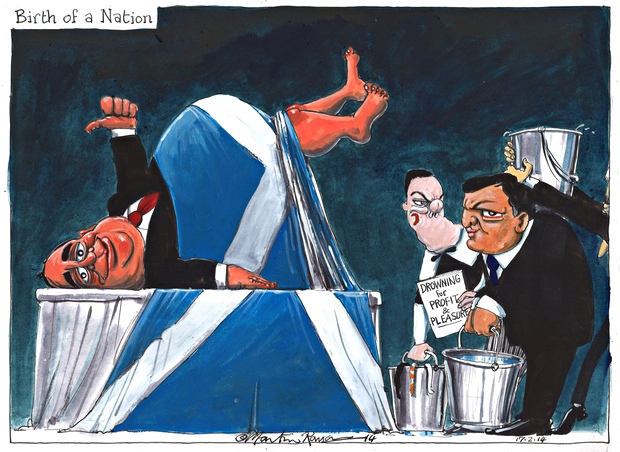
I suspect someone with a bit of savvy told Cameroon to keep his plummy clock well away from the Scootland thingy.
His voice and demeanour alone might have tilted the scales in favour of a yes vote.
In the meantime, we have Wee Eck Samlon hooting and screaming for independence, whilst straining at the leash to tie the scots up to an even bigger tyranny.
I hope the jocks have more sense than to listen to tossers like Samlon.
His voice and demeanour alone might have tilted the scales in favour of a yes vote.
In the meantime, we have Wee Eck Samlon hooting and screaming for independence, whilst straining at the leash to tie the scots up to an even bigger tyranny.
I hope the jocks have more sense than to listen to tossers like Samlon.
Haystack
- 16 Feb 2014 21:44
- 36716 of 81564
It is very unlikely that any breakaway state would be allowed into the EU. The Spanish have their own reasons and other countries would think it sets a bad and dangerous precedent.
MaxK - 16 Feb 2014 23:37 - 36717 of 81564

Fred1new
- 16 Feb 2014 23:51
- 36718 of 81564
Haze,
Perhaps the Spanish will not be as cynical as you appear/
Or, perhaps the Spanish central government may address the reasons for Catalan and Basques who wish to separate, rather than trying to subjugate them.
Perhaps the Spanish will not be as cynical as you appear/
Or, perhaps the Spanish central government may address the reasons for Catalan and Basques who wish to separate, rather than trying to subjugate them.
Haystack
- 17 Feb 2014 01:05
- 36719 of 81564
Spain has already blocked Kosovo's accession to the EU on the grounds that it would encourage separatism in its Catalonia or Basque regions.
MaxK - 17 Feb 2014 07:47 - 36720 of 81564
MaxK - 17 Feb 2014 08:21 - 36721 of 81564

required field - 17 Feb 2014 08:37 - 36722 of 81564
Pound up against Euro, Dollar,...gold up....crude up....(perhaps because pound against dollar up)....some nice rises here and there...
MaxK - 17 Feb 2014 08:50 - 36723 of 81564
Nick Clegg hints at Lib/Lab pact with first demand in future coalition talks

Andy McSmith Author Biography
Sunday 16 February 2014
http://www.independent.co.uk/news/uk/politics/nick-clegg-hints-at-liblab-pact-with-first-demand-in-future-coalition-talks-9132351.html
Nick Clegg has set out the first demand that the Liberal Democrats would make if they were asked by Ed Miliband to form a coalition government with Labour: “Don’t break the bank.”
His words are likely to annoy the shadow Chancellor, Ed Balls, who would challenge any suggestion that government finances would be unsafe in his hands. They will please Labour MPs and many grass-roots Liberal Democrat activists, however, showing that the Deputy Prime Minister is making public overtures to Labour, while accusing the Conservatives of having changed “dramatically” – for the worse.
In an interview with The Independent’s political commentator, Steve Richards, to be broadcast on Monday night on BBC Radio 4, Mr Clegg said: “There is just no doubt in my mind that if there were a Labour/Liberal Democrat coalition, we the Liberal Democrats would absolutely insist that government would not break the bank.”
He implied that the Labour Party now looks more like a potential party of government than it did three years ago. He said: “I think they’ve changed. I think there’s nothing like the prospect of reality in an election to get politicians to think again and the Labour Party, which is a party unused to sharing power with others is realising that it might have to.”
Mr Clegg also suggested that the Liberal Democrats are finding the Conservatives increasingly hard to deal with. He claimed: “The Conservative Party has changed quite dramatically since we entered into coalition with them. They’ve become much more ideological, they’ve returned much more to a lot of their familiar theme tunes.
“I think it would be best for everybody if the Conservative Party were to rediscover a talent for actually talking to mainstream voters about mainstream concerns.”
The Liberal Democrats have suffered a run of disastrous opinion poll findings, and their candidate in last week’s Wythenshawe by election lost her deposit, which suggests they will lose seats in next year’s general election. But they have a track record of holding on in places where they have a strong presence, as they demonstrated when they won to Eastleigh by-election after Chris Huhne resigned.
Andy McSmith Author Biography
Sunday 16 February 2014
http://www.independent.co.uk/news/uk/politics/nick-clegg-hints-at-liblab-pact-with-first-demand-in-future-coalition-talks-9132351.html
Nick Clegg has set out the first demand that the Liberal Democrats would make if they were asked by Ed Miliband to form a coalition government with Labour: “Don’t break the bank.”
His words are likely to annoy the shadow Chancellor, Ed Balls, who would challenge any suggestion that government finances would be unsafe in his hands. They will please Labour MPs and many grass-roots Liberal Democrat activists, however, showing that the Deputy Prime Minister is making public overtures to Labour, while accusing the Conservatives of having changed “dramatically” – for the worse.
In an interview with The Independent’s political commentator, Steve Richards, to be broadcast on Monday night on BBC Radio 4, Mr Clegg said: “There is just no doubt in my mind that if there were a Labour/Liberal Democrat coalition, we the Liberal Democrats would absolutely insist that government would not break the bank.”
He implied that the Labour Party now looks more like a potential party of government than it did three years ago. He said: “I think they’ve changed. I think there’s nothing like the prospect of reality in an election to get politicians to think again and the Labour Party, which is a party unused to sharing power with others is realising that it might have to.”
Mr Clegg also suggested that the Liberal Democrats are finding the Conservatives increasingly hard to deal with. He claimed: “The Conservative Party has changed quite dramatically since we entered into coalition with them. They’ve become much more ideological, they’ve returned much more to a lot of their familiar theme tunes.
“I think it would be best for everybody if the Conservative Party were to rediscover a talent for actually talking to mainstream voters about mainstream concerns.”
The Liberal Democrats have suffered a run of disastrous opinion poll findings, and their candidate in last week’s Wythenshawe by election lost her deposit, which suggests they will lose seats in next year’s general election. But they have a track record of holding on in places where they have a strong presence, as they demonstrated when they won to Eastleigh by-election after Chris Huhne resigned.
goldfinger
- 17 Feb 2014 08:54
- 36724 of 81564
Turn off your iPad, David Cameron, and start dealing with Britain's debt
The Prime Minister David Cameron talks about fiscal sanity but is borrowing like a drunken Keynesian.
Inactive: for all David Cameron's talk about cutting debt, state spending has barely changed since Gordon Brown's peak rate - Turn off your iPad, David Cameron, and start dealing with our debt
By Fraser Nelson8:14PM BST 17 May 2012
No one dispenses advice to the eurozone better than David Cameron. His speech yesterday was a fountain of good sense and hard truth. Quite rightly, he said there’s no point in any uncompetitive, debt-addicted country thinking it can just muddle along. Radical, structural reform is needed. He didn’t say which of the many basket-case European economies he had in mind, but one sticks out. It is increasing its debt faster than anywhere else in Europe. It languishes behind even Pakistan and Nicaragua on the global regulation league tables. Its growth prospects have almost evaporated.
How do you solve a problem like the United Kingdom? Two years in, and Mr Cameron seems no nearer to a solution. He is ambitious over welfare and schools, but on the economy he seems trapped inside a failed Brownite consensus. The Prime Minister does know what should be done, as we heard yesterday: radical reform, and accepting that you can’t (as he puts it) “borrow your way out of a debt crisis”. But his government is attempting to do precisely that, borrowing more over five years than Labour did over 13.
Fairly soon, Mr Cameron will be fully aware of these depressing metrics. He has ordered a special app on his iPad that will give him a “management dashboard”, with everything from dole figures to inflation. (One of his senior advisers says the PM spends “a crazy, scary amount of time playing Fruit Ninja on his iPad”, so the new software will offer some respite.) It will be a digital horror show. His government is “dealing with the debt” in the same way that George Best dealt with the drink: bingeing on it. Ours has increased more than any eurozone member’s. And still, as his iPad will soon tell him, the government envisages no economic improvement to speak of by 2015. Britain’s deficit won’t be abolished. It will still be there – indeed, it will be the largest in the Western world.
The Institute of Directors has done more than just provide a stage for the Prime Minister’s speech yesterday. Next week, with the Taxpayers’ Alliance, it will publish a compendium of radical solutions to get the economy moving, almost all of which he will likely consider beyond the pale. The report of its 2020 Tax Commission (of which I am a member) is intended to be the most comprehensive guide to supply-side economic reform published in Britain in a generation. It highlights the many options open to George Osborne to replace the losing formula of tax rises and slow-mo austerity.
Tinkering won’t be enough. It’s not much use trying to simplify taxes, for example, when the system itself is beyond redemption. Rules on inheritance tax alone would take the world’s fastest speaker 10 hours to read. The time has come to start abolishing taxes wholesale, as Nigel Lawson used to do with every Budget. The entire tax system needs to be replaced with something coherent. Trying to incubate “green technology” jobs may well keep ministers busy, but will make no noticeable difference to the economy. British government spending is about half of economic output. Study after study shows the optimal size of government is closer to a third. This should be the aim.
The Treasury is locked in the old way of thinking about growth: it assumes that everyone will just carry on as before, but pay more tax. Take the North Sea oil raid in last year’s Budget, which the Treasury claimed was cunning enough not to impact on any activity at all. Exploration projects collapsed by half last year, production by a fifth. Meanwhile, the Institute for Economic Affairs calculates that the VAT increase has cost about a quarter of a million jobs, and dealt such a hammer blow to growth that it ended up actually increasing the deficit – the opposite of the intended effect.
If Britain’s state spending were cut back to 2004 levels – hardly the Dark Ages – studies suggest our economy would be able to grow at twice today’s speed. William Hague recently suggested that the only growth strategy is for people to “work hard”. It’s not quite so simple. Ministers need to create a stronger incentive for people to work hard, cutting taxes and letting them keep more of the money they earn. None of this is hard to grasp, none of it is outlandish. The moral and economic case for limited government is firmly grasped in the roaring Asian economies. But none of this is obvious to HM Treasury: it is still risk-averse, still mistrustful, still hardwired with assumptions that Gordon Brown programmed in over 10 years.
For all the talk of cuts, state spending has come down just 0.9 per cent from Brown’s peak. The British strategy has been not so much sado-austerity as thesp-austerity: minimal cuts imposed with maximal dramatics. Mr Cameron is giving the best speeches on fiscal sanity on the world stage at the moment, while his ministers are borrowing like drunken Keynesians. The Prime Minister is not trying to “dupe the bond markets”, as one City firm suggested this week. The gap between what he’s saying and what he’s doing is better explained by the gap between what he knows he needs to do and what he feels able to enact.
For those around Mr Cameron, this gap is deeply frustrating – and illustrated by one dramatic incident a few weeks ago. As Benedict Brogan revealed yesterday, a small group inside No 10 had drawn up proposals for an immediate cut in corporation tax to 15 per cent. This would have been a game-changer – a clear signal that Britain was open for business with the one of the lowest corporation taxes on the planet. The idea was for companies to come flocking back from Ireland, itself sending a signal, and the cost of the tax rise would be funded by welfare cuts (which remain popular).
But the plan was rejected out of hand by the Treasury, and its advocates were given no help at all from Mr Cameron. To those who had believed they were working for a radical Prime Minister, it was a bitter blow. This sense of frustration is shared throughout the Conservative backbenches. Tory MPs fought an election saying that Britain was on the wrong path – yet some feel they’re still plodding along that path, whistling a different tune but with the cliff edge still in sight. The glummer Tories argue that a fresh eurozone blow-up would have its advantages for the Government, as there would be something to blame for the abject lack of economic progress.
Perhaps the most depressing theory circulating in Westminster at present is that “you have to go through Heath to get to Thatcher”. That is to say, tinkering has to be tried, and failed, before the Conservative Party reaches for radicalism. In 1970 Ted Heath spoke brilliantly about the changes needed to save Britain, but felt unable to implement them in office. Mr Cameron is familiar with the unflattering comparisons to Heath. He responds that Lady Thatcher was cautious at first, biding her time before waging war with the unions and saving Britain. If the Prime Minister does have such a card up his sleeve, now might be a good time to play it.
The Prime Minister David Cameron talks about fiscal sanity but is borrowing like a drunken Keynesian.
Inactive: for all David Cameron's talk about cutting debt, state spending has barely changed since Gordon Brown's peak rate - Turn off your iPad, David Cameron, and start dealing with our debt
By Fraser Nelson8:14PM BST 17 May 2012
No one dispenses advice to the eurozone better than David Cameron. His speech yesterday was a fountain of good sense and hard truth. Quite rightly, he said there’s no point in any uncompetitive, debt-addicted country thinking it can just muddle along. Radical, structural reform is needed. He didn’t say which of the many basket-case European economies he had in mind, but one sticks out. It is increasing its debt faster than anywhere else in Europe. It languishes behind even Pakistan and Nicaragua on the global regulation league tables. Its growth prospects have almost evaporated.
How do you solve a problem like the United Kingdom? Two years in, and Mr Cameron seems no nearer to a solution. He is ambitious over welfare and schools, but on the economy he seems trapped inside a failed Brownite consensus. The Prime Minister does know what should be done, as we heard yesterday: radical reform, and accepting that you can’t (as he puts it) “borrow your way out of a debt crisis”. But his government is attempting to do precisely that, borrowing more over five years than Labour did over 13.
Fairly soon, Mr Cameron will be fully aware of these depressing metrics. He has ordered a special app on his iPad that will give him a “management dashboard”, with everything from dole figures to inflation. (One of his senior advisers says the PM spends “a crazy, scary amount of time playing Fruit Ninja on his iPad”, so the new software will offer some respite.) It will be a digital horror show. His government is “dealing with the debt” in the same way that George Best dealt with the drink: bingeing on it. Ours has increased more than any eurozone member’s. And still, as his iPad will soon tell him, the government envisages no economic improvement to speak of by 2015. Britain’s deficit won’t be abolished. It will still be there – indeed, it will be the largest in the Western world.
The Institute of Directors has done more than just provide a stage for the Prime Minister’s speech yesterday. Next week, with the Taxpayers’ Alliance, it will publish a compendium of radical solutions to get the economy moving, almost all of which he will likely consider beyond the pale. The report of its 2020 Tax Commission (of which I am a member) is intended to be the most comprehensive guide to supply-side economic reform published in Britain in a generation. It highlights the many options open to George Osborne to replace the losing formula of tax rises and slow-mo austerity.
Tinkering won’t be enough. It’s not much use trying to simplify taxes, for example, when the system itself is beyond redemption. Rules on inheritance tax alone would take the world’s fastest speaker 10 hours to read. The time has come to start abolishing taxes wholesale, as Nigel Lawson used to do with every Budget. The entire tax system needs to be replaced with something coherent. Trying to incubate “green technology” jobs may well keep ministers busy, but will make no noticeable difference to the economy. British government spending is about half of economic output. Study after study shows the optimal size of government is closer to a third. This should be the aim.
The Treasury is locked in the old way of thinking about growth: it assumes that everyone will just carry on as before, but pay more tax. Take the North Sea oil raid in last year’s Budget, which the Treasury claimed was cunning enough not to impact on any activity at all. Exploration projects collapsed by half last year, production by a fifth. Meanwhile, the Institute for Economic Affairs calculates that the VAT increase has cost about a quarter of a million jobs, and dealt such a hammer blow to growth that it ended up actually increasing the deficit – the opposite of the intended effect.
If Britain’s state spending were cut back to 2004 levels – hardly the Dark Ages – studies suggest our economy would be able to grow at twice today’s speed. William Hague recently suggested that the only growth strategy is for people to “work hard”. It’s not quite so simple. Ministers need to create a stronger incentive for people to work hard, cutting taxes and letting them keep more of the money they earn. None of this is hard to grasp, none of it is outlandish. The moral and economic case for limited government is firmly grasped in the roaring Asian economies. But none of this is obvious to HM Treasury: it is still risk-averse, still mistrustful, still hardwired with assumptions that Gordon Brown programmed in over 10 years.
For all the talk of cuts, state spending has come down just 0.9 per cent from Brown’s peak. The British strategy has been not so much sado-austerity as thesp-austerity: minimal cuts imposed with maximal dramatics. Mr Cameron is giving the best speeches on fiscal sanity on the world stage at the moment, while his ministers are borrowing like drunken Keynesians. The Prime Minister is not trying to “dupe the bond markets”, as one City firm suggested this week. The gap between what he’s saying and what he’s doing is better explained by the gap between what he knows he needs to do and what he feels able to enact.
For those around Mr Cameron, this gap is deeply frustrating – and illustrated by one dramatic incident a few weeks ago. As Benedict Brogan revealed yesterday, a small group inside No 10 had drawn up proposals for an immediate cut in corporation tax to 15 per cent. This would have been a game-changer – a clear signal that Britain was open for business with the one of the lowest corporation taxes on the planet. The idea was for companies to come flocking back from Ireland, itself sending a signal, and the cost of the tax rise would be funded by welfare cuts (which remain popular).
But the plan was rejected out of hand by the Treasury, and its advocates were given no help at all from Mr Cameron. To those who had believed they were working for a radical Prime Minister, it was a bitter blow. This sense of frustration is shared throughout the Conservative backbenches. Tory MPs fought an election saying that Britain was on the wrong path – yet some feel they’re still plodding along that path, whistling a different tune but with the cliff edge still in sight. The glummer Tories argue that a fresh eurozone blow-up would have its advantages for the Government, as there would be something to blame for the abject lack of economic progress.
Perhaps the most depressing theory circulating in Westminster at present is that “you have to go through Heath to get to Thatcher”. That is to say, tinkering has to be tried, and failed, before the Conservative Party reaches for radicalism. In 1970 Ted Heath spoke brilliantly about the changes needed to save Britain, but felt unable to implement them in office. Mr Cameron is familiar with the unflattering comparisons to Heath. He responds that Lady Thatcher was cautious at first, biding her time before waging war with the unions and saving Britain. If the Prime Minister does have such a card up his sleeve, now might be a good time to play it.
goldfinger
- 17 Feb 2014 08:56
- 36725 of 81564
But his government is attempting to do precisely that, borrowing more over five years than Labour did over 13.
goldfinger
- 17 Feb 2014 08:58
- 36726 of 81564
Is it just me or have the fonts got bigger on money am?????????????????????????
The print seems very large this morning.
The print seems very large this morning.
MaxK - 17 Feb 2014 09:02 - 36727 of 81564
Looks normal to me gf.
Fred1new
- 17 Feb 2014 09:11
- 36728 of 81564
GF
Try ctrl + or - for your screen.
Try ctrl + or - for your screen.
goldfinger
- 17 Feb 2014 09:39
- 36729 of 81564
Cheers will do Fred. Thanks Max.
Think it might be last nights ale.
Think it might be last nights ale.
Fred1new
- 17 Feb 2014 10:23
- 36730 of 81564
Check your sugar!
Fred1new
- 17 Feb 2014 10:28
- 36731 of 81564
doodlebug4 - 17 Feb 2014 10:33 - 36732 of 81564
Ministers have been ordered to stop squandering British aid on wasteful projects, including climate change schemes in wealthy countries, the Telegraph has learnt.
Justine Greening, the development secretary, fears Whitehall departments, in particular the Department for Energy and Climate Change, could undermine public support for overseas aid by funding poorly-run projects in middle-income countries that do not need help from British taxpayers.
In a letter seen by the Telegraph, Mrs Greening warns ministers they risk breaching international protocols and face investigation by Britain's aid watchdog if they spend continue to spend money on anything other than relieving extreme poverty in the world’s poorest regions.
Mrs Greening fully supports the Government’s target of spending 0.7 per cent of GDP on foreign aid. But the warning that some departments are may be misusing aid will bolster Conservative MPs who want David Cameron to divert some of the £8bn a year aid budget on flood relief in Britain.
Mrs Greening’s department, which accounts for the lion’s share of aid spending, has stripped funds from more than a dozen rapidly growing countries and has been swift to shut down programmes that misspent funds. She wants private sector firms such as supermarkets to work with her department to help developing economies come off aid and stand on their own feet.
Mrs Greening did not single out any departments in the letter, which was sent to every member of the Cabinet.
However, she is understood to be particularly frustrated at Liberal Democrat Ed Davey's energy and climate change department, which oversees hundreds of millions of pounds of grants designed to help poor and middle-income countries curb their carbon emissions.
It recently gave £15m to cattle ranchers in Colombia, the world’s 30th richest country, to help cut flatulence in cows. It has also funded projects in Turkey and Chile, which are enjoying rapid economic growth.
Daily Telegraph
Justine Greening, the development secretary, fears Whitehall departments, in particular the Department for Energy and Climate Change, could undermine public support for overseas aid by funding poorly-run projects in middle-income countries that do not need help from British taxpayers.
In a letter seen by the Telegraph, Mrs Greening warns ministers they risk breaching international protocols and face investigation by Britain's aid watchdog if they spend continue to spend money on anything other than relieving extreme poverty in the world’s poorest regions.
Mrs Greening fully supports the Government’s target of spending 0.7 per cent of GDP on foreign aid. But the warning that some departments are may be misusing aid will bolster Conservative MPs who want David Cameron to divert some of the £8bn a year aid budget on flood relief in Britain.
Mrs Greening’s department, which accounts for the lion’s share of aid spending, has stripped funds from more than a dozen rapidly growing countries and has been swift to shut down programmes that misspent funds. She wants private sector firms such as supermarkets to work with her department to help developing economies come off aid and stand on their own feet.
Mrs Greening did not single out any departments in the letter, which was sent to every member of the Cabinet.
However, she is understood to be particularly frustrated at Liberal Democrat Ed Davey's energy and climate change department, which oversees hundreds of millions of pounds of grants designed to help poor and middle-income countries curb their carbon emissions.
It recently gave £15m to cattle ranchers in Colombia, the world’s 30th richest country, to help cut flatulence in cows. It has also funded projects in Turkey and Chile, which are enjoying rapid economic growth.
Daily Telegraph
Haystack
- 17 Feb 2014 11:45
- 36733 of 81564
This an interesting response to the US looking at people's emails
http://mobile.nytimes.com/2014/02/17/world/europe/merkel-backs-plan-to-keep-european-data-in-europe.html?_r=0&referrer=
Merkel Backs Plan to Keep European Data in Europe
ERLIN — Chancellor Angela Merkel of Germany has embraced proposals to create European data networks that would keep emails and other communications on the European side of the Atlantic, farther from prying American eyes, and said she would raise the matter this week with President François Hollande of France.
http://mobile.nytimes.com/2014/02/17/world/europe/merkel-backs-plan-to-keep-european-data-in-europe.html?_r=0&referrer=
Merkel Backs Plan to Keep European Data in Europe
ERLIN — Chancellor Angela Merkel of Germany has embraced proposals to create European data networks that would keep emails and other communications on the European side of the Atlantic, farther from prying American eyes, and said she would raise the matter this week with President François Hollande of France.
Haystack
- 17 Feb 2014 12:43
- 36734 of 81564
It is encouraging to see examples of misplaced belief in religion
http://news.sky.com/story/1212846/snake-handling-tv-pastor-dies-from-snakebite
Snake-Handling TV Pastor Dies From Snakebite
A snake-handling pastor who appeared on a National Geographic television reality show has died after being bitten by a snake.
Jamie Coots was bitten on the hand by a rattlesnake during a weekend church service in Kentucky.
After the bite, he dropped the snakes, but then picked them back up and continued on.
Rev Coots went home before emergency workers got to the Full Gospel Tabernacle in Jesus Name Church in Middlesboro.
The emergency workers then went to his house, but he refused medical treatment on grounds that he believed in faith healing, and declined to be taken to hospital.
When the emergency workers returned about an hour later, he was dead from a venomous bite, Middlesboro police said.
Rev Coots, a 42-year-old Pentecostal preacher, had recently been featured on the National Geographic show Snake Salvation.
His son, Cody, told local station WBIR-TV that the pastor had been bitten eight times before, but never had such a severe reaction and expected Saturday's bite to be like the others.
"We're going to go home, he's going to lay on the couch, he's going to hurt, he's going to pray for a while and he's going to get better," Cody Coots said.
http://news.sky.com/story/1212846/snake-handling-tv-pastor-dies-from-snakebite
Snake-Handling TV Pastor Dies From Snakebite
A snake-handling pastor who appeared on a National Geographic television reality show has died after being bitten by a snake.
Jamie Coots was bitten on the hand by a rattlesnake during a weekend church service in Kentucky.
After the bite, he dropped the snakes, but then picked them back up and continued on.
Rev Coots went home before emergency workers got to the Full Gospel Tabernacle in Jesus Name Church in Middlesboro.
The emergency workers then went to his house, but he refused medical treatment on grounds that he believed in faith healing, and declined to be taken to hospital.
When the emergency workers returned about an hour later, he was dead from a venomous bite, Middlesboro police said.
Rev Coots, a 42-year-old Pentecostal preacher, had recently been featured on the National Geographic show Snake Salvation.
His son, Cody, told local station WBIR-TV that the pastor had been bitten eight times before, but never had such a severe reaction and expected Saturday's bite to be like the others.
"We're going to go home, he's going to lay on the couch, he's going to hurt, he's going to pray for a while and he's going to get better," Cody Coots said.
| About MoneyAM | Ts and Cs | Privacy Policy | Investment Warning | Content Standards | Corporate Solutions | Advertise With Us | Site Map | © 2026 MoneyAM |
Register now for FREE
Share Prices,
Stock Quotes,
Charts, Bulletin Boards, Indices, Watchlists, Portfolio, Market News, Research
or see our Premium Services including Level 2, Terminal and much more.
 Follow us on Twitter