

| Home | Log In | Register | Our Services | My Account | Contact | Help |
You are NOT currently logged in
Register now or login to post to this thread.
THE TALK TO YOURSELF THREAD. (NOWT)
goldfinger

 - 09 Jun 2005 12:25


Thought Id start this one going because its rather dead on this board at the moment and I suppose all my usual muckers are either at the Stella tennis event watching Dim Tim (lose again) or at Henly Regatta eating cucumber sandwiches (they wish,...NOT).
Anyway please feel free to just talk to yourself blast away and let it go on any company or subject you wish. Just wish Id thought of this one before.
cheers GF.
Anyway please feel free to just talk to yourself blast away and let it go on any company or subject you wish. Just wish Id thought of this one before.
cheers GF.
aldwickk
- 29 Mar 2014 10:07
- 39028 of 81564
.
ptholden
- 29 Mar 2014 10:10
- 39029 of 81564
So a 0.25% interest rate hike equates to a 50% increase in mortgage costs?
How does that work?
How does that work?
Haystack
- 29 Mar 2014 10:16
- 39030 of 81564
It doesn't. Mortgage rates are around about 3% to 4% for variable rates. So you can see what the increase would be.
MaxK - 30 Mar 2014 11:00 - 39031 of 81564
MaxK - 30 Mar 2014 11:06 - 39032 of 81564
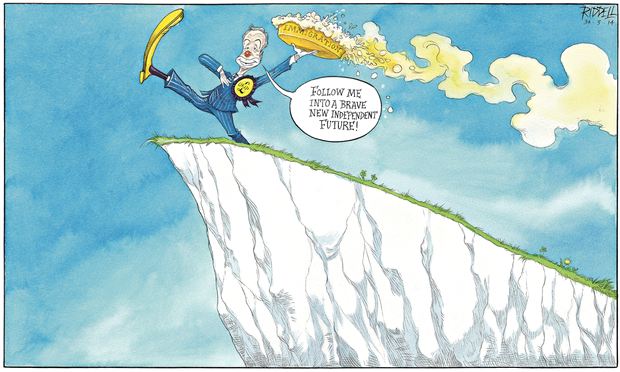
The people feel ignored – and they are angry
Not one leader of a major party has a true connection with ordinary folk. This is dangerous

Nigel Farage may sound like the guy down the pub, but that is more in tune with the public mood than smart-talking little boys doing debating society tricks Photo: PA/IAN WEST
By Janet Daley
6:30PM GMT 29 Mar 2014
There will really be only two contestants in the next general election: the political class and the people. And by the “political class”, I mean the entire operation that runs, manipulates and communicates the activities of government. That conglomeration of politicians and their special interest lobbies, media followers and professional handlers is now more self-referring, inbred and profoundly detached from the reality of most people’s lives than at any time in a generation.
This fact was brought home very sharply by the grotesquely embarrassing fault line that appeared in the brief lapse of time between the ending of the Farage-Clegg debate – during which a vast army of esteemed press commentators declared Nick Clegg the winner – and the release of the YouGov poll, showing that a large majority of the ordinary public believed Nigel Farage had won. Most alarmingly, there was a remarkable media consensus: it was not just wishful-thinking Europhiles who thought Clegg had walked it.
In the mortifying aftermath, which saw pundits scrambling to amend – or explain away – the bizarre discrepancy between their initial judgment and that of the wider world, an awful truth began to emerge. It was, indeed, as if the Westminster media and actual voters in the country had been listening to an entirely different event – as, for all intents and purposes, they were. And strangely enough, the preconceptions of the two camps were almost exactly the opposite of what might be expected.
It was the pundits, not the public, who were obsessed with personality quirks and presentational cool, where the public were much more attracted to convictions and basic values. The press commentary focused on Farage’s sweaty anger and contrasted it with Clegg’s calm smoothness: political success had to be all about clever presentation and professional delivery. But real people clearly saw Farage’s anger as genuine and appropriate, and reacted against Clegg’s glib patter, which they presumably perceived as untrustworthy.
So maybe all those post-Blair assumptions about politicians needing to be sold like products with the slickest possible advertising techniques need to be re-examined. When the electorate feels that its own concerns are being ignored or marginalised, it will embrace a spokesman who looks as if he genuinely shares their strong beliefs, even if he is amateurish or unpolished in his delivery. It is the Westminster club that is addicted to image-led politics, not the country.
More:http://www.telegraph.co.uk/news/politics/ukip/10730787/The-people-feel-ignored-and-they-are-angry.html
Not one leader of a major party has a true connection with ordinary folk. This is dangerous
Nigel Farage may sound like the guy down the pub, but that is more in tune with the public mood than smart-talking little boys doing debating society tricks Photo: PA/IAN WEST
By Janet Daley
6:30PM GMT 29 Mar 2014
There will really be only two contestants in the next general election: the political class and the people. And by the “political class”, I mean the entire operation that runs, manipulates and communicates the activities of government. That conglomeration of politicians and their special interest lobbies, media followers and professional handlers is now more self-referring, inbred and profoundly detached from the reality of most people’s lives than at any time in a generation.
This fact was brought home very sharply by the grotesquely embarrassing fault line that appeared in the brief lapse of time between the ending of the Farage-Clegg debate – during which a vast army of esteemed press commentators declared Nick Clegg the winner – and the release of the YouGov poll, showing that a large majority of the ordinary public believed Nigel Farage had won. Most alarmingly, there was a remarkable media consensus: it was not just wishful-thinking Europhiles who thought Clegg had walked it.
In the mortifying aftermath, which saw pundits scrambling to amend – or explain away – the bizarre discrepancy between their initial judgment and that of the wider world, an awful truth began to emerge. It was, indeed, as if the Westminster media and actual voters in the country had been listening to an entirely different event – as, for all intents and purposes, they were. And strangely enough, the preconceptions of the two camps were almost exactly the opposite of what might be expected.
It was the pundits, not the public, who were obsessed with personality quirks and presentational cool, where the public were much more attracted to convictions and basic values. The press commentary focused on Farage’s sweaty anger and contrasted it with Clegg’s calm smoothness: political success had to be all about clever presentation and professional delivery. But real people clearly saw Farage’s anger as genuine and appropriate, and reacted against Clegg’s glib patter, which they presumably perceived as untrustworthy.
So maybe all those post-Blair assumptions about politicians needing to be sold like products with the slickest possible advertising techniques need to be re-examined. When the electorate feels that its own concerns are being ignored or marginalised, it will embrace a spokesman who looks as if he genuinely shares their strong beliefs, even if he is amateurish or unpolished in his delivery. It is the Westminster club that is addicted to image-led politics, not the country.
More:http://www.telegraph.co.uk/news/politics/ukip/10730787/The-people-feel-ignored-and-they-are-angry.html
MaxK - 30 Mar 2014 12:05 - 39033 of 81564
Labour opinion poll support falls to lowest level since 2010 election
Labour's two-point fall in Opinium/Observer poll leaves it just one point ahead of the Tories, with Ukip up to 15%
Toby Helm, political editor
The Observer, Saturday 29 March 2014 18.21 GMT
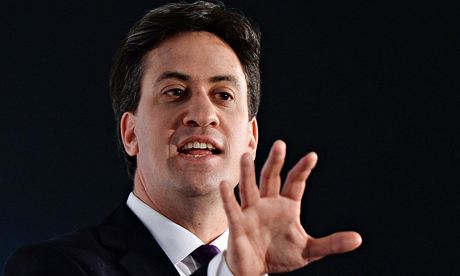
Labour's support has slumped to its lowest level since soon after the 2010 election, according to a new Opinium/Observer poll. Ed Miliband's party now has a lead of just one percentage point over the Conservatives.
The findings – showing a clear bounce for the Tories after George Osborne's budget – will put more pressure on Miliband, whose party was 10 points ahead of the Tories a year ago.
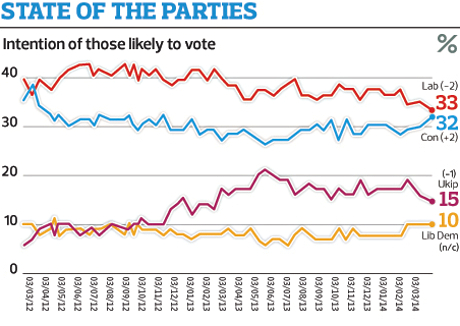
The poll puts Labour on 33% (down two points on a fortnight ago), the Conservatives on 32% (up two), Ukip on 15% (down one) and the Liberal Democrats unchanged on 10%. Since the budget on 19 March, several polls have shown Labour's lead cut, but Labour strategists hoped the Tory bounce would be shortlived.
The Conservatives and Labour have not been so close in the polls since before Osborne's so-called "omnishambles" budget of March 2012 in which he abolished the 50p rate of tax and imposed other controversial taxes on pasties, caravans and charities.
The only comfort for Labour is that, as its support has fallen, the Conservatives have failed to record any strong increase and are still well down on previous highs in this parliament. In early March 2012 Opinium had the Tories on 38% and Labour on 36%.
More: http://www.theguardian.com/politics/2014/mar/29/labour-support-falls-lowest-2010-observer-opinium-opinion-poll
aldwickk
- 30 Mar 2014 16:14
- 39034 of 81564
.
goldfinger
- 30 Mar 2014 19:36
- 39035 of 81564
Yep but were still in front and that means a lot at this stage.
MaxK - 30 Mar 2014 23:00 - 39036 of 81564
lol, well done to you gf , against all the negative points, you keep trying to polish the turd that is the three main parties of GB.
They have failed miserably to protect those they have sworn to protect, ie the british public.
They are about to pay the price!
They have failed miserably to protect those they have sworn to protect, ie the british public.
They are about to pay the price!
cynic
- 31 Mar 2014 08:20
- 39037 of 81564
max - are you therefore predicting ukip winning a stack of seats at the general election? ..... and thus effectively the balance of power in a hung parliament
MaxK - 31 Mar 2014 09:03 - 39038 of 81564
Morning c.
No, Im not expecting ukip to win a load of seats at the GE. What I am looking for is ukip to break up the cosy consensus between the three main party's.
The Eastliegh by-election should have been a wake up call, but has been dismissed as an anomaly.
The €uro elections are another matter, they should make gains against the existing crowd, further enhancing their position.
The GE will be won in the marginals, as usual. But with ukip in the frame, who can feel safe, how do you begin to predict the unknowable?
No, Im not expecting ukip to win a load of seats at the GE. What I am looking for is ukip to break up the cosy consensus between the three main party's.
The Eastliegh by-election should have been a wake up call, but has been dismissed as an anomaly.
The €uro elections are another matter, they should make gains against the existing crowd, further enhancing their position.
The GE will be won in the marginals, as usual. But with ukip in the frame, who can feel safe, how do you begin to predict the unknowable?
Haystack
- 31 Mar 2014 09:42
- 39039 of 81564
UKIP will win a lot of MEPs. They may come second or third. As far as the GE is concerned, nothing much will change. They are on course to get zero MPs. They will just disrupt the votes for other parties. All a bit of a waste of time voting for UKIP.
cynic
- 31 Mar 2014 09:46
- 39040 of 81564
not quite a fair comparison, but the french have a habit of voting in the unelectable at local elections and similar (for which read eu elections) and then reverting to form when it's serious
at the last serious election, the french voted in the socialist "heron king", and have bitterly regretted it ever since .... as result the unelectable but dangerous far-right candidates are now making significant gains at the local elections
at the last serious election, the french voted in the socialist "heron king", and have bitterly regretted it ever since .... as result the unelectable but dangerous far-right candidates are now making significant gains at the local elections
Fred1new
- 31 Mar 2014 10:16
- 39041 of 81564
YouGov/Sunday Times – CON 33, LAB 40, LD 9, UKIP 11
30 MAR 2014
The weekly YouGov/Sunday Times poll is out here. Topline voting intentions are CON 33%, LAB 40%, LDEM 9%, UKIP 11%.
Haystack
- 31 Mar 2014 10:25
- 39042 of 81564
What is better dangerous far right parties like BNP or dangerous far left parties like Labour?
The choice is between no immigrants and as many as we can cram into the UK.
The choice is between no immigrants and as many as we can cram into the UK.
Fred1new
- 31 Mar 2014 11:15
- 39043 of 81564
Hazy One!
Why haven't you posted the polls with joy in your skirts!
YouGov/Sunday Times – CON 33, LAB 40, LD 9, UKIP 11
30 MAR 2014
The weekly YouGov/Sunday Times poll is out here.
Topline voting intentions are
CON 33%,
LAB 40%,
LDEM 9%,
UKIP 11%.
How many seats on this basis has Labour.
Time to ditch Wavy Dave and Porky?
Why haven't you posted the polls with joy in your skirts!
YouGov/Sunday Times – CON 33, LAB 40, LD 9, UKIP 11
30 MAR 2014
The weekly YouGov/Sunday Times poll is out here.
Topline voting intentions are
CON 33%,
LAB 40%,
LDEM 9%,
UKIP 11%.
How many seats on this basis has Labour.
Time to ditch Wavy Dave and Porky?
Fred1new
- 31 Mar 2014 11:16
- 39044 of 81564
Haze,
Do you roll your trouser leg up when you go to party HQ?
There must be an awful arms in the air there at the moment!
Do you roll your trouser leg up when you go to party HQ?
There must be an awful arms in the air there at the moment!
ExecLine
 - 31 Mar 2014 12:11
- 39045 of 81564
- 31 Mar 2014 12:11
- 39045 of 81564

Now we all strongly suspect our Foreign Aid is not going to the right places. How much longer are we going to let the government keep 'chucking it' away to despotic regimes?
Ethiopian farmer sues UK over our foreign aid handouts
Check out: http://www.express.co.uk/news/world/467818/Ethiopian-farmer-sues-UK-over-our-foreign-aid-handouts
And the poor guy is using tens of thousands of £GBP of our Legal Aid to sue our own government!
You can't make it up!
Ethiopian farmer sues UK over our foreign aid handouts
Check out: http://www.express.co.uk/news/world/467818/Ethiopian-farmer-sues-UK-over-our-foreign-aid-handouts
And the poor guy is using tens of thousands of £GBP of our Legal Aid to sue our own government!
You can't make it up!
MaxK - 31 Mar 2014 12:14 - 39046 of 81564

MaxK - 31 Mar 2014 12:20 - 39047 of 81564

| About MoneyAM | Ts and Cs | Privacy Policy | Investment Warning | Content Standards | Corporate Solutions | Advertise With Us | Site Map | © 2026 MoneyAM |
Register now for FREE
Share Prices,
Stock Quotes,
Charts, Bulletin Boards, Indices, Watchlists, Portfolio, Market News, Research
or see our Premium Services including Level 2, Terminal and much more.
 Follow us on Twitter