

| Home | Log In | Register | Our Services | My Account | Contact | Help |
You are NOT currently logged in
Register now or login to post to this thread.
THE TALK TO YOURSELF THREAD. (NOWT)
goldfinger

 - 09 Jun 2005 12:25


Thought Id start this one going because its rather dead on this board at the moment and I suppose all my usual muckers are either at the Stella tennis event watching Dim Tim (lose again) or at Henly Regatta eating cucumber sandwiches (they wish,...NOT).
Anyway please feel free to just talk to yourself blast away and let it go on any company or subject you wish. Just wish Id thought of this one before.
cheers GF.
Anyway please feel free to just talk to yourself blast away and let it go on any company or subject you wish. Just wish Id thought of this one before.
cheers GF.
cynic
- 19 May 2014 17:07
- 40936 of 81564
and i really can't be bothered to read it as, due to its author, i know where it's headed before i start .... i just wish he wouldn't take up so much unnecessary and unwarranted page space
Stan
- 19 May 2014 17:12
- 40937 of 81564
"i just wish he wouldn't take up so much unnecessary and unwarranted page space"... hark who's talking -):
cynic
- 19 May 2014 17:13
- 40938 of 81564
at least my posts are brief!
goldfinger
- 19 May 2014 17:44
- 40939 of 81564
Hays IDS is a cheat and a thief.
He needs flinging in prison.
He needs flinging in prison.
MaxK - 19 May 2014 18:05 - 40940 of 81564
Id's is an (ex) officer and a gentleman.
Stan
- 19 May 2014 18:21
- 40941 of 81564
brief?.. bereft more like-):
cynic
- 19 May 2014 20:23
- 40942 of 81564
not bereft of briefs for sure, so bereft of what? .... agreement with the ravers? .... bereft of hope that the ravers will ever learn to paraphrase, let alone leave their minds open?
goldfinger
- 19 May 2014 20:38
- 40943 of 81564
Hays hays Hays........ASHSCROFT has labour back in the LEAD today.......
New Ashcroft Poll
19 MAY 2014
Ashcroft’s own poll – the second of his new weekly series – shows Labour back in front. His topline figures are CON 29%, LAB 35%, LDEM 9%, UKIP 14%. Until we get some more of Ashcroft’s polls under our belt it’s hard to judge the trend – was last week’s just a rogue, this a return to normality, or vice-versa, or a shift to Labour. I don’t know, we need to give it some time and see how it compares to figures produced by other companies...........................ENDS
Hays thats a 6% lead to Labour.
It comes on the back of the 4 polls showing labour with a 4% lead this weekend.
Obviously the Populus Poll you put up earlier today is a rouge poll.
Back to the drawing board old bean, the trend is in labours favour.
Milly as pulled it around once again.
New Ashcroft Poll
19 MAY 2014
Ashcroft’s own poll – the second of his new weekly series – shows Labour back in front. His topline figures are CON 29%, LAB 35%, LDEM 9%, UKIP 14%. Until we get some more of Ashcroft’s polls under our belt it’s hard to judge the trend – was last week’s just a rogue, this a return to normality, or vice-versa, or a shift to Labour. I don’t know, we need to give it some time and see how it compares to figures produced by other companies...........................ENDS
Hays thats a 6% lead to Labour.
It comes on the back of the 4 polls showing labour with a 4% lead this weekend.
Obviously the Populus Poll you put up earlier today is a rouge poll.
Back to the drawing board old bean, the trend is in labours favour.
Milly as pulled it around once again.
Haystack
- 19 May 2014 21:27
- 40944 of 81564
Still a year to go!!!!
MaxK - 19 May 2014 23:28 - 40945 of 81564
It's in the Guardian, so it must be true!
European elections: union left sullen by fury and frustration with political class
Special report: results certain to bring bonanza for tub-thumping mavericks and radicals on extreme right and far left of Europe
Ian Traynor in Vienna
The Guardian, Monday 19 May 2014 15.55 BST
http://www.theguardian.com/politics/2014/may/19/european-elections-fury-frustration-extreme-right-far-left-union
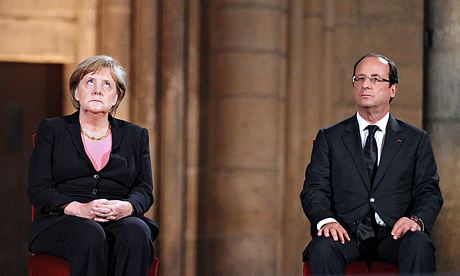
Germany's chancellor, Angela Merkel, and France's president, François Hollande. The 'twin-engine of Europe' seems have faltered. Photograph: Francois Nascimbeni/AFP/Getty Images
Josef Höppinger is an increasingly rare type among European voters. He never changes. "I'm a worker. I vote socialist. Always," said the retired plumber, 81. But he thinks the governing Social Democrats of Austria's chancellor, Werner Faymann, will suffer badly when Europe goes to the ballot box this week.
"You've got all these scandals with the banks, all the sleaze and corruption. The big parties will get weaker, not stronger."
Höppinger has lived all his life in the centre of "Red Vienna", a city for ever run by Social Democrats. His home is in Karl Marx-Hof, the expressionist workers' fortress that was Europe's pioneering experiment in social housing in the 1920s and then a battleground in the civil war of 1934, when the left lost to the pre-Hitler Austro-fascists.
The complex still houses 5,000 people in 1,400 flats. But it is no longer a vibrant, cohesive community guaranteed to vote for the left. Rather, it is a multi-ethnic mixture of immigrants and poor Viennese, many of them unemployed, making it a fertile hunting ground for the far-right Freedom party of Heinz-Christian Strache: anti-EU, anti-immigration, anti-Muslim.
"You have areas here that are 70% immigrant and 30% Austrian," said Rudolf, 61, declining to give his surname. "I've got nothing against immigrants, but it's a big problem in Vienna. Strache might not be electable, but he is very strong here. The old parties just don't seem to have the answers any more. They've been there for a very long time but now they are getting more competition. The Social Democrats will lose. Everything is in flux."
Not only in Vienna. As the EU braces itself for four days of polling to send 751 MEPs to Strasbourg and Brussels from 28 countries, the temper of the union is one of sullen anger and frustration with a mainstream political class seen as detached and remote, incompetent and venal, and often illegitimate.
The results are certain to bring a bonanza for tub-thumping mavericks and radicals on the extreme right and the far left, with the traditional parties of the centre right and centre left haemorrhaging support to the fringes. "We see the risks from these fringe groups being represented in the parliament," said Anthony Gardner, the US ambassador to the EU.
Simon Hix, European politics professor at the London School of Economics, said: "What's happening all across Europe is a decline of mainstream political parties, a fragmentation of the vote on the centre left and the centre right. The social democrats have lost the connection to lower-income voters by not producing jobs and squeezing public spending. There's a failure to generate jobs outside the big urban centres. The decline of manufacturing is replaced by service jobs in capital cities, doing nothing for the white underclass in Salford or Marseille. And the centre right [have] lost the rural conservatives because of their different metropolitan values and the perception they've been captured by big business."
The period between this week's vote and the last European election, in 2009, has been the EU's worst ever. The union's crowning achievement, the single currency, almost disappeared under the pressure of a banking and sovereign debt crisis that threatened to tear the EU apart.
Five countries – Greece, Cyprus, Spain, Portugal and Ireland – were brought to their knees. Big questions, still unanswered, were raised about France and Italy – the eurozone's second and third economies. German-prescribed austerity and spending cuts were administered on a grand scale. Hundreds of billions were poured into a rotten banking sector whose reckless lending policies did much to create the crisis in the first place. The tensions and resentments brought a resurgence of nationalism in Europe. Youth unemployment soared to more than 25%, to more than 50% in Spain and Greece.
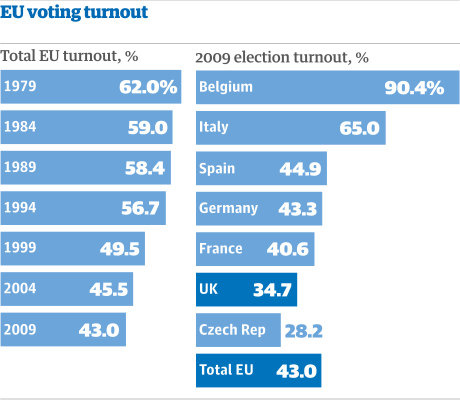
If the currency has been saved, the political price has been very high. On the eve of the elections, the EU is staring at years of stagnation and relative decline, increasingly unable to compete globally, to sustain its social and welfare systems, to generate growth and jobs.
"Europe is in a mess. Our economies are failing to deliver higher living standards for most people, and many have lost faith in politicians' ability to deliver a brighter future, with support for extremists soaring," wrote Philippe Legrain, a former adviser to the head of the European commission and the author of a recent book on the crisis, last week. "After the longest and deepest recession since the 1930s, the recovery is the flimsiest on record. Much of Europe remains lumbered with broken banks and crushing debts. Most of Europe suffers from record low investment and feeble productivity growth. All of Europe is ageing fast. Depressingly, most Europeans think younger generations will have a worse life than they do."
And when things seemed irredeemably bleak, along came Russia's Vladimir Putin, invading and destabilising Ukraine, unilaterally redrawing the map of Europe on the EU's frontier, and challenging its leaders to stop him.
"If you listen to Putin, there's only contempt for Europe," said Radek Sikorski, the Polish foreign minister. "Europe has been living in a postmodern illusion, that everyone wants the same as we do, but just wants to get there at different speeds. That's just not true any more."
One of the EU's top diplomats sounds desperate: "We don't have a coherent strategic view and Putin is taking advantage of our shortcomings. What kind of European order do we want? If we cannot give straightforward answers as to what we want to do, you give everything to the populists."
In London, Vienna, Berlin, Paris, Brussels and The Hague, the term "populist" is the hold-your-nose form of abuse for the anti-European mavericks and radicals riding high in the polls, beneficiaries of the collapse of public confidence in Europe's political elites – figures such as Nigel Farage in Britain, Marine Le Pen in France, Geert Wilders in the Netherlands, Strache in Austria, all of whom are tipped either to win or come a close second in the elections in their respective countries.
"We talk about them but never with them," said Ivan Krastev, a liberal Bulgarian political scientist. "That will be different after these elections. You have a sclerotic political system and a resentment of elites. You have a democracy of mistrust."
Besides, European populism is far from a fringe phenomenon. The mainstream centre right, the dominant force in European politics for the past decade, has included Hungary's Viktor Orban, Italy's Silvio Berlusconi and France's Nicolas Sarkozy in recent years, all of them proud populists.
Hix argues that Europe's leaders are making a big mistake by ignoring the anti-European insurgents. They are not going away. The new parliament is likely to return three blocs of MEPs, around 150 in total, to the right of the mainstream conservatives. They veer from the Eurosceptical British and Polish conservatives to the outright Europe rejectionists of France's National Front, the Dutch Freedom party and Farage's Ukip.
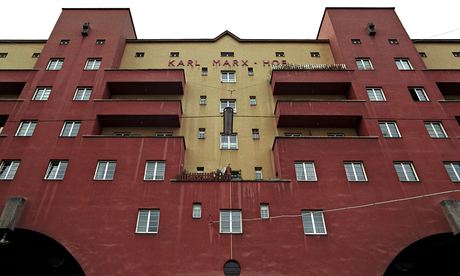
Karl Marx Hof, the expressionist workers' fortress that was Europe's pioneering experiment in social housing in the 1920s. Photograph: Dave Penman/Rex Features
Then there is the often anti-EU hard left, which is likely to do well and supplant the Greens as the fourth biggest bloc in the new parliament. It will do creditably in Germany – where Die Linke is now the main opposition party to Angela Merkel's coalition of Christian and Social Democrats – in France, Spain, the Netherlands, Belgium, the Czech Republic, and most of all in Greece, where Europe's leftist firebrand, Alexis Tsipras, is tipped to win the election.
"It's good for the European parliament that these populists get elected. They represent the real views of Europeans," said Hix. "There is greater competition for low-skilled jobs. It's healthy and legitimate and the mainstream parties are forced to respond. But it's very difficult for the mainstream parties to get it."
The conclusion frequently drawn from the rise of the Europhobes is that the EU is in the grip of an anti-Brussels insurgency as the primacy of the nation states of Europe is reaffirmed. But that conclusion is belied by the opinion polls, which show that public confidence has eroded severely in traditional political elites wherever they are found in Europe.
A Eurobarometer survey unveiled on Monday found that trust in the EU had fallen steeply to 31% from 57% in 2007. But the same poll found that trust in national parliaments and governments was much lower, at 25% and 23%, and has been consistently lower than faith in the EU for all of the past decade.
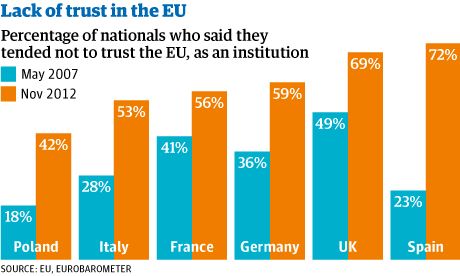
Source: Guardian Graphics
This may be because, Britain apart, most countries have historically sought salvation in the EU from their own failed political elites and systems. For the Germans the EU brought rehabilitation from the Nazi shame. For the French, Italians and others the EU brought recovery from the trauma of Nazi occupation and collaboration. For Spain, Portugal and Greece the EU secured democracy and helped banish military dictatorships. For the east Europeans, the EU provided an escape channel from the clutches of communism and Soviet control. The hope of securing respite in the EU from corrupt and discredited national elites still obtains in the Balkans and in Ukraine.
Britain here is the exception since fighting Hitler was its finest hour and because it has traditionally viewed Europe as a source of trouble rather than trust.
But those times may be over. "For many member states, the EU was a scaffolding. But now it's become a cage," said Brigid Laffan, director of the global governance programme at the European University Institute in Florence.
Sikorski said: "The EU had it easy for many years because we in central Europe were obsessed with rejoining Europe. We've reached the limits of that."
EU leaders continue to invoke history to bolster the argument for "more Europe". But in the age of austerity, of slashed budgets, of wrenching reforms, of mass unemployment, recession and stagnation, the arguments have less and less traction if the EU's leaders are not delivering.
"The problem is not the Eurosceptics," said Joschka Fischer, the former German foreign minister. "The problem is the mainstream parties. Completely irresponsible. What makes the Eurosceptics so strong? They're strong because they are managing the emotions and we are not. It's hard to counter their arguments."
The mainstream counter-arguments are essentially inaudible. Take immigration, a sensitive and emotive topic dominating an agenda set by Farage, Le Pen and Wilders.
On the centre left and the centre right, an immigration debate is being avoided, leaving the stage to those who shout loudest. Last October, when more than 300 refugees from north Africa drowned off the coast of Lampedusa in Italy, there was an outcry as an EU summit approached. Europe's national leaders opted to shelve the issue. Herman Van Rompuy, the European council president chairing the summit, scratched the topic from the agenda and arranged to have immigration up for debate at a summit at the end of next month. Why? Because, senior officials in Brussels said, EU leaders did not want to trigger arguments about immigration before the elections for fear of boosting the anti-immigrant campaigners.
For the centre right in Britain, Germany and elsewhere, the response to the immigration controversy has been to try to appease the far right's supporters by talking about curbs on freedom of movement, clampdowns on alleged benefits tourism, tighter border controls.
The centre right or Christian democrats have been the ascendant force in Europe in recent years and are predicted to win the elections very narrowly, but at the price of forfeiting around 60 seats, which would also make them the biggest losers.
The mainstream centre left or social democrats have been gaining over the past three years. They now run France, Italy and Denmark and are in coalition in Germany, Belgium and the Netherlands, and are tipped to win in Sweden in September. But in March, France's ruling Socialists collapsed in local elections while the Dutch Labour party fell to 10%, losing control of its traditional power bases in the seaboard cities of Rotterdam, Amsterdam, The Hague and Groningen.
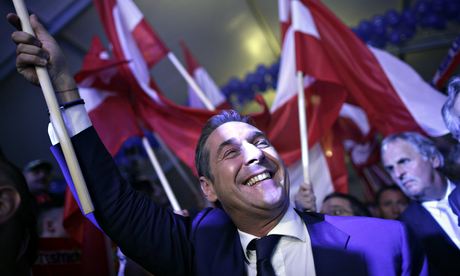
Heinz-Christian Strache, the leader of Austra's far-right Freedom party, which is anti-EU, anti-immigration, anti-Muslim. Photograph: Georg Hochmuth/EPA
The fragmentation that is part of the current European political fabric was graphically displayed and could not be ascribed to the Wilders insurgency. Some 30% cast their ballots for new local and regional campaigners, highlighting the failure of the mainstream to maintain its appeal.
The centre left has opted to keep generally quiet on immigration even though it may be the key to its central dilemma – how to secure welfare systems for its traditional constituencies in a time of low-growth austerity and neo-liberalism.
"The traditional parties have no real answers on immigration," said Ania Skrzypek, a Polish political scientist who helped draft the European social democrats' election programme. "For us, the main issue is about preserving the European social model. People feel the welfare state is not delivering. In western Europe many think the welfare systems are not sustainable. We just can't afford them. Migration is the answer. We have some answers, but we don't proclaim them."
There is very little evidence in the academic analysis suggesting that migration within the EU has done anything other than bolster the welfare and pension systems of the host countries, with migrants generally contributing more in taxes than they take out in benefits.
Rainer Muenz, a leading European demographer, argues that immigration is essential in a greying Europe, but that Europe's leaders have been asleep at the wheel.
The next generation will be 25% smaller than the current one, with huge holes opening up in an EU labour market of 240 million, just under half the population of 505 million. His research concludes that extending retirement ages by a decade will fail to plug the gap and that it is already too late to bring in the numbers of migrants needed in ways that would be politically acceptable.
"The options on the table are not attractive for politicians – more migrants, later retirement and unemployment. Plus, a majority of voters will be over 50," he said.
Laffan said: "Europe has a huge demographic challenge. It's hard to cope with it politically, but if you analyse it you have to concede that we need inward immigration. But too much is done behind a veil. There's a lot of masking of a big part of the system. That degrades European politics."
The "masking" extends above all to the handling of the euro emergency and the triumph of technocracy over democracy in four years of crisis management.
A senior Spanish politician points out how difficult it was to campaign for office and be taken seriously when budget, spending and fiscal policies were being decided elsewhere by a troika of anonymous men in suits from the European commission, the European Central Bank and the International Monetary Fund.
"The voters are not stupid. They know you cannot deliver on what you're telling them. They don't believe you. You lose legitimacy," he said.
Laffan said: "It's the politics of constrained choice. You need to tell the public that. But the leaders have been in denial. There's a lot of dissembling, politics by stealth. It drains politics of credibility."
That's a view commonly held among policy-makers and senior officials in Brussels. "Our government is not credible any more," said an ambassador in Brussels of one member state. "You have to tell people things they don't like. If you don't, you get a populist party. You need to let people benefit from the new Europe and it's not happening."
Another ambassador from a large member state said of the elections: "It will be a pretty large populist revolt against elites. There's a very real risk that the barbarians are at the gates and that the gates will be closed. The risk is of complacency."
In Karl Marx-Hof, Höppinger noted that he was born in Vienna the year that the Austro-fascists were shelling the housing complex he has lived in for decades. Their heirs, he said, were back.
"Strache does a lot of shouting, but he doesn't have any answers. But people are voting for him."
European elections: union left sullen by fury and frustration with political class
Special report: results certain to bring bonanza for tub-thumping mavericks and radicals on extreme right and far left of Europe
Ian Traynor in Vienna
The Guardian, Monday 19 May 2014 15.55 BST
http://www.theguardian.com/politics/2014/may/19/european-elections-fury-frustration-extreme-right-far-left-union
Germany's chancellor, Angela Merkel, and France's president, François Hollande. The 'twin-engine of Europe' seems have faltered. Photograph: Francois Nascimbeni/AFP/Getty Images
Josef Höppinger is an increasingly rare type among European voters. He never changes. "I'm a worker. I vote socialist. Always," said the retired plumber, 81. But he thinks the governing Social Democrats of Austria's chancellor, Werner Faymann, will suffer badly when Europe goes to the ballot box this week.
"You've got all these scandals with the banks, all the sleaze and corruption. The big parties will get weaker, not stronger."
Höppinger has lived all his life in the centre of "Red Vienna", a city for ever run by Social Democrats. His home is in Karl Marx-Hof, the expressionist workers' fortress that was Europe's pioneering experiment in social housing in the 1920s and then a battleground in the civil war of 1934, when the left lost to the pre-Hitler Austro-fascists.
The complex still houses 5,000 people in 1,400 flats. But it is no longer a vibrant, cohesive community guaranteed to vote for the left. Rather, it is a multi-ethnic mixture of immigrants and poor Viennese, many of them unemployed, making it a fertile hunting ground for the far-right Freedom party of Heinz-Christian Strache: anti-EU, anti-immigration, anti-Muslim.
"You have areas here that are 70% immigrant and 30% Austrian," said Rudolf, 61, declining to give his surname. "I've got nothing against immigrants, but it's a big problem in Vienna. Strache might not be electable, but he is very strong here. The old parties just don't seem to have the answers any more. They've been there for a very long time but now they are getting more competition. The Social Democrats will lose. Everything is in flux."
Not only in Vienna. As the EU braces itself for four days of polling to send 751 MEPs to Strasbourg and Brussels from 28 countries, the temper of the union is one of sullen anger and frustration with a mainstream political class seen as detached and remote, incompetent and venal, and often illegitimate.
The results are certain to bring a bonanza for tub-thumping mavericks and radicals on the extreme right and the far left, with the traditional parties of the centre right and centre left haemorrhaging support to the fringes. "We see the risks from these fringe groups being represented in the parliament," said Anthony Gardner, the US ambassador to the EU.
Simon Hix, European politics professor at the London School of Economics, said: "What's happening all across Europe is a decline of mainstream political parties, a fragmentation of the vote on the centre left and the centre right. The social democrats have lost the connection to lower-income voters by not producing jobs and squeezing public spending. There's a failure to generate jobs outside the big urban centres. The decline of manufacturing is replaced by service jobs in capital cities, doing nothing for the white underclass in Salford or Marseille. And the centre right [have] lost the rural conservatives because of their different metropolitan values and the perception they've been captured by big business."
The period between this week's vote and the last European election, in 2009, has been the EU's worst ever. The union's crowning achievement, the single currency, almost disappeared under the pressure of a banking and sovereign debt crisis that threatened to tear the EU apart.
Five countries – Greece, Cyprus, Spain, Portugal and Ireland – were brought to their knees. Big questions, still unanswered, were raised about France and Italy – the eurozone's second and third economies. German-prescribed austerity and spending cuts were administered on a grand scale. Hundreds of billions were poured into a rotten banking sector whose reckless lending policies did much to create the crisis in the first place. The tensions and resentments brought a resurgence of nationalism in Europe. Youth unemployment soared to more than 25%, to more than 50% in Spain and Greece.
If the currency has been saved, the political price has been very high. On the eve of the elections, the EU is staring at years of stagnation and relative decline, increasingly unable to compete globally, to sustain its social and welfare systems, to generate growth and jobs.
"Europe is in a mess. Our economies are failing to deliver higher living standards for most people, and many have lost faith in politicians' ability to deliver a brighter future, with support for extremists soaring," wrote Philippe Legrain, a former adviser to the head of the European commission and the author of a recent book on the crisis, last week. "After the longest and deepest recession since the 1930s, the recovery is the flimsiest on record. Much of Europe remains lumbered with broken banks and crushing debts. Most of Europe suffers from record low investment and feeble productivity growth. All of Europe is ageing fast. Depressingly, most Europeans think younger generations will have a worse life than they do."
And when things seemed irredeemably bleak, along came Russia's Vladimir Putin, invading and destabilising Ukraine, unilaterally redrawing the map of Europe on the EU's frontier, and challenging its leaders to stop him.
"If you listen to Putin, there's only contempt for Europe," said Radek Sikorski, the Polish foreign minister. "Europe has been living in a postmodern illusion, that everyone wants the same as we do, but just wants to get there at different speeds. That's just not true any more."
One of the EU's top diplomats sounds desperate: "We don't have a coherent strategic view and Putin is taking advantage of our shortcomings. What kind of European order do we want? If we cannot give straightforward answers as to what we want to do, you give everything to the populists."
In London, Vienna, Berlin, Paris, Brussels and The Hague, the term "populist" is the hold-your-nose form of abuse for the anti-European mavericks and radicals riding high in the polls, beneficiaries of the collapse of public confidence in Europe's political elites – figures such as Nigel Farage in Britain, Marine Le Pen in France, Geert Wilders in the Netherlands, Strache in Austria, all of whom are tipped either to win or come a close second in the elections in their respective countries.
"We talk about them but never with them," said Ivan Krastev, a liberal Bulgarian political scientist. "That will be different after these elections. You have a sclerotic political system and a resentment of elites. You have a democracy of mistrust."
Besides, European populism is far from a fringe phenomenon. The mainstream centre right, the dominant force in European politics for the past decade, has included Hungary's Viktor Orban, Italy's Silvio Berlusconi and France's Nicolas Sarkozy in recent years, all of them proud populists.
Hix argues that Europe's leaders are making a big mistake by ignoring the anti-European insurgents. They are not going away. The new parliament is likely to return three blocs of MEPs, around 150 in total, to the right of the mainstream conservatives. They veer from the Eurosceptical British and Polish conservatives to the outright Europe rejectionists of France's National Front, the Dutch Freedom party and Farage's Ukip.
Karl Marx Hof, the expressionist workers' fortress that was Europe's pioneering experiment in social housing in the 1920s. Photograph: Dave Penman/Rex Features
Then there is the often anti-EU hard left, which is likely to do well and supplant the Greens as the fourth biggest bloc in the new parliament. It will do creditably in Germany – where Die Linke is now the main opposition party to Angela Merkel's coalition of Christian and Social Democrats – in France, Spain, the Netherlands, Belgium, the Czech Republic, and most of all in Greece, where Europe's leftist firebrand, Alexis Tsipras, is tipped to win the election.
"It's good for the European parliament that these populists get elected. They represent the real views of Europeans," said Hix. "There is greater competition for low-skilled jobs. It's healthy and legitimate and the mainstream parties are forced to respond. But it's very difficult for the mainstream parties to get it."
The conclusion frequently drawn from the rise of the Europhobes is that the EU is in the grip of an anti-Brussels insurgency as the primacy of the nation states of Europe is reaffirmed. But that conclusion is belied by the opinion polls, which show that public confidence has eroded severely in traditional political elites wherever they are found in Europe.
A Eurobarometer survey unveiled on Monday found that trust in the EU had fallen steeply to 31% from 57% in 2007. But the same poll found that trust in national parliaments and governments was much lower, at 25% and 23%, and has been consistently lower than faith in the EU for all of the past decade.
Source: Guardian Graphics
This may be because, Britain apart, most countries have historically sought salvation in the EU from their own failed political elites and systems. For the Germans the EU brought rehabilitation from the Nazi shame. For the French, Italians and others the EU brought recovery from the trauma of Nazi occupation and collaboration. For Spain, Portugal and Greece the EU secured democracy and helped banish military dictatorships. For the east Europeans, the EU provided an escape channel from the clutches of communism and Soviet control. The hope of securing respite in the EU from corrupt and discredited national elites still obtains in the Balkans and in Ukraine.
Britain here is the exception since fighting Hitler was its finest hour and because it has traditionally viewed Europe as a source of trouble rather than trust.
But those times may be over. "For many member states, the EU was a scaffolding. But now it's become a cage," said Brigid Laffan, director of the global governance programme at the European University Institute in Florence.
Sikorski said: "The EU had it easy for many years because we in central Europe were obsessed with rejoining Europe. We've reached the limits of that."
EU leaders continue to invoke history to bolster the argument for "more Europe". But in the age of austerity, of slashed budgets, of wrenching reforms, of mass unemployment, recession and stagnation, the arguments have less and less traction if the EU's leaders are not delivering.
"The problem is not the Eurosceptics," said Joschka Fischer, the former German foreign minister. "The problem is the mainstream parties. Completely irresponsible. What makes the Eurosceptics so strong? They're strong because they are managing the emotions and we are not. It's hard to counter their arguments."
The mainstream counter-arguments are essentially inaudible. Take immigration, a sensitive and emotive topic dominating an agenda set by Farage, Le Pen and Wilders.
On the centre left and the centre right, an immigration debate is being avoided, leaving the stage to those who shout loudest. Last October, when more than 300 refugees from north Africa drowned off the coast of Lampedusa in Italy, there was an outcry as an EU summit approached. Europe's national leaders opted to shelve the issue. Herman Van Rompuy, the European council president chairing the summit, scratched the topic from the agenda and arranged to have immigration up for debate at a summit at the end of next month. Why? Because, senior officials in Brussels said, EU leaders did not want to trigger arguments about immigration before the elections for fear of boosting the anti-immigrant campaigners.
For the centre right in Britain, Germany and elsewhere, the response to the immigration controversy has been to try to appease the far right's supporters by talking about curbs on freedom of movement, clampdowns on alleged benefits tourism, tighter border controls.
The centre right or Christian democrats have been the ascendant force in Europe in recent years and are predicted to win the elections very narrowly, but at the price of forfeiting around 60 seats, which would also make them the biggest losers.
The mainstream centre left or social democrats have been gaining over the past three years. They now run France, Italy and Denmark and are in coalition in Germany, Belgium and the Netherlands, and are tipped to win in Sweden in September. But in March, France's ruling Socialists collapsed in local elections while the Dutch Labour party fell to 10%, losing control of its traditional power bases in the seaboard cities of Rotterdam, Amsterdam, The Hague and Groningen.
Heinz-Christian Strache, the leader of Austra's far-right Freedom party, which is anti-EU, anti-immigration, anti-Muslim. Photograph: Georg Hochmuth/EPA
The fragmentation that is part of the current European political fabric was graphically displayed and could not be ascribed to the Wilders insurgency. Some 30% cast their ballots for new local and regional campaigners, highlighting the failure of the mainstream to maintain its appeal.
The centre left has opted to keep generally quiet on immigration even though it may be the key to its central dilemma – how to secure welfare systems for its traditional constituencies in a time of low-growth austerity and neo-liberalism.
"The traditional parties have no real answers on immigration," said Ania Skrzypek, a Polish political scientist who helped draft the European social democrats' election programme. "For us, the main issue is about preserving the European social model. People feel the welfare state is not delivering. In western Europe many think the welfare systems are not sustainable. We just can't afford them. Migration is the answer. We have some answers, but we don't proclaim them."
There is very little evidence in the academic analysis suggesting that migration within the EU has done anything other than bolster the welfare and pension systems of the host countries, with migrants generally contributing more in taxes than they take out in benefits.
Rainer Muenz, a leading European demographer, argues that immigration is essential in a greying Europe, but that Europe's leaders have been asleep at the wheel.
The next generation will be 25% smaller than the current one, with huge holes opening up in an EU labour market of 240 million, just under half the population of 505 million. His research concludes that extending retirement ages by a decade will fail to plug the gap and that it is already too late to bring in the numbers of migrants needed in ways that would be politically acceptable.
"The options on the table are not attractive for politicians – more migrants, later retirement and unemployment. Plus, a majority of voters will be over 50," he said.
Laffan said: "Europe has a huge demographic challenge. It's hard to cope with it politically, but if you analyse it you have to concede that we need inward immigration. But too much is done behind a veil. There's a lot of masking of a big part of the system. That degrades European politics."
The "masking" extends above all to the handling of the euro emergency and the triumph of technocracy over democracy in four years of crisis management.
A senior Spanish politician points out how difficult it was to campaign for office and be taken seriously when budget, spending and fiscal policies were being decided elsewhere by a troika of anonymous men in suits from the European commission, the European Central Bank and the International Monetary Fund.
"The voters are not stupid. They know you cannot deliver on what you're telling them. They don't believe you. You lose legitimacy," he said.
Laffan said: "It's the politics of constrained choice. You need to tell the public that. But the leaders have been in denial. There's a lot of dissembling, politics by stealth. It drains politics of credibility."
That's a view commonly held among policy-makers and senior officials in Brussels. "Our government is not credible any more," said an ambassador in Brussels of one member state. "You have to tell people things they don't like. If you don't, you get a populist party. You need to let people benefit from the new Europe and it's not happening."
Another ambassador from a large member state said of the elections: "It will be a pretty large populist revolt against elites. There's a very real risk that the barbarians are at the gates and that the gates will be closed. The risk is of complacency."
In Karl Marx-Hof, Höppinger noted that he was born in Vienna the year that the Austro-fascists were shelling the housing complex he has lived in for decades. Their heirs, he said, were back.
"Strache does a lot of shouting, but he doesn't have any answers. But people are voting for him."
goldfinger
- 20 May 2014 01:15
- 40946 of 81564
Millions face becoming ‘mortgage prisoners’ as rise in interest rates could trap to 2.3m homeowners
ANDREW GRICE Author Biography POLITICAL EDITOR Tuesday 20 May 2014
About 2.3 million householders could become “mortgage prisoners” who struggle to afford their repayments when interest rates rise, according to a report published today.
Ads by Google
In the first detailed study of the likely impact of rate rises, the Resolution Foundation think tank predicted that 770,000 households - one in 10 of those with mortgages - will be most at risk. They will be unable to switch to better deals to protect themselves against rate rises or will find that their monthly repayments soak up at least one third of their disposable income by 2018.
Although the Bank of England last week played down the prospect of an early increase in interest rates, City analysts expect them to start rising from April next year. Some Conservatives are nervous about the political impact of a rise before next May’s general election., Mark Carney, the Bank’s Governor, who said at the weekend that it might intervene to stop the housing market overheating, added: “We don’t want to build up another big debt overhang that is going to hurt individuals and is very much going to slow the economy in the medium term.”
The independent think tank raised the alarm about the most vulnerable 770,000 households already with mortgages, saying they were “doubly exposed”. Typically, they might have very low equity in their home (less than five per cent), might be self-employed or have an interest-only mortgage, making them less attractive to lenders. Secondly, it would take only a relatively modest rise in rates by 2018 for a third of their income to be eaten up by mortgage repayments.
Today’s report, “Mortgaged Future”, cast doubt on the so-called “golden age” for home-buyers while interest rates have remained at a record low 0.5 per cent for five years. Although a household with a £75,000 tracker mortgage has saved £12,400 since 2008, many people have missed out. Wages rose by less than inflation and some householders failed to get the full reduction in rates because they were on fixed-rate deals or because their lender did not pass on all the benefit. So the proportion of people struggling to pay their mortgage fell only slightly during this period and still stands at 1.1 million today, the foundation said.
That figure could more than double to 2.3 million households – almost one in four of the 8.4 million with mortgages - by 2018 if interest rates rise to three per cent as financial markets expect. The report said the total number at risk of becoming “mortgage prisoners” could be as high as 3.5million, but some of these will be able to negotiate new terms with their lender. However, those with low equity or interest-only mortgages will find it difficult to access new deals, the foundation feared, especially as tighter lending conditions have just been imposed following the financial crisis.
Matthew Whittaker, the Foundation’s chief economist and the report’s author, said: “Many borrowers have enjoyed spectacular savings over recent years, with mortgage rates falling to historic lows, and most will be able to ride the tide of gradually rising interest rates. But for around one in four, even modest rate rises could create financial difficulties. Those at greatest risk are members of this group who also find themselves unable to access the best deals in the market today. Almost one in 10 households are doubly exposed: facing the prospect of their mortgage becoming increasingly unaffordable in the future and with the market offering them limited, if any, choice today.”
He added: “There is still a window of opportunity to think creatively about the best way of reducing the risk to this vulnerable group while we still have ultra-low interest rates. But that era is coming to an end relatively soon and the legacy of easy credit and the associated debt-overhang will have to be reckoned with. Financial institutions and policy-makers must consider now how best to minimise the scale of the adjustment problems these families face when interest rates start to return to normal.”
According to the foundation, the current “affordability problem” is greatest among the lowest-income households. Some 25 per cent of those already spending more than a third of their income on mortgage repayments are in the bottom tenth of the income ladder.
As interest rates rise, the problem is set to spread up the income scale. By 2018, only 15 per cent of those spending a third of their income on mortgage repayments are expected to be in the lowest tenth of the income distribution.
London and the East of England are most exposed to risk. Some 35 per cent of mortgagors in these regions will spend a third of their income on repayments by 2018, compared to only 18 per cent in Scotland and 19 per cent in Yorkshire and the Humber and 22 per cent in Wales.
Northern Ireland and London are the parts of the UK where borrowers are most likely to be in the most vulnerable group – with 16 per cent and 13 per cent of mortgagors respectively projected to be both spending a third of their income in 2018 and at risk of being “mortgage prisoners” today. Northern Ireland is the region where low equity is most common – 35 per cent of mortgagors have less than five per cent equity in their home, compared to just two per cent in London.
ANDREW GRICE Author Biography POLITICAL EDITOR Tuesday 20 May 2014
About 2.3 million householders could become “mortgage prisoners” who struggle to afford their repayments when interest rates rise, according to a report published today.
Ads by Google
In the first detailed study of the likely impact of rate rises, the Resolution Foundation think tank predicted that 770,000 households - one in 10 of those with mortgages - will be most at risk. They will be unable to switch to better deals to protect themselves against rate rises or will find that their monthly repayments soak up at least one third of their disposable income by 2018.
Although the Bank of England last week played down the prospect of an early increase in interest rates, City analysts expect them to start rising from April next year. Some Conservatives are nervous about the political impact of a rise before next May’s general election., Mark Carney, the Bank’s Governor, who said at the weekend that it might intervene to stop the housing market overheating, added: “We don’t want to build up another big debt overhang that is going to hurt individuals and is very much going to slow the economy in the medium term.”
The independent think tank raised the alarm about the most vulnerable 770,000 households already with mortgages, saying they were “doubly exposed”. Typically, they might have very low equity in their home (less than five per cent), might be self-employed or have an interest-only mortgage, making them less attractive to lenders. Secondly, it would take only a relatively modest rise in rates by 2018 for a third of their income to be eaten up by mortgage repayments.
Today’s report, “Mortgaged Future”, cast doubt on the so-called “golden age” for home-buyers while interest rates have remained at a record low 0.5 per cent for five years. Although a household with a £75,000 tracker mortgage has saved £12,400 since 2008, many people have missed out. Wages rose by less than inflation and some householders failed to get the full reduction in rates because they were on fixed-rate deals or because their lender did not pass on all the benefit. So the proportion of people struggling to pay their mortgage fell only slightly during this period and still stands at 1.1 million today, the foundation said.
That figure could more than double to 2.3 million households – almost one in four of the 8.4 million with mortgages - by 2018 if interest rates rise to three per cent as financial markets expect. The report said the total number at risk of becoming “mortgage prisoners” could be as high as 3.5million, but some of these will be able to negotiate new terms with their lender. However, those with low equity or interest-only mortgages will find it difficult to access new deals, the foundation feared, especially as tighter lending conditions have just been imposed following the financial crisis.
Matthew Whittaker, the Foundation’s chief economist and the report’s author, said: “Many borrowers have enjoyed spectacular savings over recent years, with mortgage rates falling to historic lows, and most will be able to ride the tide of gradually rising interest rates. But for around one in four, even modest rate rises could create financial difficulties. Those at greatest risk are members of this group who also find themselves unable to access the best deals in the market today. Almost one in 10 households are doubly exposed: facing the prospect of their mortgage becoming increasingly unaffordable in the future and with the market offering them limited, if any, choice today.”
He added: “There is still a window of opportunity to think creatively about the best way of reducing the risk to this vulnerable group while we still have ultra-low interest rates. But that era is coming to an end relatively soon and the legacy of easy credit and the associated debt-overhang will have to be reckoned with. Financial institutions and policy-makers must consider now how best to minimise the scale of the adjustment problems these families face when interest rates start to return to normal.”
According to the foundation, the current “affordability problem” is greatest among the lowest-income households. Some 25 per cent of those already spending more than a third of their income on mortgage repayments are in the bottom tenth of the income ladder.
As interest rates rise, the problem is set to spread up the income scale. By 2018, only 15 per cent of those spending a third of their income on mortgage repayments are expected to be in the lowest tenth of the income distribution.
London and the East of England are most exposed to risk. Some 35 per cent of mortgagors in these regions will spend a third of their income on repayments by 2018, compared to only 18 per cent in Scotland and 19 per cent in Yorkshire and the Humber and 22 per cent in Wales.
Northern Ireland and London are the parts of the UK where borrowers are most likely to be in the most vulnerable group – with 16 per cent and 13 per cent of mortgagors respectively projected to be both spending a third of their income in 2018 and at risk of being “mortgage prisoners” today. Northern Ireland is the region where low equity is most common – 35 per cent of mortgagors have less than five per cent equity in their home, compared to just two per cent in London.
Haystack
- 20 May 2014 08:31
- 40947 of 81564
Usual rubbish
aldwickk
- 20 May 2014 08:31
- 40948 of 81564
Lot of copy & paste this morning
goldfinger
- 20 May 2014 09:08
- 40949 of 81564
Hays your running scared.
Haystack
- 20 May 2014 09:18
- 40950 of 81564
gf
You are desperate to find some bad news.
You are desperate to find some bad news.
MaxK - 20 May 2014 09:31 - 40951 of 81564

cynic
- 20 May 2014 09:38
- 40952 of 81564
monthly repayments soak up at least one third of their disposable income by 2018.
what's wrong with that?
memory tells me that that is about what would expect
what's wrong with that?
memory tells me that that is about what would expect
MaxK - 20 May 2014 09:40 - 40953 of 81564
Problem is c, they don't have any disposable income.
cynic
- 20 May 2014 09:47
- 40954 of 81564
chuckle chuckle
never mind; i'm sure you and i (the taxpayer) will bail them out with housing benefits
really couldn't be bothered to read all that junk, but the above phrase caught my eye as i quickly skimmed down
at what level are mortgage rates generally now?
i think the historic norm is around 5%, though there have certainly been times when a certain party created terrifying inflation in mid/late 70s when they were around 10/12%
never mind; i'm sure you and i (the taxpayer) will bail them out with housing benefits
really couldn't be bothered to read all that junk, but the above phrase caught my eye as i quickly skimmed down
at what level are mortgage rates generally now?
i think the historic norm is around 5%, though there have certainly been times when a certain party created terrifying inflation in mid/late 70s when they were around 10/12%
Haystack
- 20 May 2014 10:44
- 40955 of 81564
It was the late 80s. Peak was 89 when BoE rate was 14.87% and some mortgages were almost 20%. I bought a property in 89 and was in negative equity for years. In the end it went up four times in price before I sold it.
| About MoneyAM | Ts and Cs | Privacy Policy | Investment Warning | Content Standards | Corporate Solutions | Advertise With Us | Site Map | © 2026 MoneyAM |
Register now for FREE
Share Prices,
Stock Quotes,
Charts, Bulletin Boards, Indices, Watchlists, Portfolio, Market News, Research
or see our Premium Services including Level 2, Terminal and much more.
 Follow us on Twitter