

| Home | Log In | Register | Our Services | My Account | Contact | Help |
You are NOT currently logged in
Register now or login to post to this thread.
THE TALK TO YOURSELF THREAD. (NOWT)
goldfinger

 - 09 Jun 2005 12:25


Thought Id start this one going because its rather dead on this board at the moment and I suppose all my usual muckers are either at the Stella tennis event watching Dim Tim (lose again) or at Henly Regatta eating cucumber sandwiches (they wish,...NOT).
Anyway please feel free to just talk to yourself blast away and let it go on any company or subject you wish. Just wish Id thought of this one before.
cheers GF.
Anyway please feel free to just talk to yourself blast away and let it go on any company or subject you wish. Just wish Id thought of this one before.
cheers GF.
ExecLine
 - 25 Jul 2014 11:15
- 44299 of 81564
- 25 Jul 2014 11:15
- 44299 of 81564

Betfair says 1/7 that Scotland will say 'No' to independence.
Is it a good bet?
Is it a good bet?
2517GEORGE
- 25 Jul 2014 11:18
- 44300 of 81564
''Admitedly its their own fault for wanting everything new and modern'' gf you forgot to add 'rightaway'-------and there lies the crux of the matter gf.
2517
2517
jimmy b
- 25 Jul 2014 11:19
- 44301 of 81564
Lol GF .
jimmy b
- 25 Jul 2014 11:21
- 44302 of 81564

Mind you ?
Haystack
- 25 Jul 2014 11:33
- 44303 of 81564

hilary
- 25 Jul 2014 11:42
- 44304 of 81564
I was thinking of ringing my manager at Coutts and asking for a menu.
ExecLine
- 25 Jul 2014 11:45
- 44305 of 81564
Remember when 'Scripophilist' (Peter Webb) used to run our lottery syndicate?
I found the following article. It's bit out of date, but interesting nevertheless:
From: http://www.channelregister.co.uk/2010/12/06/channel_man_turns_over_quarter_billion_on_betfair/
Robert Blincoe 6th December 2010 12:23
How I went from punting PCs to betting a quarter billion on Betfair
But failed to convince Warren Buffett...
Interview
Former channel man Peter Webb has become one of Betfair's leading customers and bets a quarter of a billion pounds annually on horseracing alone. He also sloshes a good amount on the X Factor market.
The ex Compaq and Medion man finally left the UK's computer distribution channel in 2003 to make a full time go of trading on the betting exchange. He says: “I doubt there's many people earning more than me on Betfair – it's substantial by any terms.”
Webb trades the exchange the way a City trader plays the financial markets. He puts around £20,000 into individual horse races (where even a snowy weekday race at Wolverhampton can attract more than £500,000 on the exchange). As there can be four race meetings in a day and seven races at each of them, it is easy to see how his turnover gets so high.
Here' how it works. Webb will back Dobbin to win (say at 5.0, which is the same as 4 to 1). If, then, the odds to back Dobbin not to win (this is called laying) fall below the back price (say 4.0, or 3 to 1) and Webb makes this bet then he has made a profit no matter what happens in the race.
The exchange keeps track of his net position so he's free to re-bet his capital immediately. If Dobbin's lay price goes up, he's stuffed. Webb makes lots of trade in this manner, on several horses, before a race starts. The odds movements don't tend to be as extreme as this example.
When there's racing in the UK, Australia and the US he'll be up at 2am working the Australian market. The UK business is usually between 2pm and 5pm, and then the US comes online at 9pm until 1pm.
Webb starts trading 10 minutes before a race starts and closes all his bets 10 seconds before the off. “Most of the money arrives five minutes before it starts,” he says. When the race starts, he no longer has any financial interest in its result, he's off to trading the next race.
“When I looked at Betfair all I could see was opportunity,” he says. “I dabbled around on several markets, and with several strategies. Horse racing stood out because of the amount of money that went through it, so I started to work really hard at understanding it.”
Webb's approach has nothing to do with knowing form or horse bloodlines. “My lack of knowledge has really helped. I'm looking at the price of a horse and estimate where the price will go. My role in the market is as an arbiter of value and whatever I do I do before the race starts – I don't believe I'm better at predicting the form than anyone else.”
This sort of thinking might be familiar to anyone who's made money not from taking a view on the absolute merits of a given technology or piece or kit - but rather on how prices are likely to move over time.
Webb will also bet major football matches, where he can put £50,000 to £70,000 through the market, and where the price changes aren't as rapid. There are also 100 dog races a day which he can trade. “Football, horse-racing and tennis are the big three markets. I've also been providing a lot of the liquidity for X Factor - people would be horrified about how much of that market was me.
These opportunities pop out of the woodwork at all times. I think the exchange is beautiful – I look at it and it speaks to me,” he says.
Webb opened an account with Betfair seven days after it first went live in 2000. He heard about it while knocking around the First Tuesday meetings of the original and glorious dotcom boom.
He deposited £1,000 and his first-ever bet (position) was placed with £5. He says he's never had to put more money in, and currently has £250,000 in his account. He doesn't need more because unlike the financial markets, Betfair settles trades immediately. A relatively small sum placed in a market can be leveraged very quickly, by closing its position then rebetting it.
Webb's last proper job was launching the Medion PC brand into the UK and managing accounts selling it such as DSG and Aldi. He builds his own PCs (and uses six monitors to trade), and upgrades them every six months. However, he says Medion is good value and he'd buy them now. “Sometimes you work for companies and think 'I wouldn't touch that',” he recalls.
He started in the distribution business straight from school working for Portsmouth distributor Softly Softly. He worked at Compaq, account managing its retail division, and had an office round the corner from legendary UK boss Joe 'Meat Packer' McNally. “I have worked with most if not all the top manufacturers of consumer technology products and their respective channel partners,” he says. “Dixons, Tesco, Wallmart, Aldi, Toys R Us, Sony, Panasonic, Samsung, Hewlett Packard, Intel, Microsoft.” He's also worked with Tech Data and Netcom Internet.
Webb won't say how much profit he makes on his Betfair trading, but stresses that each trade is only netting tenths of a per cent profit, and the line between making money and losing it is very fine. But he himself suggests £40,000 a month wouldn't be unreasonable for some top Betfair traders. Another reason to be cagey around money is that gambling profits aren't taxable in the UK – but profits from trading activity can be.
Webb is also behind a Betfair trading product called BetAngel and says he doesn't want anyone thinking that using this is route to getting rich quick. “You have to work at it,” he says.
BetAngel acts as a Bloomberg-type information screen for the betting exchange with a touch of the eBay sniping technology, says Webb. “It's a trading tool and allows you to place orders quickly. We borrowed ideas and technology from financial markets, and it allows 'fill kill', stop losses, and charting.”
Webb funds its development through subscriptions. He also runs courses in Betfair trading, which engenders the classic get-rich-quick suspicion of "Why tell anyone else, if you're making so much money?", he says.
Webb says he just enjoys meeting people and talking about his business. “I'm a social person and trading is a lonely business. When I first started doing courses, they came off the back of the software. I didn't think trading would last very long – I thought I had three or four years in it – so software and training was a bit of an insurance policy.”
Gambling and the gaming business is afforded quite a low status by many people (Reg readers among them), and at the heart of Webb talking up his business is that he wants his performance to be recognised.
“Having worked so hard and so long on this, I just want some legitimacy added to it,” he says. “Spread betting is considered normal and what we do here is exactly the same. Rather than the price of oil to go from here to there, we're looking on the price of Yojimbo [a horse racing on the day of the interview] to go from here to there."
In 2006, Webb did some financial shows with Betfair. The betting exchange's name wasn't proving a draw and Webb says he only got any attention when he started putting up financial-style market charts and explaining how he would trade the position. “The next slide would say the 14.10pm at Wolverhampton,” he says.
“I consistently get people saying what I do is not possible. I've been doing it for 10 years and still get that.”
Webb is also a financial investor and a big fan and shareholder of billionaire Warren Buffett's Berkshire Hathaway business (a single share of which is currently priced at $120,000). The backbone of Buffett's business is insurance. At one shareholder get-together, Webb asked Buffett how he reconciled his anti-gambling views with his risk-related business.
“When I look at the insurance industry I see an industry based on probabilities and people not knowing those true probabilities. Money is being made for the house in the same way I see it being made in the gambling industry,” said Webb.
“Gambling involves creating risk that doesn't need to be created,” replied Buffett. “If you want to go out and gamble on a where little ball is going to fall on a wheel that's revolving, that's a created risk. You can watch a football game without betting on it, but you can't live in a house on the Florida coast without having a risk that your entire investment can disappear. But I hope that you're right and that the house wins in both cases.”
Webb does have his battles with the Betfair house and thinks he should be treated better by them than he is. He doesn't have an account manager, which he thinks strange, and the business has introduced premium charges for customers placing or editing more than 1,000 bets an hour, or making large numbers of data requests within the same second. Which is exactly what he does.
“Betfair's argument is that people like me, who make money consistently, should help fund acquisition of new customers,” says Webb. “But I'll put through millions a week, all at my own risk.”
The newly floated business has changed a lot since he first joined. “It's much more like a traditional bookmakers now. The Utopian dream has faded,” he says wistfully. A bit like the channel perhaps?®
I found the following article. It's bit out of date, but interesting nevertheless:
From: http://www.channelregister.co.uk/2010/12/06/channel_man_turns_over_quarter_billion_on_betfair/
Robert Blincoe 6th December 2010 12:23
How I went from punting PCs to betting a quarter billion on Betfair
But failed to convince Warren Buffett...
Interview
Former channel man Peter Webb has become one of Betfair's leading customers and bets a quarter of a billion pounds annually on horseracing alone. He also sloshes a good amount on the X Factor market.
The ex Compaq and Medion man finally left the UK's computer distribution channel in 2003 to make a full time go of trading on the betting exchange. He says: “I doubt there's many people earning more than me on Betfair – it's substantial by any terms.”
Webb trades the exchange the way a City trader plays the financial markets. He puts around £20,000 into individual horse races (where even a snowy weekday race at Wolverhampton can attract more than £500,000 on the exchange). As there can be four race meetings in a day and seven races at each of them, it is easy to see how his turnover gets so high.
Here' how it works. Webb will back Dobbin to win (say at 5.0, which is the same as 4 to 1). If, then, the odds to back Dobbin not to win (this is called laying) fall below the back price (say 4.0, or 3 to 1) and Webb makes this bet then he has made a profit no matter what happens in the race.
The exchange keeps track of his net position so he's free to re-bet his capital immediately. If Dobbin's lay price goes up, he's stuffed. Webb makes lots of trade in this manner, on several horses, before a race starts. The odds movements don't tend to be as extreme as this example.
When there's racing in the UK, Australia and the US he'll be up at 2am working the Australian market. The UK business is usually between 2pm and 5pm, and then the US comes online at 9pm until 1pm.
Webb starts trading 10 minutes before a race starts and closes all his bets 10 seconds before the off. “Most of the money arrives five minutes before it starts,” he says. When the race starts, he no longer has any financial interest in its result, he's off to trading the next race.
“When I looked at Betfair all I could see was opportunity,” he says. “I dabbled around on several markets, and with several strategies. Horse racing stood out because of the amount of money that went through it, so I started to work really hard at understanding it.”
Webb's approach has nothing to do with knowing form or horse bloodlines. “My lack of knowledge has really helped. I'm looking at the price of a horse and estimate where the price will go. My role in the market is as an arbiter of value and whatever I do I do before the race starts – I don't believe I'm better at predicting the form than anyone else.”
This sort of thinking might be familiar to anyone who's made money not from taking a view on the absolute merits of a given technology or piece or kit - but rather on how prices are likely to move over time.
Webb will also bet major football matches, where he can put £50,000 to £70,000 through the market, and where the price changes aren't as rapid. There are also 100 dog races a day which he can trade. “Football, horse-racing and tennis are the big three markets. I've also been providing a lot of the liquidity for X Factor - people would be horrified about how much of that market was me.
These opportunities pop out of the woodwork at all times. I think the exchange is beautiful – I look at it and it speaks to me,” he says.
Webb opened an account with Betfair seven days after it first went live in 2000. He heard about it while knocking around the First Tuesday meetings of the original and glorious dotcom boom.
He deposited £1,000 and his first-ever bet (position) was placed with £5. He says he's never had to put more money in, and currently has £250,000 in his account. He doesn't need more because unlike the financial markets, Betfair settles trades immediately. A relatively small sum placed in a market can be leveraged very quickly, by closing its position then rebetting it.
Webb's last proper job was launching the Medion PC brand into the UK and managing accounts selling it such as DSG and Aldi. He builds his own PCs (and uses six monitors to trade), and upgrades them every six months. However, he says Medion is good value and he'd buy them now. “Sometimes you work for companies and think 'I wouldn't touch that',” he recalls.
He started in the distribution business straight from school working for Portsmouth distributor Softly Softly. He worked at Compaq, account managing its retail division, and had an office round the corner from legendary UK boss Joe 'Meat Packer' McNally. “I have worked with most if not all the top manufacturers of consumer technology products and their respective channel partners,” he says. “Dixons, Tesco, Wallmart, Aldi, Toys R Us, Sony, Panasonic, Samsung, Hewlett Packard, Intel, Microsoft.” He's also worked with Tech Data and Netcom Internet.
Webb won't say how much profit he makes on his Betfair trading, but stresses that each trade is only netting tenths of a per cent profit, and the line between making money and losing it is very fine. But he himself suggests £40,000 a month wouldn't be unreasonable for some top Betfair traders. Another reason to be cagey around money is that gambling profits aren't taxable in the UK – but profits from trading activity can be.
Webb is also behind a Betfair trading product called BetAngel and says he doesn't want anyone thinking that using this is route to getting rich quick. “You have to work at it,” he says.
BetAngel acts as a Bloomberg-type information screen for the betting exchange with a touch of the eBay sniping technology, says Webb. “It's a trading tool and allows you to place orders quickly. We borrowed ideas and technology from financial markets, and it allows 'fill kill', stop losses, and charting.”
Webb funds its development through subscriptions. He also runs courses in Betfair trading, which engenders the classic get-rich-quick suspicion of "Why tell anyone else, if you're making so much money?", he says.
Webb says he just enjoys meeting people and talking about his business. “I'm a social person and trading is a lonely business. When I first started doing courses, they came off the back of the software. I didn't think trading would last very long – I thought I had three or four years in it – so software and training was a bit of an insurance policy.”
Gambling and the gaming business is afforded quite a low status by many people (Reg readers among them), and at the heart of Webb talking up his business is that he wants his performance to be recognised.
“Having worked so hard and so long on this, I just want some legitimacy added to it,” he says. “Spread betting is considered normal and what we do here is exactly the same. Rather than the price of oil to go from here to there, we're looking on the price of Yojimbo [a horse racing on the day of the interview] to go from here to there."
In 2006, Webb did some financial shows with Betfair. The betting exchange's name wasn't proving a draw and Webb says he only got any attention when he started putting up financial-style market charts and explaining how he would trade the position. “The next slide would say the 14.10pm at Wolverhampton,” he says.
“I consistently get people saying what I do is not possible. I've been doing it for 10 years and still get that.”
Webb is also a financial investor and a big fan and shareholder of billionaire Warren Buffett's Berkshire Hathaway business (a single share of which is currently priced at $120,000). The backbone of Buffett's business is insurance. At one shareholder get-together, Webb asked Buffett how he reconciled his anti-gambling views with his risk-related business.
“When I look at the insurance industry I see an industry based on probabilities and people not knowing those true probabilities. Money is being made for the house in the same way I see it being made in the gambling industry,” said Webb.
“Gambling involves creating risk that doesn't need to be created,” replied Buffett. “If you want to go out and gamble on a where little ball is going to fall on a wheel that's revolving, that's a created risk. You can watch a football game without betting on it, but you can't live in a house on the Florida coast without having a risk that your entire investment can disappear. But I hope that you're right and that the house wins in both cases.”
Webb does have his battles with the Betfair house and thinks he should be treated better by them than he is. He doesn't have an account manager, which he thinks strange, and the business has introduced premium charges for customers placing or editing more than 1,000 bets an hour, or making large numbers of data requests within the same second. Which is exactly what he does.
“Betfair's argument is that people like me, who make money consistently, should help fund acquisition of new customers,” says Webb. “But I'll put through millions a week, all at my own risk.”
The newly floated business has changed a lot since he first joined. “It's much more like a traditional bookmakers now. The Utopian dream has faded,” he says wistfully. A bit like the channel perhaps?®
MaxK - 25 Jul 2014 13:01 - 44306 of 81564
Google pays just £20m on £3.3bn UK revenue: Fresh outrage over internet giant's tiny bill to the Government
California-based search provider routes UK sales through low-tax Ireland
The tax rate there is just 12.5 per cent, compared with 21 per cent in Britain
Google then slashes the bill even more by siphoning money to Bermuda
By Rob Davies
Published: 23:22, 24 July 2014 | Updated: 02:56, 25 July 2014
Google is facing fresh outrage over its meagre contribution to the UK taxman, after revealing it paid just £20million in corporation tax last year.
The California-based internet giant has faced stinging criticism for using a complex corporate structure that allows it to route UK sales through Ireland to slash its tax bill.
And the scheme appears to have again paid off.
Last night it revealed in accounts filed to Companies House that it paid £20.4million in taxes last year – despite admitting earlier this year that it pulls in £3.3billion of revenues in Britain, largely from advertising.
But in accounts filed last night Google UK said it made a profit of £70.8million before tax on sales of £642million
These numbers are artificially low because Google officially registers much of its British sales in Ireland, where the headline rate of corporation tax is 12.5 per cent compared with 21 per cent in the UK.
And the internet behemoth is then able to slash its bill even further by siphoning cash out of Ireland by paying royalties to another firm based in the tax haven of Bermuda.
More highway robbery here: http://www.dailymail.co.uk/news/article-2704927/Google-pays-just-20m-3-3bn-UK-revenue-Fresh-outrage-internet-giant-s-tiny-bill-Government.html
California-based search provider routes UK sales through low-tax Ireland
The tax rate there is just 12.5 per cent, compared with 21 per cent in Britain
Google then slashes the bill even more by siphoning money to Bermuda
By Rob Davies
Published: 23:22, 24 July 2014 | Updated: 02:56, 25 July 2014
Google is facing fresh outrage over its meagre contribution to the UK taxman, after revealing it paid just £20million in corporation tax last year.
The California-based internet giant has faced stinging criticism for using a complex corporate structure that allows it to route UK sales through Ireland to slash its tax bill.
And the scheme appears to have again paid off.
Last night it revealed in accounts filed to Companies House that it paid £20.4million in taxes last year – despite admitting earlier this year that it pulls in £3.3billion of revenues in Britain, largely from advertising.
But in accounts filed last night Google UK said it made a profit of £70.8million before tax on sales of £642million
These numbers are artificially low because Google officially registers much of its British sales in Ireland, where the headline rate of corporation tax is 12.5 per cent compared with 21 per cent in the UK.
And the internet behemoth is then able to slash its bill even further by siphoning cash out of Ireland by paying royalties to another firm based in the tax haven of Bermuda.
More highway robbery here: http://www.dailymail.co.uk/news/article-2704927/Google-pays-just-20m-3-3bn-UK-revenue-Fresh-outrage-internet-giant-s-tiny-bill-Government.html
Haystack
- 25 Jul 2014 13:27
- 44307 of 81564
Try making the same charges against Ford, General Motors, Coca Cola, Pepsi, Nissan, Nestle, BMW, Audi, Carlsberg and every foreign company that does business in UK. Those companies have been doing it for longer than any of us have been alive.
goldfinger
- 25 Jul 2014 13:56
- 44308 of 81564
Do YOU feel as prosperous as you were before the crisis?
25 Friday Jul 2014
Posted by Mike Sivier in Austerity
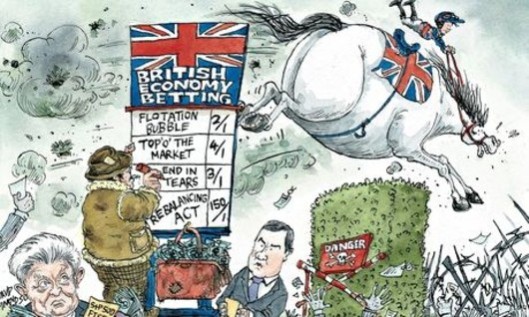
Britain has returned to prosperity, with the economy finally nudging beyond its pre-crisis peak, according to official figures.
Well, that’s a relief, isn’t it? Next time you’re in the supermarket looking for bargains or mark-downs because you can’t afford the kind of groceries you had in 2008, you can at least console yourself that we’re all doing better than we were back then.
The hundreds of thousands of poor souls who have to scrape by on handouts from food banks will, no doubt, be bolstered by the knowledge that Britain is back on its feet.
And the relatives of those who did not survive Iain Duncan Smith’s brutal purge of benefit claimants can be comforted by the thought that they did not die in vain.
Right?
NO! Of course not! Gross domestic product might be up 3.1 per cent on last year but it’s got nothing to do with most of the population! In real terms, you’re £1,600 per year worse-off!
The Conservatives who have been running the economy since 2010 have re-balanced it, just as they said they would – but they lied about the way it would be re-balanced and as a result the money is going to the people who least deserve it; the super-rich and the bankers who caused the crash in the first place.
You can be sure that the mainstream media won’t be telling you that, though.
Even some of the figures they are prepare to use are enough to cast doubt on the whole process. The UK economy is forecast to be the fastest-growing among the G7 developed nations according to the IMF (as reported by the BBC) – but our export growth since 2010 puts us below all but one of the other G7 nations, according to Ed Balls in The Guardian.
And it is exports that should be fuelling the economy, according to JML chairman John Mills in the Huffington Post. He reckons the government needs to invest in manufacturing and achieve competitive exchange rates in order to improve our export ability.
“Since most international trade is in goods and not in services, once the proportion of the economy devoted to producing internationally tradable goods drops below about 15 per cent, it becomes more and more difficult to combine a reasonable rate of growth and full employment with a sustainable balance of payments position,” he writes.
“In the UK, the proportion of GDP coming from manufacturing is now barely above 10 per cent. Hardly surprising then that we have not had a foreign trade surplus balance since 1982 – over thirty years ago – while our share of world trade which was 10.7 per cent in 1950 had fallen by 2012 to no more than 2.6 per cent.”
All of this seems to be good business sense. It also runs contrary to successive governments’ economic policies for the past 35 years, ever since the neoliberal government of Margaret Thatcher took over in 1979.
As this blog has explained, Thatcher and her buddies Nicholas Ridley and Keith Joseph were determined to undermine the confidence then enjoyed by the people who actually worked for a living, because it was harming the ability of the idle rich – shareholders, bosses… bankers – to increase their own undeserved profits; improvements in working-class living standards were holding back their greed.
In order to hammer the workers back into the Stone Age, they deliberately destroyed the UK’s manufacturing and exporting capability and blamed it on the unions.
That is why we have had a foreign trade deficit since 1982. That is why our share of world trade is less than one-third of what it was in 1950 (under a Labour government, notice). That is why unemployment has rocketed, even though the true level goes unrecognised as governments have rigged the figures to suit themselves.
(The current wheeze has the government failing to count as unemployed anyone on Universal Credit, anyone on Workfare/Mandatory Work Activity and anyone who whose benefit has been sanctioned – among many other groups – for example.)
You may wish to argue that the economy is fine – after all, that’s what everybody is saying, including the Office for National Statistics.
Not according to Mr Mills: “The current improvement in our economic performance, based on buttressing consumer confidence by boosting asset values fuelled by yet more borrowing, is all to unlikely to last.”
(He means the housing bubble created by George Osborne’s ‘Help to Buy’ scheme will burst soon, and then the economy will be right up the creek because the whole edifice is based on more borrowing at a time when Osborne has been claiming he is paying down the deficit.)
Ed Balls has got the right idea – at least, on the face of it. In his Guardian article he states: “We are not going to deliver a balanced, investment-led recovery that benefits all working people with the same old Tory economics,” and he’s right.
“Hoping tax cuts at the very top will trickle down, a race to the bottom on wages, Treasury opposition to a proper industrial strategy, and flirting with exit from the European Union cannot be the right prescription for Britain.” Right again – although our contract with Europe must be renegotiated and the Transatlantic Trade and Investment Partnership agreement would be a disaster for the UK if we signed it.
But none of that affects you, does it? It’s all too far away, controlled by people we’ve never met. That’s why Balls focuses on what a Labour government would do for ordinary people: “expanding free childcare, introducing a lower 10p starting rate of tax, raising the minimum wage and ending the exploitative use of zero-hours contracts. We need to create more good jobs and ensure young people have the skills they need to succeed.”
And how do the people respond to these workmanlike proposals?
“You intend to continue the Tories’ destructive ‘austerity’ policies.”
“The economy isn’t fixed but you broke it.”
There was one comment suggesting that all the main parties are the same now, which – it has been suggested – was what Lynton Crosby told David Cameron to spread if he wanted to win the next election.
Very few of the comments under the Guardian piece have anything to do with what Balls actually wrote; they harp on about New Labour’s record (erroneously), they conflate Labour’s vow not to increase borrowing with an imaginary plan to continue Tory austerity policies… in fact they do all they can to discredit him.
Not because his information is wrong but because they have heard rumours about him that have put them off.
It’s as if people don’t want their situation to improve.
Until we can address that problem – which is one of perception – we’ll keep going around in circles while the exploiters laugh.
25 Friday Jul 2014
Posted by Mike Sivier in Austerity
Britain has returned to prosperity, with the economy finally nudging beyond its pre-crisis peak, according to official figures.
Well, that’s a relief, isn’t it? Next time you’re in the supermarket looking for bargains or mark-downs because you can’t afford the kind of groceries you had in 2008, you can at least console yourself that we’re all doing better than we were back then.
The hundreds of thousands of poor souls who have to scrape by on handouts from food banks will, no doubt, be bolstered by the knowledge that Britain is back on its feet.
And the relatives of those who did not survive Iain Duncan Smith’s brutal purge of benefit claimants can be comforted by the thought that they did not die in vain.
Right?
NO! Of course not! Gross domestic product might be up 3.1 per cent on last year but it’s got nothing to do with most of the population! In real terms, you’re £1,600 per year worse-off!
The Conservatives who have been running the economy since 2010 have re-balanced it, just as they said they would – but they lied about the way it would be re-balanced and as a result the money is going to the people who least deserve it; the super-rich and the bankers who caused the crash in the first place.
You can be sure that the mainstream media won’t be telling you that, though.
Even some of the figures they are prepare to use are enough to cast doubt on the whole process. The UK economy is forecast to be the fastest-growing among the G7 developed nations according to the IMF (as reported by the BBC) – but our export growth since 2010 puts us below all but one of the other G7 nations, according to Ed Balls in The Guardian.
And it is exports that should be fuelling the economy, according to JML chairman John Mills in the Huffington Post. He reckons the government needs to invest in manufacturing and achieve competitive exchange rates in order to improve our export ability.
“Since most international trade is in goods and not in services, once the proportion of the economy devoted to producing internationally tradable goods drops below about 15 per cent, it becomes more and more difficult to combine a reasonable rate of growth and full employment with a sustainable balance of payments position,” he writes.
“In the UK, the proportion of GDP coming from manufacturing is now barely above 10 per cent. Hardly surprising then that we have not had a foreign trade surplus balance since 1982 – over thirty years ago – while our share of world trade which was 10.7 per cent in 1950 had fallen by 2012 to no more than 2.6 per cent.”
All of this seems to be good business sense. It also runs contrary to successive governments’ economic policies for the past 35 years, ever since the neoliberal government of Margaret Thatcher took over in 1979.
As this blog has explained, Thatcher and her buddies Nicholas Ridley and Keith Joseph were determined to undermine the confidence then enjoyed by the people who actually worked for a living, because it was harming the ability of the idle rich – shareholders, bosses… bankers – to increase their own undeserved profits; improvements in working-class living standards were holding back their greed.
In order to hammer the workers back into the Stone Age, they deliberately destroyed the UK’s manufacturing and exporting capability and blamed it on the unions.
That is why we have had a foreign trade deficit since 1982. That is why our share of world trade is less than one-third of what it was in 1950 (under a Labour government, notice). That is why unemployment has rocketed, even though the true level goes unrecognised as governments have rigged the figures to suit themselves.
(The current wheeze has the government failing to count as unemployed anyone on Universal Credit, anyone on Workfare/Mandatory Work Activity and anyone who whose benefit has been sanctioned – among many other groups – for example.)
You may wish to argue that the economy is fine – after all, that’s what everybody is saying, including the Office for National Statistics.
Not according to Mr Mills: “The current improvement in our economic performance, based on buttressing consumer confidence by boosting asset values fuelled by yet more borrowing, is all to unlikely to last.”
(He means the housing bubble created by George Osborne’s ‘Help to Buy’ scheme will burst soon, and then the economy will be right up the creek because the whole edifice is based on more borrowing at a time when Osborne has been claiming he is paying down the deficit.)
Ed Balls has got the right idea – at least, on the face of it. In his Guardian article he states: “We are not going to deliver a balanced, investment-led recovery that benefits all working people with the same old Tory economics,” and he’s right.
“Hoping tax cuts at the very top will trickle down, a race to the bottom on wages, Treasury opposition to a proper industrial strategy, and flirting with exit from the European Union cannot be the right prescription for Britain.” Right again – although our contract with Europe must be renegotiated and the Transatlantic Trade and Investment Partnership agreement would be a disaster for the UK if we signed it.
But none of that affects you, does it? It’s all too far away, controlled by people we’ve never met. That’s why Balls focuses on what a Labour government would do for ordinary people: “expanding free childcare, introducing a lower 10p starting rate of tax, raising the minimum wage and ending the exploitative use of zero-hours contracts. We need to create more good jobs and ensure young people have the skills they need to succeed.”
And how do the people respond to these workmanlike proposals?
“You intend to continue the Tories’ destructive ‘austerity’ policies.”
“The economy isn’t fixed but you broke it.”
There was one comment suggesting that all the main parties are the same now, which – it has been suggested – was what Lynton Crosby told David Cameron to spread if he wanted to win the next election.
Very few of the comments under the Guardian piece have anything to do with what Balls actually wrote; they harp on about New Labour’s record (erroneously), they conflate Labour’s vow not to increase borrowing with an imaginary plan to continue Tory austerity policies… in fact they do all they can to discredit him.
Not because his information is wrong but because they have heard rumours about him that have put them off.
It’s as if people don’t want their situation to improve.
Until we can address that problem – which is one of perception – we’ll keep going around in circles while the exploiters laugh.
goldfinger
- 25 Jul 2014 13:57
- 44309 of 81564
NO! Of course not! Gross domestic product might be up 3.1 per cent on last year but it’s got nothing to do with most of the population! In real terms, you’re £1,600 per year worse-off!
The Conservatives who have been running the economy since 2010 have re-balanced it, just as they said they would – but they lied about the way it would be re-balanced and as a result the money is going to the people who least deserve it; the super-rich and the bankers who caused the crash in the first place.
You can be sure that the mainstream media won’t be telling you that, though.
The Conservatives who have been running the economy since 2010 have re-balanced it, just as they said they would – but they lied about the way it would be re-balanced and as a result the money is going to the people who least deserve it; the super-rich and the bankers who caused the crash in the first place.
You can be sure that the mainstream media won’t be telling you that, though.
goldfinger
- 25 Jul 2014 14:00
- 44310 of 81564
No way do I feel better off than in 2008, food and clothing prices for a start have shot up then ENERGY prices have gone ballistik.
Service jobs like plumbers, and joiners are charging a fortune these days.
This so called back to 2008 is one big con from the Tories, the only people who are better off are the top 1% in this country.
Service jobs like plumbers, and joiners are charging a fortune these days.
This so called back to 2008 is one big con from the Tories, the only people who are better off are the top 1% in this country.
ExecLine
- 25 Jul 2014 14:09
- 44311 of 81564
A taxation problem?
When you look at all the litter at the side of the road, on our streets and in our parks, then you see something very similar.
Just like stopping litter, the problem is to do with a complete lack of political will to sort the whole thing out.
Taxation can be either 'Direct' or 'Indirect'. It seems to me Direct Taxation which is the thing that isn't working so well.
A Direct Tax is one paid directly to the government by the persons on whom it is imposed. Examples include Income Tax, Corporation Tax and transfer taxes such as Inheritance Tax and gift tax.
An Indirect Tax is one such as VAT, Fuel Surcharge, Stamp Duty and is a tax collected by an intermediary (such as a retail store or solicitor) from the person who bears the ultimate economic burden of the tax (such as the customer).
The problem is, when moving over to Indirect Taxation then EVERYONE has to pay it and paying it isn't dependent on the individual's ability to pay.
Perhaps the latter problem could be overcome by individuals and corporations each having their own 'Tax Paying ID Card'?
Seeing as I thought of it, my card should show, that I have to pay any tax due at the 'NIL Rate'. :-)
When you look at all the litter at the side of the road, on our streets and in our parks, then you see something very similar.
Just like stopping litter, the problem is to do with a complete lack of political will to sort the whole thing out.
Taxation can be either 'Direct' or 'Indirect'. It seems to me Direct Taxation which is the thing that isn't working so well.
A Direct Tax is one paid directly to the government by the persons on whom it is imposed. Examples include Income Tax, Corporation Tax and transfer taxes such as Inheritance Tax and gift tax.
An Indirect Tax is one such as VAT, Fuel Surcharge, Stamp Duty and is a tax collected by an intermediary (such as a retail store or solicitor) from the person who bears the ultimate economic burden of the tax (such as the customer).
The problem is, when moving over to Indirect Taxation then EVERYONE has to pay it and paying it isn't dependent on the individual's ability to pay.
Perhaps the latter problem could be overcome by individuals and corporations each having their own 'Tax Paying ID Card'?
Seeing as I thought of it, my card should show, that I have to pay any tax due at the 'NIL Rate'. :-)
goldfinger
- 25 Jul 2014 14:24
- 44312 of 81564
Malnutrition soars by more than 70% since Coalition came to power
Jul 23, 2014 21:53 By Martin Bagot
During the Tory-led Government’s relentless cuts drive doctors in England have seen huge increases in conditions usually associated with the Third World
Malnutrition has soared by more than 70% since the Coalition came to power according to shocking data on hospital admissions.
During the Tory-led Government’s relentless cuts drive doctors in England have seen huge increases in conditions usually associated with the Third World.
People unable to feed themselves saw a staggering 6,686 admissions where malnutrition was the primary or secondary diagnosis during 2013/14.
This is a rise of 71% from 3,899 in the year up to April 2010.
Data from the Health and Social Care Information Centre released today also revealed admissions for scarlet fever were up by 110% and cholera by a staggering 450% since 2010.
Labour has branded the figures a “national scandal”.
Luciana Berger MP, Labour’s Shadow Public Health Minister, said: “This shouldn’t be happening in 21st century Britain and the Government’s response is hopelessly complacent.
“People are living under greater pressure and struggling with the cost of living.
“Hundreds of thousands are forced to turn to food banks and sadly it’s unsurprising people are eating less, and eating less healthily too.
“David Cameron needs to listen to what the experts are saying and tackle the cost of living crisis that is driving people into food poverty.”
Cases of malnutrition have been steadily increasing since the 2010 general election.
In 2009/10 there were 3,899 hospital admissions for this, in 2010/11 there were 4,660, in 2011/12 there were 5,396 then in 2012/13 this had risen again to 5,594.
Greater Manchester had the highest rate of malnutrition diagnosis last year at 2.1 for every 100,000 people - nearly double the national average.
Many of those taken to hospital with malnutrition were also suffering from other conditions.
In most severe cases where malnutrition was the primary reason for admission London came top with 65 cases last year, followed by Greater Manchester with 58 and the Wessex region with 53.
Chris Mould, chief executive of the Trussell Trust which runs a nationwide network of food banks, said: “This shows increases in diseases related to poverty and that’s alarming.
“Our food banks see tens of thousands of people who have been going hungry, missing meals and cutting back on the quality of the food they buy.
“We know quite a large proportion of the population are struggling to get nutritious food on the table. And at the extreme end of that you get people who are malnourished.
“We don’t believe anyone should have to go hungry in the UK.
“The scale of the increases we’re seeing must be further investigated to find out why this is happening.”
Scurvy - a disease associated with pirates stuck at sea for long periods - has increased by 31% in England since 2010.
This is caused by a lack of vitamin C and can be caused by a diet without enough fresh fruit and vegetables.
Victorian diseases such as mumps and measles have fallen but have still not been eradicated.
There were 393 cases of mumps last year which was a rise from 319 the previous year but down from 543 cases in 2010.
Hospital admissions for measles saw a spike in 2012/13 with 692 cases. This fell to 205 admissions last year.
Kingsley Manning, Chair of the HSCIC, said: “It is fascinating to look at current statistics for some of the diseases and conditions that were prevalent in the 1800s and early 1900s.
“We are fortunate that these diseases are not as widespread today, however our figures do show that hospital admissions for gout are increasing.
“Healthcare organisations may be interested in undertaking further study into the trends highlighted in our report.”
The figures also revealed we are more susceptible to allergies with 20,318 admissions due to severe reactions last year. This was up 8% on 2012/13.
The Government claimed the rapid increase in malnutrition cases “could be partly due to better diagnosis”.
Health minister Dr Dan Poulter said: “We want everybody to live a healthy life and a good diet is essential.
“We want to reduce levels of malnutrition, particularly amongst frail and elderly people.
“We are working with Age UK on a half a million pound project, which aims to tackle the issue in a range of health and care settings.
“We’ve also given local authorities a £5.4billion budget over two years to help them manage public health issues including malnutrition."
Jul 23, 2014 21:53 By Martin Bagot
During the Tory-led Government’s relentless cuts drive doctors in England have seen huge increases in conditions usually associated with the Third World
Malnutrition has soared by more than 70% since the Coalition came to power according to shocking data on hospital admissions.
During the Tory-led Government’s relentless cuts drive doctors in England have seen huge increases in conditions usually associated with the Third World.
People unable to feed themselves saw a staggering 6,686 admissions where malnutrition was the primary or secondary diagnosis during 2013/14.
This is a rise of 71% from 3,899 in the year up to April 2010.
Data from the Health and Social Care Information Centre released today also revealed admissions for scarlet fever were up by 110% and cholera by a staggering 450% since 2010.
Labour has branded the figures a “national scandal”.
Luciana Berger MP, Labour’s Shadow Public Health Minister, said: “This shouldn’t be happening in 21st century Britain and the Government’s response is hopelessly complacent.
“People are living under greater pressure and struggling with the cost of living.
“Hundreds of thousands are forced to turn to food banks and sadly it’s unsurprising people are eating less, and eating less healthily too.
“David Cameron needs to listen to what the experts are saying and tackle the cost of living crisis that is driving people into food poverty.”
Cases of malnutrition have been steadily increasing since the 2010 general election.
In 2009/10 there were 3,899 hospital admissions for this, in 2010/11 there were 4,660, in 2011/12 there were 5,396 then in 2012/13 this had risen again to 5,594.
Greater Manchester had the highest rate of malnutrition diagnosis last year at 2.1 for every 100,000 people - nearly double the national average.
Many of those taken to hospital with malnutrition were also suffering from other conditions.
In most severe cases where malnutrition was the primary reason for admission London came top with 65 cases last year, followed by Greater Manchester with 58 and the Wessex region with 53.
Chris Mould, chief executive of the Trussell Trust which runs a nationwide network of food banks, said: “This shows increases in diseases related to poverty and that’s alarming.
“Our food banks see tens of thousands of people who have been going hungry, missing meals and cutting back on the quality of the food they buy.
“We know quite a large proportion of the population are struggling to get nutritious food on the table. And at the extreme end of that you get people who are malnourished.
“We don’t believe anyone should have to go hungry in the UK.
“The scale of the increases we’re seeing must be further investigated to find out why this is happening.”
Scurvy - a disease associated with pirates stuck at sea for long periods - has increased by 31% in England since 2010.
This is caused by a lack of vitamin C and can be caused by a diet without enough fresh fruit and vegetables.
Victorian diseases such as mumps and measles have fallen but have still not been eradicated.
There were 393 cases of mumps last year which was a rise from 319 the previous year but down from 543 cases in 2010.
Hospital admissions for measles saw a spike in 2012/13 with 692 cases. This fell to 205 admissions last year.
Kingsley Manning, Chair of the HSCIC, said: “It is fascinating to look at current statistics for some of the diseases and conditions that were prevalent in the 1800s and early 1900s.
“We are fortunate that these diseases are not as widespread today, however our figures do show that hospital admissions for gout are increasing.
“Healthcare organisations may be interested in undertaking further study into the trends highlighted in our report.”
The figures also revealed we are more susceptible to allergies with 20,318 admissions due to severe reactions last year. This was up 8% on 2012/13.
The Government claimed the rapid increase in malnutrition cases “could be partly due to better diagnosis”.
Health minister Dr Dan Poulter said: “We want everybody to live a healthy life and a good diet is essential.
“We want to reduce levels of malnutrition, particularly amongst frail and elderly people.
“We are working with Age UK on a half a million pound project, which aims to tackle the issue in a range of health and care settings.
“We’ve also given local authorities a £5.4billion budget over two years to help them manage public health issues including malnutrition."
goldfinger
- 25 Jul 2014 14:27
- 44313 of 81564
Rise in NHS trusts in financial difficulties
By Nick Triggle
Health correspondent, BBC News
Nineteen NHS trusts have been referred to ministers after auditors raised concerns about their financial health.
The Audit Commission made the move after reviewing the health of 98 trusts running a combination of hospital, ambulance and community services.
The referrals have been made because the trusts have failed to break even and do not have robust enough plans to balance the books in the coming years.
The number represents nearly a four-fold rise from five last year.
It is another sign of the growing financial problems being seen in the health service. Earlier this month the Nuffield Trust warned that a quarter of trusts had finished the year in deficit, but that included nearly 250 trusts across the whole health service.
The Audit Commission looked in-depth at only those trusts that have not achieved foundation trusts status - given to the elite performers - and, as such, they tend to be the most financially-challenged organisations.
'Worrying'
Overall the watchdog had concerns about a third, but the 19 hospital trusts who got referrals are effectively the ones with the most deeply-rooted problems.
Not only did they fail to break even in 2013-14, but they were unable to convince auditors they could rectify the issues in the medium term.
The referral to Health Secretary Jeremy Hunt means the trusts will face closer scrutiny from the authorities.
One of those referred is Hinchingbrooke, which is the first hospital trust to be run by a private firm, Circle.
Audit Commission controller Marcine Waterman said the findings were "worrying".
A Department of Health spokesman said the government recognised there were challenges which was why the budget had been protected this parliament.
He added: "It is essential that trust chief executives have a tight financial grip and ensure they live within their means."
The 19 trusts are: Barking, Havering and Redbridge University Hospitals NHS Trust; Barnet and Chase Farm Hospitals NHS Trust; Epsom and St Helier University Hospitals NHS Trust; George Eliot Hospital NHS Trust; Hinchingbrooke Health Care NHS Trust; Ipswich Hospital NHS Trust; Leeds Teaching Hospitals NHS Trust; Mid Essex Hospital Services NHS Trust; Mid Yorkshire Hospitals NHS Trust; North Bristol NHS Trust; North Cumbria University Hospitals NHS Trust; North West London Hospitals NHS Trust; Shrewsbury and Telford Hospital NHS Trust; Surrey and Sussex Healthcare NHS Trust; The Princess Alexandra Hospital NHS Trust; United Lincolnshire Hospitals NHS Trust; University Hospital of North Staffordshire NHS Trust; Weston Area Health NHS Trust; Worcestershire Acute Hospitals NHS Trust.
By Nick Triggle
Health correspondent, BBC News
Nineteen NHS trusts have been referred to ministers after auditors raised concerns about their financial health.
The Audit Commission made the move after reviewing the health of 98 trusts running a combination of hospital, ambulance and community services.
The referrals have been made because the trusts have failed to break even and do not have robust enough plans to balance the books in the coming years.
The number represents nearly a four-fold rise from five last year.
It is another sign of the growing financial problems being seen in the health service. Earlier this month the Nuffield Trust warned that a quarter of trusts had finished the year in deficit, but that included nearly 250 trusts across the whole health service.
The Audit Commission looked in-depth at only those trusts that have not achieved foundation trusts status - given to the elite performers - and, as such, they tend to be the most financially-challenged organisations.
'Worrying'
Overall the watchdog had concerns about a third, but the 19 hospital trusts who got referrals are effectively the ones with the most deeply-rooted problems.
Not only did they fail to break even in 2013-14, but they were unable to convince auditors they could rectify the issues in the medium term.
The referral to Health Secretary Jeremy Hunt means the trusts will face closer scrutiny from the authorities.
One of those referred is Hinchingbrooke, which is the first hospital trust to be run by a private firm, Circle.
Audit Commission controller Marcine Waterman said the findings were "worrying".
A Department of Health spokesman said the government recognised there were challenges which was why the budget had been protected this parliament.
He added: "It is essential that trust chief executives have a tight financial grip and ensure they live within their means."
The 19 trusts are: Barking, Havering and Redbridge University Hospitals NHS Trust; Barnet and Chase Farm Hospitals NHS Trust; Epsom and St Helier University Hospitals NHS Trust; George Eliot Hospital NHS Trust; Hinchingbrooke Health Care NHS Trust; Ipswich Hospital NHS Trust; Leeds Teaching Hospitals NHS Trust; Mid Essex Hospital Services NHS Trust; Mid Yorkshire Hospitals NHS Trust; North Bristol NHS Trust; North Cumbria University Hospitals NHS Trust; North West London Hospitals NHS Trust; Shrewsbury and Telford Hospital NHS Trust; Surrey and Sussex Healthcare NHS Trust; The Princess Alexandra Hospital NHS Trust; United Lincolnshire Hospitals NHS Trust; University Hospital of North Staffordshire NHS Trust; Weston Area Health NHS Trust; Worcestershire Acute Hospitals NHS Trust.
MaxK - 25 Jul 2014 14:38 - 44314 of 81564
Hinchingbrooke Health Care NHS Trust, run by Circle (private)
They done a big puff piece on that a while back..saying how well it was doing etc etc.
And now it's broke.
And what about the Queen Alexandra hospital.... PFI'd to death, so much so they recon the debt will never go away unless they get a bailout.
They done a big puff piece on that a while back..saying how well it was doing etc etc.
And now it's broke.
And what about the Queen Alexandra hospital.... PFI'd to death, so much so they recon the debt will never go away unless they get a bailout.
goldfinger
- 25 Jul 2014 15:29
- 44315 of 81564
OUT OF TOUCH TORIES..........they know they have to do well in the NORTH if they are to get an overal majority at the GE. At the moment NO CHANCE. Anyone dissolusionised up here with Camoron from the tories are voting for UKIP.
Its as TANKER says, Northerners dont trust Camoron and the Bullingdon Boys.

Its as TANKER says, Northerners dont trust Camoron and the Bullingdon Boys.
Haystack
- 25 Jul 2014 16:55
- 44316 of 81564
Northerners? They are foreigners aren't they?
Stan
- 25 Jul 2014 17:15
- 44317 of 81564
Say goodnight Dick.
aldwickk
- 25 Jul 2014 17:33
- 44318 of 81564
Goodnight Dick head
| About MoneyAM | Ts and Cs | Privacy Policy | Investment Warning | Content Standards | Corporate Solutions | Advertise With Us | Site Map | © 2026 MoneyAM |
Register now for FREE
Share Prices,
Stock Quotes,
Charts, Bulletin Boards, Indices, Watchlists, Portfolio, Market News, Research
or see our Premium Services including Level 2, Terminal and much more.
 Follow us on Twitter