

| Home | Log In | Register | Our Services | My Account | Contact | Help |
You are NOT currently logged in
Register now or login to post to this thread.
THE TALK TO YOURSELF THREAD. (NOWT)
goldfinger

 - 09 Jun 2005 12:25


Thought Id start this one going because its rather dead on this board at the moment and I suppose all my usual muckers are either at the Stella tennis event watching Dim Tim (lose again) or at Henly Regatta eating cucumber sandwiches (they wish,...NOT).
Anyway please feel free to just talk to yourself blast away and let it go on any company or subject you wish. Just wish Id thought of this one before.
cheers GF.
Anyway please feel free to just talk to yourself blast away and let it go on any company or subject you wish. Just wish Id thought of this one before.
cheers GF.
Chris Carson
- 18 Oct 2014 18:41
- 48000 of 81564
LABOUR needs to rediscover its sense of purpose and represent “a better Scotland”, the party’s last first minister has argued.
Lord McConnell, who was first minister for more than five years until the SNP won power at Holyrood in 2007, said the party had become “a political machine that is angry about what has happened in Scotland in the recent past”.
Instead of just attacking the SNP - which will be led by Nicola Sturgeon when Alex Salmond steps down next month - he called on Labour to focus more on setting out its own policies and priorities.
He also warned the forthcoming appointment of Ms Sturgeon - who he regards as more left wing than Mr Salmond - could make the challenge that the party is facing more difficult.
He told The Times newspaper: “I joined the Labour Party because it was a movement. My loyalty over years has not been to a party structure, it has been to a cause.
“In all the ups and downs I have had, the thing that has kept me going is a belief in a better society. The Scottish Labour Party needs to be a cause. It needs to represent the future and a better Scotland.”
He spoke out as a new group of Labour activists, who want the party north of the border to make radical changes, prepared to hold their first meeting.
The Labour for Scotland group wants the party to consider changing its name to the Independent Labour Party, and also supports Holyrood being given full control over income tax, as well as complete responsibility for welfare - a position which goes further than Labour’s existing plans for further devolution.
It states the party should pledge not to work with the Conservatives in any future Scottish independence referendums or “any other party whose policies are fundamentally at odds with the views of people in Scotland”.
Scottish Labour must be “fully autonomous from its London leadership”, it argues, suggesting the party north of the border should have the right to appoint its own full-time officials and write its own constitution.
Meanwhile Lord McConnell described the state of the party in Scotland as “very sad for Labour but more importantly it’s very sad for those we represent”.
He claimed senior figures in the party “have found it far too difficult to get over their anger at losing, their anger at Alex Salmond being first minister, their anger at the media for not holding the SNP to account enough, their general anger at the state of the world”.
He added: “What we haven’t had is an expression of what Scottish Labour stands for as we move through the 21st century. What is our purpose? Why should people support us? Why should we want to be the Scottish Government?
“We must rediscover our sense of purpose, our vision for Scotland, our ability to stand up and articulate the concerns of the people we most represent. We need policies and ideas that reflect that - and we’re running out of time.”
He said while Mr Salmond was “essentially a right-wing populist posing as a social democrat” Ms Sturgeon “is a social democrat”.
Lord McConnell added: “So if we’ve had a challenge of the last few years (her) election changes that dynamic even more. She is a post-devolution politician who is positive about the parliament, and Scottish Labour needs to be very aware of the scale of the challenge it now faces.”
SEE ALSO
• George Kerevan: Scottish Labour are biggest losers
Lord McConnell, who was first minister for more than five years until the SNP won power at Holyrood in 2007, said the party had become “a political machine that is angry about what has happened in Scotland in the recent past”.
Instead of just attacking the SNP - which will be led by Nicola Sturgeon when Alex Salmond steps down next month - he called on Labour to focus more on setting out its own policies and priorities.
He also warned the forthcoming appointment of Ms Sturgeon - who he regards as more left wing than Mr Salmond - could make the challenge that the party is facing more difficult.
He told The Times newspaper: “I joined the Labour Party because it was a movement. My loyalty over years has not been to a party structure, it has been to a cause.
“In all the ups and downs I have had, the thing that has kept me going is a belief in a better society. The Scottish Labour Party needs to be a cause. It needs to represent the future and a better Scotland.”
He spoke out as a new group of Labour activists, who want the party north of the border to make radical changes, prepared to hold their first meeting.
The Labour for Scotland group wants the party to consider changing its name to the Independent Labour Party, and also supports Holyrood being given full control over income tax, as well as complete responsibility for welfare - a position which goes further than Labour’s existing plans for further devolution.
It states the party should pledge not to work with the Conservatives in any future Scottish independence referendums or “any other party whose policies are fundamentally at odds with the views of people in Scotland”.
Scottish Labour must be “fully autonomous from its London leadership”, it argues, suggesting the party north of the border should have the right to appoint its own full-time officials and write its own constitution.
Meanwhile Lord McConnell described the state of the party in Scotland as “very sad for Labour but more importantly it’s very sad for those we represent”.
He claimed senior figures in the party “have found it far too difficult to get over their anger at losing, their anger at Alex Salmond being first minister, their anger at the media for not holding the SNP to account enough, their general anger at the state of the world”.
He added: “What we haven’t had is an expression of what Scottish Labour stands for as we move through the 21st century. What is our purpose? Why should people support us? Why should we want to be the Scottish Government?
“We must rediscover our sense of purpose, our vision for Scotland, our ability to stand up and articulate the concerns of the people we most represent. We need policies and ideas that reflect that - and we’re running out of time.”
He said while Mr Salmond was “essentially a right-wing populist posing as a social democrat” Ms Sturgeon “is a social democrat”.
Lord McConnell added: “So if we’ve had a challenge of the last few years (her) election changes that dynamic even more. She is a post-devolution politician who is positive about the parliament, and Scottish Labour needs to be very aware of the scale of the challenge it now faces.”
SEE ALSO
• George Kerevan: Scottish Labour are biggest losers
Chris Carson
- 18 Oct 2014 18:46
- 48001 of 81564
by GEORGE KEREVAN
Published on the
19 September
2014
22:35
Tweet
Print this
comments
Have your say!
SCOTTISH INDEPENDENCE: Its core support alienated, its top echelons thirled to the metropolitan media, it’s on the road to nowhere, writes George Kerevan.
Of all the outcomes stemming from the referendum No vote on 18 September, the least noticed (because most counter-intuitive) is the disaster it is for the Labour Party in Scotland.
The extra 15 or 20 points the Yes camp won on top of the traditional bedrock support for independence came largely from Labour’s core electoral base. Labour’s pro-Union message was spurned not just by Glasgow’s white working class but by an Asian community totally alienated by the Cameron government’s position over Gaza. Even in its Pollokshields political bastion, the Sarwar political dynasty was unable to hold the Muslim vote for Labour’s pro-Union position.
True, Labour was able to mobilise support from trade unionists in the defence industries, who felt (rightly or wrongly) that their livelihoods were threatened by separation from the UK. But the Yes camp was always going to lose that particular constituency. On the other hand, the alienated poor in the housing schemes that ring the affluent city centre of Glasgow instinctively responded to the message being preached on the doorsteps by the young activists of the Radical Independence Campaign that a Yes vote would see off the chances of another Tory government “forever”.
The Scottish Labour leadership, abetted by the metropolitan media, wrongly tarred proponents of independence as tartan romantics – or even anti-English bigots. The reality is that, by the end, the Yes campaign had morphed into the beginnings of a genuine populist, anti-austerity movement like the “Indignant Citizens” in Greece or the May 15 Movement in Spain. Put another way, it was class politics – not old-style nationalism – that fired the Yes campaign.
The emergence of broad-based, anti-austerity movements across southern Europe has proved electorally lethal to existing mainstream social democratic parties. The once-powerful Spanish Labour Party is haemorrhaging support to Podemos, a loose coalition of anti-austerity activists groups founded only this year. Yet Scottish Labour wilfully discounts the fact that 45 per cent of voters felt so alienated from the capitalist system that they persisted in voting Yes despite dire warnings of economic catastrophe if they did not toe the Unionist line. Labour may not feel so smug after Chancellor Ed Balls introduces emergency cuts to keep the financial markets happy – and a Scottish equivalent of Podemos takes 15 per cent of the vote at the 2016 Holyrood election.
Perversely, had there been a Yes victory, Scottish Labour would now face a bright future. It would certainly dump its present lacklustre Holyrood leadership, which hardly shone during the referendum. But within a short period, the rejuvenated Scottish Labour Party might form the government of an independent Scotland.
Instead, Labour now faces Tory demands that Scotland’s representation at Westminster be slashed as a quid pro quo for giving Holyrood more powers. That will diminish Labour’s chances of forming a UK government. Never mind the fact that David Cameron is planning to create an English legislature that will be dominated by Ukip and Tory right-wingers. Will England then demand its own independence referendum?
doodlebug4 - 18 Oct 2014 20:33 - 48002 of 81564
By Kyle Caldwell
7:03AM BST 18 Oct 2014
History offers a clue as to how British shares will perform heading into next year’s general election
There are two things financial markets hate more than anything: uncertainty and political meddling. So with next year’s general election approaching, private investors are keeping a close eye on events that could offer clues about the eventual winner, such as by elections and the party conferences.
However, many stock-pickers would counter that when it comes to investing, it is much more useful to look at individual companies’ key results, such as profit margins and cash flow, rather than trying to second guess the moves of politicians.,
But over the years certain share prices have been severely hit by the actions of our elected leaders, some even by the mere mention of a new policy. The uncertainty that this creates unnerves investors, particularly in an election year.
They may take comfort from a look at what happened before and after previous general elections.
Telegraph Money has compiled data from the 11 elections that have taken place since 1966 to find out how British shares have fared – both in the run-up and in the aftermath.
ADVERTISEMENT
In the chart there are two bars for each election year, one showing the performance of the FTSE All Share index 12 months before the election took place and the other the performance over the following 12 months.
Here we examine what this chart can tell us, while in Action Points, right, we explain which shares are under threat from political meddling as we approach the election in May next year.
British shares perform best when an election is easy to call . . .
In the elections that have taken place since 1966 there have been plenty of changes of power, with a total of nine different British prime ministers since Harold Wilson won his second general election in March 1966.
Mr Wilson, who was first elected in 1964, called an early election in an attempt to give Labour a working majority in the House of Commons. This he achieved, increasing his majority from four to 96.
The election win was widely expected and, as a result, the financial markets behaved calmly in the year beforehand, with the FTSE All Share index rising by 10pc. British shares performed well in other elections when opinion polls pointed to a heavy win for a particular party.
This occurred in the run-up to Margaret Thatcher’s three victories in 1979, 1983 and 1987, and in 1997, when Tony Blair put Labour back in power.
Russ Mould of AJ Bell YouInvest, the investment shop, said: “History shows that the FTSE All Share’s performance in the 12 months before a general election tends to be best when the market senses a Conservative victory.
“This is evidenced by the strong performance before Margaret Thatcher’s victories, with the index rising by more than 30pc in the year before each election win.”
. . . but fall when the result is in the balance
In stark contrast, British shares do not react well when an election is difficult to call and the result goes right to the wire.
In both 1970 and 1992, when the Conservatives won small majorities under the respective leaderships of Edward Heath and John Major, the FTSE All Share index posted losses of 11pc and 5pc the year before both elections. The outcome of each case was not a foregone conclusion and this may have unnerved investors.
But the biggest pre-election fall took place in November 1974, when the Labour Party and Harold Wilson won one of the smallest majorities in history. Mr Wilson achieved a majority of just three seats.
This was the second election that Mr Wilson won that year. The first, in February, resulted in a hung parliament, which is why a second was needed.
As the race was close, investors fretted over the outcome, with the FTSE All Share index falling by 21pc in the year before voters went to the polls for the second time.
Tom Stevenson of Fidelity, the fund shop, said that investors hated uncertainty and as a result it was unsurprising that the index usually had a poor run before elections that could go either way.
“The correlation certainly conforms to common sense as markets hate uncertainty, particularly when an election is too close to call,” he said.
“This also occurs internationally. For instance, the Indian market soared earlier this year as it was widely predicted that Narendra Modi would win the election in May, while in recent weeks Brazil shares have had a tough time as the outcome of the election later this month is expected to go right to the wire.”
- Peter Hargreaves: Stock markets are still benefiting from Margaret Thatcher
What happens when leaders change
Since 1966 the party in power has changed four times, with the latest being in 2010 when David Cameron led the Conservative Party to victory, albeit in coalition with the Liberal Democrats.
On two of the four occasions the FTSE All-Share has soared in the year following the election, with investors seemingly welcoming the change in administration.
This is what happened in 1970, when Edward Heath replaced Harold Wilson and the index rose by 37pc over the next 12 months. Similarly, in 1997, shares soared after Tony Blair ended Labour’s 18 years in opposition. On this occasion the FTSE All Share index rose by 32pc.
But on the other two occasions – in 1974, after Mr Wilson secured a small majority, and in 1979, when Margaret Thatcher defeated James Callaghan – the market did not react well, falling by 15pc and 7pc, respectively, over the following year.
What about next year’s election?
The election due in May next year is expected to be close and the stock market’s performance recently has reflected the uncertainty. Since May 7 the index has fallen by about 9pc.
Guy Ellison, who researches shares for Investec Wealth & Investment, said that other factors, such as investors fretting over the state of Europe’s fragile economy, were partly to blame for the fall, but he added that the uncertainty over who will win next year’s general election had also played a part.
“Investors hate uncertainty and would prefer it if there was a heavy favourite rather than a close race, which will potentially hold British shares back until the electorate goes to the polls next May,” he said.
The Telegraph
7:03AM BST 18 Oct 2014
History offers a clue as to how British shares will perform heading into next year’s general election
There are two things financial markets hate more than anything: uncertainty and political meddling. So with next year’s general election approaching, private investors are keeping a close eye on events that could offer clues about the eventual winner, such as by elections and the party conferences.
However, many stock-pickers would counter that when it comes to investing, it is much more useful to look at individual companies’ key results, such as profit margins and cash flow, rather than trying to second guess the moves of politicians.,
But over the years certain share prices have been severely hit by the actions of our elected leaders, some even by the mere mention of a new policy. The uncertainty that this creates unnerves investors, particularly in an election year.
They may take comfort from a look at what happened before and after previous general elections.
Telegraph Money has compiled data from the 11 elections that have taken place since 1966 to find out how British shares have fared – both in the run-up and in the aftermath.
ADVERTISEMENT
In the chart there are two bars for each election year, one showing the performance of the FTSE All Share index 12 months before the election took place and the other the performance over the following 12 months.
Here we examine what this chart can tell us, while in Action Points, right, we explain which shares are under threat from political meddling as we approach the election in May next year.
British shares perform best when an election is easy to call . . .
In the elections that have taken place since 1966 there have been plenty of changes of power, with a total of nine different British prime ministers since Harold Wilson won his second general election in March 1966.
Mr Wilson, who was first elected in 1964, called an early election in an attempt to give Labour a working majority in the House of Commons. This he achieved, increasing his majority from four to 96.
The election win was widely expected and, as a result, the financial markets behaved calmly in the year beforehand, with the FTSE All Share index rising by 10pc. British shares performed well in other elections when opinion polls pointed to a heavy win for a particular party.
This occurred in the run-up to Margaret Thatcher’s three victories in 1979, 1983 and 1987, and in 1997, when Tony Blair put Labour back in power.
Russ Mould of AJ Bell YouInvest, the investment shop, said: “History shows that the FTSE All Share’s performance in the 12 months before a general election tends to be best when the market senses a Conservative victory.
“This is evidenced by the strong performance before Margaret Thatcher’s victories, with the index rising by more than 30pc in the year before each election win.”
. . . but fall when the result is in the balance
In stark contrast, British shares do not react well when an election is difficult to call and the result goes right to the wire.
In both 1970 and 1992, when the Conservatives won small majorities under the respective leaderships of Edward Heath and John Major, the FTSE All Share index posted losses of 11pc and 5pc the year before both elections. The outcome of each case was not a foregone conclusion and this may have unnerved investors.
But the biggest pre-election fall took place in November 1974, when the Labour Party and Harold Wilson won one of the smallest majorities in history. Mr Wilson achieved a majority of just three seats.
This was the second election that Mr Wilson won that year. The first, in February, resulted in a hung parliament, which is why a second was needed.
As the race was close, investors fretted over the outcome, with the FTSE All Share index falling by 21pc in the year before voters went to the polls for the second time.
Tom Stevenson of Fidelity, the fund shop, said that investors hated uncertainty and as a result it was unsurprising that the index usually had a poor run before elections that could go either way.
“The correlation certainly conforms to common sense as markets hate uncertainty, particularly when an election is too close to call,” he said.
“This also occurs internationally. For instance, the Indian market soared earlier this year as it was widely predicted that Narendra Modi would win the election in May, while in recent weeks Brazil shares have had a tough time as the outcome of the election later this month is expected to go right to the wire.”
- Peter Hargreaves: Stock markets are still benefiting from Margaret Thatcher
What happens when leaders change
Since 1966 the party in power has changed four times, with the latest being in 2010 when David Cameron led the Conservative Party to victory, albeit in coalition with the Liberal Democrats.
On two of the four occasions the FTSE All-Share has soared in the year following the election, with investors seemingly welcoming the change in administration.
This is what happened in 1970, when Edward Heath replaced Harold Wilson and the index rose by 37pc over the next 12 months. Similarly, in 1997, shares soared after Tony Blair ended Labour’s 18 years in opposition. On this occasion the FTSE All Share index rose by 32pc.
But on the other two occasions – in 1974, after Mr Wilson secured a small majority, and in 1979, when Margaret Thatcher defeated James Callaghan – the market did not react well, falling by 15pc and 7pc, respectively, over the following year.
What about next year’s election?
The election due in May next year is expected to be close and the stock market’s performance recently has reflected the uncertainty. Since May 7 the index has fallen by about 9pc.
Guy Ellison, who researches shares for Investec Wealth & Investment, said that other factors, such as investors fretting over the state of Europe’s fragile economy, were partly to blame for the fall, but he added that the uncertainty over who will win next year’s general election had also played a part.
“Investors hate uncertainty and would prefer it if there was a heavy favourite rather than a close race, which will potentially hold British shares back until the electorate goes to the polls next May,” he said.
The Telegraph
cynic
- 19 Oct 2014 06:24
- 48003 of 81564
fred (and others)
a very good morning to you from balmier (or barmier in this case) climes
if reckless loses his seat, then i'll eat my hat
labour will just shrug and say they never had any chance - true
tories will say it was unfortunate and rather as expected, but glossed over considerably
ukip will be buying rounds for all claiming a stunning victory - which of course is not really true either either even though it will enhance their standing in the country
a very good morning to you from balmier (or barmier in this case) climes
if reckless loses his seat, then i'll eat my hat
labour will just shrug and say they never had any chance - true
tories will say it was unfortunate and rather as expected, but glossed over considerably
ukip will be buying rounds for all claiming a stunning victory - which of course is not really true either either even though it will enhance their standing in the country
Fred1new
- 19 Oct 2014 09:15
- 48004 of 81564
Manuel,
You must miss the Thames Embankment.
You must miss the Thames Embankment.
Fred1new
- 19 Oct 2014 09:52
- 48005 of 81564
Manuel,
Haze seems to have missed the polls to-day, so out of my benevolence to you
ComRes/
Sunday Indy – LAB 35, CON 32, LD 7, UKIP 16…
Forecasted Labour overall majority of 26. (But of course that could be improved upwards)
But UKIP % may be improved by Reckless!
PS,
Be careful which row you stand in when you come back through migration controls. You never know what might happen.
Haze seems to have missed the polls to-day, so out of my benevolence to you
ComRes/
Sunday Indy – LAB 35, CON 32, LD 7, UKIP 16…
Forecasted Labour overall majority of 26. (But of course that could be improved upwards)
But UKIP % may be improved by Reckless!
PS,
Be careful which row you stand in when you come back through migration controls. You never know what might happen.
Fred1new
- 19 Oct 2014 10:09
- 48006 of 81564
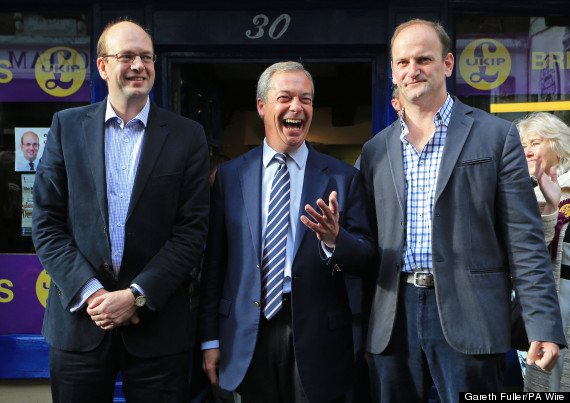
But remember if you do get back that perhaps this will be the new leadership of the Con party after Wavy Dave does another deal. Sorry U-turn!
Haystack
- 19 Oct 2014 11:31
- 48007 of 81564
Even if Reckless wins a seat for UKIP, he will have to win the seat again at the GE along with Clacton. If there is a resurgence of the Conservatives at the GE, UKIP could still end up with no seats. When there was an MP, Bob Spink, who changed parties to UKIP in 2008, he then lost his seat at the GE despite polls showing huge support for him. His constituency in Essex was very similar to Clacton. At the GE in 2010 he only managed 27% against the Conservatives on 44%.
MaxK - 19 Oct 2014 11:45 - 48008 of 81564
Dave's fighting again....
David Cameron to 'propose cap on number of low-skilled European workers in the UK as part of negotiation talks with Brussels'
Prime Minister to put plans forward as part of new deal with the EU
Number of EU migrants entering UK every year would be capped to 100,000
Government will withdraw National Insurance cards and limit existing ones
Plans revealed as Government aims to redefine Britain's position in EU
By Jennifer Smith for MailOnline
Published: 02:01, 19 October 2014 | Updated: 08:12, 19 October 2014

David Cameron is expected to announce plans for a cap on immigration in speeches designed to set out the Conservatives' 'red line' rules on EU membership
The rest of the lies are here: http://www.dailymail.co.uk/news/article-2798729/david-cameron-propose-cap-immigration-scaling-national-insurance-cards-eu-negotiations.html
David Cameron to 'propose cap on number of low-skilled European workers in the UK as part of negotiation talks with Brussels'
Prime Minister to put plans forward as part of new deal with the EU
Number of EU migrants entering UK every year would be capped to 100,000
Government will withdraw National Insurance cards and limit existing ones
Plans revealed as Government aims to redefine Britain's position in EU
By Jennifer Smith for MailOnline
Published: 02:01, 19 October 2014 | Updated: 08:12, 19 October 2014
David Cameron is expected to announce plans for a cap on immigration in speeches designed to set out the Conservatives' 'red line' rules on EU membership
The rest of the lies are here: http://www.dailymail.co.uk/news/article-2798729/david-cameron-propose-cap-immigration-scaling-national-insurance-cards-eu-negotiations.html
Haystack
- 19 Oct 2014 11:48
- 48009 of 81564
It sounds like a good policy. I wonder if the Libs or Labs will support it.
MaxK - 19 Oct 2014 11:51 - 48010 of 81564
It's not policy, it's baloney, designed to hoodwink the electorate.
It wont work, no one believes a word that comes out of Cameroons mouth.
It wont work, no one believes a word that comes out of Cameroons mouth.
Haystack
- 19 Oct 2014 11:53
- 48011 of 81564
I believe it. I think you misjudge him.
MaxK - 19 Oct 2014 12:07 - 48012 of 81564
You are entitled to your delusions.
Fred1new
- 19 Oct 2014 12:46
- 48013 of 81564
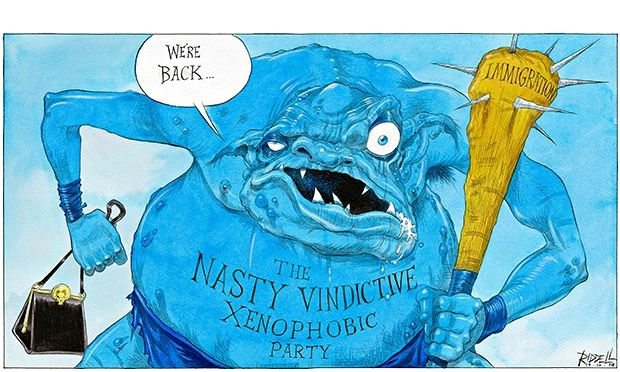
Hazy,
Cameron could have drawn this about himself while the party he is supposed to lead devolves into an extension of the Tea Party.
Mind I would swap Palin for Theresa.

Cameron could have drawn this about himself while the party he is supposed to lead devolves into an extension of the Tea Party.
Mind I would swap Palin for Theresa.
Haystack
- 19 Oct 2014 12:46
- 48014 of 81564
As you are.
doodlebug4 - 19 Oct 2014 12:47 - 48015 of 81564
David Cameron's plans to limit immigration through quotas for EU workers is illegal, European President says
Jose Manuel Barroso says freedom of movement is an essential principle, and suggests plans to limit national insurance numbers for migrants would be illegal under EU law
By Georgia Graham, Political Correspondent
10:28AM BST 19 Oct 2014
David Cameron’s attempt to control EU migration by capping national insurance numbers breaks EU laws because freedom of movement is an "essential" principle, the President of the European Commission has said.
In a clear indication that Britain will be locked into a battle with Brussels over the proposed changes José Manuel Barroso said: “The principle of freedom of movement is essential, we have to keep it.”
The Prime Minister plans to cut the level of migration from the EU by limiting the number of new national insurance numbers available to low skilled immigrants.
New arrivals from Europe would be given a temporary insurance number which would stop them from moving to Britain to work and claim benefits indefinitely.
However Mr Barroso has already suggested that the plans would be illegal under European law.
The cap on national insurance numbers for migrants is likely to be one of a series of “red lines” which will form the basis of The Prime Minister’s planned renegotiation of Britain's relationship with the EU.
The cap will be set to ensure that net migration falls to below 100,000 The Sunday Times reported.
The policy is thought to be the planned centrepiece of an upcoming speech by Mr Cameron setting out a tougher set of policies on immigration, it was reported.
Government sources have described the suggestion of a new policy for capping national insurance numbers as "speculation".
Currently net migration is almost 250,000 and blocking these migrants from working legally will prompt fears that they will still come to Britain and simply take jobs within the black economy without national insurance numbers.
Mr Barroso said: “What I can tell you is that any kind of arbitrary cap seems to me to be not in conformity with European rules because for us it’s very important the principle of non-discrimination. The freedom of movement is a very important principle in the internal market, the movement of goods, of capital, of services and of people.
“By the way, I remember when Prime Minister Cameron called me to ask the Commission to be tough ensuring the freedom of movement between Gibraltar and Spain... The principle of freedom of movement is essential, we have to keep it.”
He told BBC 2's Andrew Marr Show: “I have not yet seen the proposal, I cannot comment on it. What I say is that in principle arbitrary caps seem to me – seem, because I have to see the concrete proposal – in contradiction with European Union rules. That’s quite clear from my point of view.
However last week Mr Cameron said Britain must have “one last go” at clawing back powers from Brussels and cutting immigration from the European Union, David Cameron has said.
The Prime Minister pledged to take “further action” to address the concerns of voters and “make sure we have more effective control of immigration”.
Mr Cameron will hope the limit will help to win back voters who have abandoned the Conservatives in favour of Ukip and their tough stance on immigration.
Conservative MPs are very concerned that the party find a way to stop another Ukip MP being elected in the upcoming by-election next week, sparked by a second Tory MP defecting to Ukip.
This month Douglas Carswell, a former Conservative, became the first MP elected to Parliament for Nigel Farage’s UK Independence Party following a huge swing in support.
Labour narrowly won a second by-election by just 617 votes and Mr Miliband is also now facing a major challenge from UKIP in its traditional northern heartlands.
Nigel Farage, the leader of Ukip, said Mr Barroso had made it "crystal clear" that free movement of people is a non negotiable part of membership of the EU.
He said these comments were "fatally compromising Mr Cameron's pretence that he can in any way do anything to stop large numbers of European migrants coming to this country."
Lord Heseltine, the Conservative peer and former deputy prime minister, said the comments from Jose Manuel Barroso, the European Commission president, that the freedom of movement principle was not up for negotiation were inaccurate.
“He is the outgoing guy and it’s been negotiable ever since we’ve had new accession countries because there’s always been an anxiety that opening the door would produce a huge number of immigrants in a very short period of time so there’s been a phasing arrangement in place.
"What David Cameron is talking about is not saying we’re going to have a totally different shutter-type approach; it’s that we’re simply going to say there’s a limit to the speed at which an economy and a host community can absorb the often extremely desirable, talented and skilled people that come through in this process."
MaxK - 19 Oct 2014 12:52 - 48016 of 81564
There you go Haystack.
db4 has just driven a coach and horses through Cameroons promises.
Http://www.telegraph.co.uk/news/uknews/immigration/11172379/David-Camerons-plans-to-limit-immigration-through-quotas-for-EU-workers-is-illegal-European-President-says.html
db4 has just driven a coach and horses through Cameroons promises.
Http://www.telegraph.co.uk/news/uknews/immigration/11172379/David-Camerons-plans-to-limit-immigration-through-quotas-for-EU-workers-is-illegal-European-President-says.html
Haystack
- 19 Oct 2014 13:16
- 48017 of 81564
The EU will say it is illegal as they don't want change. It may well be illegal. It is not an announced government policy at the moment.
A more serious policy confrontation is looming. The European wide arrest warrant has to be ratified on a regular basis. The next deadline is December and Conservative backbenchers are planning to vote against it.
A more serious policy confrontation is looming. The European wide arrest warrant has to be ratified on a regular basis. The next deadline is December and Conservative backbenchers are planning to vote against it.
Fred1new
- 19 Oct 2014 13:20
- 48018 of 81564
Not another U-bend for Wavy Dave.
The tea party cons are on the march.
Hazy is playing the Big drum, but beginning to forget the tune sent down for Central office.
I hope they are not claiming expenses for shoe leather!
The tea party cons are on the march.
Hazy is playing the Big drum, but beginning to forget the tune sent down for Central office.
I hope they are not claiming expenses for shoe leather!
cynic
- 19 Oct 2014 13:22
- 48019 of 81564
fred / sticky ...... do you not find it "curious" that labour cannot establish a substantial lead in these polls, not least because as the election gets ever closer, the gap always tightens?
================
sticky - on interest rates, the fat lady has clearly far from sung, as i see there is no rise now predicted until some time after the election :-)
================
sticky - on interest rates, the fat lady has clearly far from sung, as i see there is no rise now predicted until some time after the election :-)
| About MoneyAM | Ts and Cs | Privacy Policy | Investment Warning | Content Standards | Corporate Solutions | Advertise With Us | Site Map | © 2026 MoneyAM |
Register now for FREE
Share Prices,
Stock Quotes,
Charts, Bulletin Boards, Indices, Watchlists, Portfolio, Market News, Research
or see our Premium Services including Level 2, Terminal and much more.
 Follow us on Twitter