

| Home | Log In | Register | Our Services | My Account | Contact | Help |
You are NOT currently logged in
Register now or login to post to this thread.
THE TALK TO YOURSELF THREAD. (NOWT)
goldfinger

 - 09 Jun 2005 12:25


Thought Id start this one going because its rather dead on this board at the moment and I suppose all my usual muckers are either at the Stella tennis event watching Dim Tim (lose again) or at Henly Regatta eating cucumber sandwiches (they wish,...NOT).
Anyway please feel free to just talk to yourself blast away and let it go on any company or subject you wish. Just wish Id thought of this one before.
cheers GF.
Anyway please feel free to just talk to yourself blast away and let it go on any company or subject you wish. Just wish Id thought of this one before.
cheers GF.
Haystack
- 13 Nov 2014 12:57
- 50152 of 81564
http://www.spectator.co.uk/features/9368672/its-not-just-ed-miliband-labours-on-the-wrong-side-of-history/
Ed Miliband is the least of Labour’s problems. Its troubles go far deeper than any individual. They are structural and, potentially, fatal. It is certainly easier for Labour MPs, and ultimately more comforting, to concentrate on Miliband’s deficiencies as a leader than the existential crisis facing the left. But until somebody comes up with an answer to the question of what the party is for — in an era of austerity and globalisation — it will be stuck in a death spiral.
The Labour party has always believed in spending money for the common good. Public spending was the glue that held together the traditional Labour coalition and the New Labour one. Tony Blair increased public spending from 41 per cent of GDP in 1997 to 44 per cent in 2007 — the second largest rise in the developed world in this period. By the time Labour lost power, 53 per cent of GDP was being spent by the state.
Miliband is far more left-wing than Blair, but he can’t promise increases anything like that. As he meant to say, but infamously forgot to, in his conference speech this autumn, ‘There won’t be money to spend after the next election.’
An absence of public money makes it that much harder to promise people that if they vote Labour, their lives will improve. Miliband is having to try to keep the party’s electoral coalition together without the key binding ingredient. This opens up space on Labour’s left, which the SNP and the Greens are busily trying to occupy.
These difficulties are compounded by globalisation, which severely restricts governments’ freedom of action. If governments try to raise taxes too much, businesses and people simply move elsewhere. Socialism in one country isn’t an option any more.
When François Hollande came to power in France, Miliband hailed the new president as someone who understood ‘that something can be done’. Two-and-a-half years on, unemployment in France is up to 10.5 per cent, only 12 per cent of voters approve of what Hollande is doing and the economy is flatlining. Most damningly of all for Miliband, Hollande has had to abandon socialism and appoint a reformist prime minister, Manuel Valls, who is overseeing €40 billion of tax cuts for business, paid for by €50 billion of cuts in public spending. So much for Miliband’s claim that Hollande would prove that ‘it doesn’t have to be this way’.
Hollande’s difficulties can be traced back to his commitment to introduce a top tax rate of 75 per cent. In this era, when people are more mobile than ever and governments rely on a decreasing number of income taxpayers for a larger and larger share of their revenues, national leaders can’t afford to have dramatically higher tax rates than other countries. If you try to squeeze the rich now, they leave long before you can hear the pips squeak.
Politicians can’t be heroes any more. Instead, they have to operate within the tightly drawn tramlines of the global economy. This is true for those on the left and the right, but the pressure that this places on countries to adopt a low-tax, light-regulation regime is something with which the right is far more comfortable.
Labour’s electoral position is under threat from parties that reject the economic constraints of globalisation. The Greens, according to the latest ICM/Guardian poll, now command 6 per cent support — a sixfold increase on what they polled at the last election and, to put it in perspective, twice what Ukip scored then. Even more alarming for Labour is what is happening in Scotland, one of the party’s traditional strongholds. Polls suggest that Labour’s number of Scottish seats could fall from 40 to ten, or even as few as four, next May, with the SNP garnering more than 40 per cent support. Labour’s position is probably not as dire as that, but its iron grip on Scotland appears to have been broken.
Scotland is a demonstration of what can happen when a nationalist party moves to the left. The worry for Labour is that Ukip could be undergoing the same transformation. Ukip has, since its foundation, been far more of a problem for the Tories than Labour: it was a libertarian, Euro-sceptic splinter from the Tory party, after all. Its one MP used to be a Tory, it draws more votes from the Tories than any other party and it is almost certain to win a second seat from them in the Rochester by-election next week.
But Ukip is changing rapidly. It is no longer a libertarian party. Instead, it now opposes efficiency savings in the National Health Service, the US-EU free trade deal and the so-called bedroom tax. These positions are combined with the most popular policy on voters’ biggest concern, immigration. If Ukip continues on this journey, it will become a serious threat to Labour in its heartlands in the urban north. Indeed, in the recent Heywood and Middleton by-election, Ukip cut Labour’s majority from almost 6,000 to a mere 617.
Then there is Russell Brand. It might seem absurd for an article on politics to discuss a priapic comedian best known for making an obscene crank call to an elderly actor. But Brand is fast becoming one of the most popular street captains of the left-wing mob. When he recently urged his followers to sign a petition calling for a parliamentary discussion of drugs, one of his specialist subjects, it sailed through the 100,000 barrier needed to secure a Commons debate. But what should most alarm the parliamentary left about Brand’s emergence as a political figure is that he believes people should not vote: a self-defeating electoral strategy if ever there was one.
Miliband’s aim when he became Labour leader was simple. He believed that by uniting the left as the right split between the Tories and Ukip, he could win power and overturn the Thatcher-Blair consensus.
As the most left-wing Labour leader since Neil Kinnock, and the greenest, he seemed well placed to bring the left together. He was comfortable honouring its tribal traditions in a way that his recent predecessors have not been. Unlike John Smith, Tony Blair and Gordon Brown, he attended the Durham Miners’ Gala. He also made a point of going on a trade union anti-austerity march, comparing it to the civil rights protests that Martin Luther King led in the United States in the 1960s. But despite this no-enemies-to-the-left approach, he is still faced with a fracturing of his support.
As if these problems were not enough, Labour finds itself trying to straddle the growing divide between London and the rest of the country. Half the Labour membership lives in the capital and the importance of this has been radically increased by Miliband moving the party to a one member, one vote franchise for leadership elections. But London MPs only make up 17 per cent of the Parliamentary Labour Party. This wouldn’t be a problem if London and the rest of the country thought alike. But on immigration the capital takes a radically different view to the rest of the country. Polling by Oxford University’s Migration Observatory in 2011 showed that less than half of Londoners — 46 per cent — favour reducing immigration, while the figure is 70 per cent in the north and 75 per cent in the Midlands and Wales. It is hard to see how Labour can please both its London members and its voters elsewhere in the country on this crucial issue.
Normally, a party in Labour’s situation would look around the world for inspiration, for a model to copy. This is what Labour did in the 1990s. The Clinton Democrats inspired their presentation (New Democrats/New Labour), their campaign techniques (the war room), and their policies (tax credits). But the centre-left is in disarray across the industrialised world: there is no model to copy. Indeed, in Greece and Spain parties of the radical left have usurped the role of the traditional centre-left parties and now lead in the polls.
To be sure, the Tories are not short of problems either. The fracturing of politics has hit their support, too; it is impossible to see how they can hit 40 per cent with Ukip polling so high. They have not won a majority for 22 years and, even against Miliband and Labour with all their problems, are highly unlikely to do so next May. But austerity and globalisation do not pose existential questions for the centre-right. Rather, austerity presents them with an opportunity to shrink the size of the state. Also, the pressure to keep corporate and top income tax rates down strengthens the right’s hand — offering a justification for positions that are bound to be unpopular in the current populist political climate.
Labour could still eke out a win next year. A combination of the rise of Ukip, the decline of the Liberal Democrats and favourable constituency boundaries could see them stagger back into office. But this would be a self-defeating victory. A Labour government making massive cuts to public spending would simply speed the rise of the Greens, the SNP and Ukip, and Labour’s decline. In 2020, Labour could find itself being supplanted in Scotland by the SNP and its hold on the urban north significantly weakened by Ukip.
Ed Miliband may not be a natural leader. But those who think that getting rid of him would solve Labour’s problems are deluding themselves about the disaster that the left faces.
Ed Miliband is the least of Labour’s problems. Its troubles go far deeper than any individual. They are structural and, potentially, fatal. It is certainly easier for Labour MPs, and ultimately more comforting, to concentrate on Miliband’s deficiencies as a leader than the existential crisis facing the left. But until somebody comes up with an answer to the question of what the party is for — in an era of austerity and globalisation — it will be stuck in a death spiral.
The Labour party has always believed in spending money for the common good. Public spending was the glue that held together the traditional Labour coalition and the New Labour one. Tony Blair increased public spending from 41 per cent of GDP in 1997 to 44 per cent in 2007 — the second largest rise in the developed world in this period. By the time Labour lost power, 53 per cent of GDP was being spent by the state.
Miliband is far more left-wing than Blair, but he can’t promise increases anything like that. As he meant to say, but infamously forgot to, in his conference speech this autumn, ‘There won’t be money to spend after the next election.’
An absence of public money makes it that much harder to promise people that if they vote Labour, their lives will improve. Miliband is having to try to keep the party’s electoral coalition together without the key binding ingredient. This opens up space on Labour’s left, which the SNP and the Greens are busily trying to occupy.
These difficulties are compounded by globalisation, which severely restricts governments’ freedom of action. If governments try to raise taxes too much, businesses and people simply move elsewhere. Socialism in one country isn’t an option any more.
When François Hollande came to power in France, Miliband hailed the new president as someone who understood ‘that something can be done’. Two-and-a-half years on, unemployment in France is up to 10.5 per cent, only 12 per cent of voters approve of what Hollande is doing and the economy is flatlining. Most damningly of all for Miliband, Hollande has had to abandon socialism and appoint a reformist prime minister, Manuel Valls, who is overseeing €40 billion of tax cuts for business, paid for by €50 billion of cuts in public spending. So much for Miliband’s claim that Hollande would prove that ‘it doesn’t have to be this way’.
Hollande’s difficulties can be traced back to his commitment to introduce a top tax rate of 75 per cent. In this era, when people are more mobile than ever and governments rely on a decreasing number of income taxpayers for a larger and larger share of their revenues, national leaders can’t afford to have dramatically higher tax rates than other countries. If you try to squeeze the rich now, they leave long before you can hear the pips squeak.
Politicians can’t be heroes any more. Instead, they have to operate within the tightly drawn tramlines of the global economy. This is true for those on the left and the right, but the pressure that this places on countries to adopt a low-tax, light-regulation regime is something with which the right is far more comfortable.
Labour’s electoral position is under threat from parties that reject the economic constraints of globalisation. The Greens, according to the latest ICM/Guardian poll, now command 6 per cent support — a sixfold increase on what they polled at the last election and, to put it in perspective, twice what Ukip scored then. Even more alarming for Labour is what is happening in Scotland, one of the party’s traditional strongholds. Polls suggest that Labour’s number of Scottish seats could fall from 40 to ten, or even as few as four, next May, with the SNP garnering more than 40 per cent support. Labour’s position is probably not as dire as that, but its iron grip on Scotland appears to have been broken.
Scotland is a demonstration of what can happen when a nationalist party moves to the left. The worry for Labour is that Ukip could be undergoing the same transformation. Ukip has, since its foundation, been far more of a problem for the Tories than Labour: it was a libertarian, Euro-sceptic splinter from the Tory party, after all. Its one MP used to be a Tory, it draws more votes from the Tories than any other party and it is almost certain to win a second seat from them in the Rochester by-election next week.
But Ukip is changing rapidly. It is no longer a libertarian party. Instead, it now opposes efficiency savings in the National Health Service, the US-EU free trade deal and the so-called bedroom tax. These positions are combined with the most popular policy on voters’ biggest concern, immigration. If Ukip continues on this journey, it will become a serious threat to Labour in its heartlands in the urban north. Indeed, in the recent Heywood and Middleton by-election, Ukip cut Labour’s majority from almost 6,000 to a mere 617.
Then there is Russell Brand. It might seem absurd for an article on politics to discuss a priapic comedian best known for making an obscene crank call to an elderly actor. But Brand is fast becoming one of the most popular street captains of the left-wing mob. When he recently urged his followers to sign a petition calling for a parliamentary discussion of drugs, one of his specialist subjects, it sailed through the 100,000 barrier needed to secure a Commons debate. But what should most alarm the parliamentary left about Brand’s emergence as a political figure is that he believes people should not vote: a self-defeating electoral strategy if ever there was one.
Miliband’s aim when he became Labour leader was simple. He believed that by uniting the left as the right split between the Tories and Ukip, he could win power and overturn the Thatcher-Blair consensus.
As the most left-wing Labour leader since Neil Kinnock, and the greenest, he seemed well placed to bring the left together. He was comfortable honouring its tribal traditions in a way that his recent predecessors have not been. Unlike John Smith, Tony Blair and Gordon Brown, he attended the Durham Miners’ Gala. He also made a point of going on a trade union anti-austerity march, comparing it to the civil rights protests that Martin Luther King led in the United States in the 1960s. But despite this no-enemies-to-the-left approach, he is still faced with a fracturing of his support.
As if these problems were not enough, Labour finds itself trying to straddle the growing divide between London and the rest of the country. Half the Labour membership lives in the capital and the importance of this has been radically increased by Miliband moving the party to a one member, one vote franchise for leadership elections. But London MPs only make up 17 per cent of the Parliamentary Labour Party. This wouldn’t be a problem if London and the rest of the country thought alike. But on immigration the capital takes a radically different view to the rest of the country. Polling by Oxford University’s Migration Observatory in 2011 showed that less than half of Londoners — 46 per cent — favour reducing immigration, while the figure is 70 per cent in the north and 75 per cent in the Midlands and Wales. It is hard to see how Labour can please both its London members and its voters elsewhere in the country on this crucial issue.
Normally, a party in Labour’s situation would look around the world for inspiration, for a model to copy. This is what Labour did in the 1990s. The Clinton Democrats inspired their presentation (New Democrats/New Labour), their campaign techniques (the war room), and their policies (tax credits). But the centre-left is in disarray across the industrialised world: there is no model to copy. Indeed, in Greece and Spain parties of the radical left have usurped the role of the traditional centre-left parties and now lead in the polls.
To be sure, the Tories are not short of problems either. The fracturing of politics has hit their support, too; it is impossible to see how they can hit 40 per cent with Ukip polling so high. They have not won a majority for 22 years and, even against Miliband and Labour with all their problems, are highly unlikely to do so next May. But austerity and globalisation do not pose existential questions for the centre-right. Rather, austerity presents them with an opportunity to shrink the size of the state. Also, the pressure to keep corporate and top income tax rates down strengthens the right’s hand — offering a justification for positions that are bound to be unpopular in the current populist political climate.
Labour could still eke out a win next year. A combination of the rise of Ukip, the decline of the Liberal Democrats and favourable constituency boundaries could see them stagger back into office. But this would be a self-defeating victory. A Labour government making massive cuts to public spending would simply speed the rise of the Greens, the SNP and Ukip, and Labour’s decline. In 2020, Labour could find itself being supplanted in Scotland by the SNP and its hold on the urban north significantly weakened by Ukip.
Ed Miliband may not be a natural leader. But those who think that getting rid of him would solve Labour’s problems are deluding themselves about the disaster that the left faces.
Stan
- 13 Nov 2014 13:06
- 50153 of 81564
Spot on Fred, but I'm getting worried about him as I'm sure the rest of us are -):
Haystack
- 13 Nov 2014 13:09
- 50154 of 81564
The one that needs to be worried about is Ed Miliband. Hopefully the press have Ed Balls in their sights as well.
cynic
- 13 Nov 2014 13:16
- 50155 of 81564
poll trend
though the MORI poll might be described as a rogue, as does indeed happen from time to time, there is no escaping the fact that whereas for many months labour was showing a 6 point lead - even that wasn't anything to boast about - that lead is now consistently at only 1-2 points and drifting
though the MORI poll might be described as a rogue, as does indeed happen from time to time, there is no escaping the fact that whereas for many months labour was showing a 6 point lead - even that wasn't anything to boast about - that lead is now consistently at only 1-2 points and drifting
Stan
- 13 Nov 2014 13:21
- 50156 of 81564
Oh don't you start.. now get back to your work please -):
cynic
- 13 Nov 2014 13:24
- 50157 of 81564
thankfully i was out all yesterday - golf with client + bank manager :-) - but my post above is no more than a fair obervation
Fred1new
- 13 Nov 2014 13:27
- 50158 of 81564
I have listen to Miliband's speech and thought it good.
The things which stands out is that he thoughtful, analytic and has honesty and integrity which is certainly not apparent in the overgrown etonian twins.
Also, I "believe" the majority of the UK are politically moderate and what he has said and will say appeals to them, although they may like Ed to have a little more charisma.
Crosby's smutty effect on the media and camp followers like Haze, Cynic will obviously concentrate on the messenger, but the labour party and voters will hopefully concentrate on the message as well as the messenger.
I know who I would trust.
Especially as more and more unfolds for this Gove rment and it u-bends more and more!
The things which stands out is that he thoughtful, analytic and has honesty and integrity which is certainly not apparent in the overgrown etonian twins.
Also, I "believe" the majority of the UK are politically moderate and what he has said and will say appeals to them, although they may like Ed to have a little more charisma.
Crosby's smutty effect on the media and camp followers like Haze, Cynic will obviously concentrate on the messenger, but the labour party and voters will hopefully concentrate on the message as well as the messenger.
I know who I would trust.
Especially as more and more unfolds for this Gove rment and it u-bends more and more!
Fred1new
- 13 Nov 2014 13:30
- 50159 of 81564
Stan,
Manuel, doesn't have any more dishes to wash and all the customers have fled without paying the bills.
He is hoping for a loan from his bank manager.
Times are hard on the Embankment.
Manuel, doesn't have any more dishes to wash and all the customers have fled without paying the bills.
He is hoping for a loan from his bank manager.
Times are hard on the Embankment.
Haystack
- 13 Nov 2014 13:33
- 50160 of 81564
The public know that Miliband won't be PM. The newspapers, the TV commentators and even the Labour party know. It is only Miliband that is in denial. It will be amusing to watch and see at what point it dawns on him.
cynic
- 13 Nov 2014 13:33
- 50161 of 81564
fred - what you say about EM's character and speech may well be correct, or at least that is your own (fair) assessment of it
i think it is certainly reasonable to comment that "the majority of the UK are politically moderate"
however, like it or not, it is a fact, sad or not, that the "messenger" needs to have presence and charisma which EM patently does not ..... were it otherwise, then surely labour would be out of sight in the polls ..... if you argue otherwise, then surely it means that the public thinks labour's policies are as insubstantiable or unworkable or whatever as the incumbent's?
i think it is certainly reasonable to comment that "the majority of the UK are politically moderate"
however, like it or not, it is a fact, sad or not, that the "messenger" needs to have presence and charisma which EM patently does not ..... were it otherwise, then surely labour would be out of sight in the polls ..... if you argue otherwise, then surely it means that the public thinks labour's policies are as insubstantiable or unworkable or whatever as the incumbent's?
ExecLine
 - 13 Nov 2014 13:39
- 50162 of 81564
- 13 Nov 2014 13:39
- 50162 of 81564

Fred1new
- 13 Nov 2014 14:39
- 50163 of 81564
Manuel,
It depends on whether you want a floozy, or prefer a decent cook.
I think the majority flirt with, or go to bed briefly with the first, but marry the latter.
=====
Just heard Matthew Hancock speaking.
Looks like the problem is solved for the next leader of the Con party.
He appears to me, to be a cross between Cameron and Farage.
All he needs is a barrow and Del Boy's overcoat.
Mind Cameron and Farage do remind me of Del.
Got the three of them posing together.
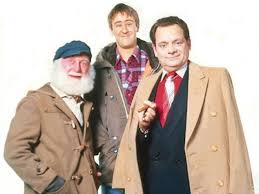
It depends on whether you want a floozy, or prefer a decent cook.
I think the majority flirt with, or go to bed briefly with the first, but marry the latter.
=====
Just heard Matthew Hancock speaking.
Looks like the problem is solved for the next leader of the Con party.
He appears to me, to be a cross between Cameron and Farage.
All he needs is a barrow and Del Boy's overcoat.
Mind Cameron and Farage do remind me of Del.
Got the three of them posing together.
hilary
- 13 Nov 2014 15:00
- 50164 of 81564
Doc,
There's only around $4bn a day passing through the global Forex market, and only a very, very small percentage will have passed through Secure Investments. There's no way in the world that they would have had anything like $1bn of client funds on deposit, and it's inconceivable that they had anywhere near 100k clients.
But, a fool and his money are easily parted, and if muppet retail investors persist in depositing their hard-earned with unregulated offshore brokers and 'fund' managers, then pas de problème.
There's only around $4bn a day passing through the global Forex market, and only a very, very small percentage will have passed through Secure Investments. There's no way in the world that they would have had anything like $1bn of client funds on deposit, and it's inconceivable that they had anywhere near 100k clients.
But, a fool and his money are easily parted, and if muppet retail investors persist in depositing their hard-earned with unregulated offshore brokers and 'fund' managers, then pas de problème.
goldfinger
- 13 Nov 2014 15:18
- 50165 of 81564
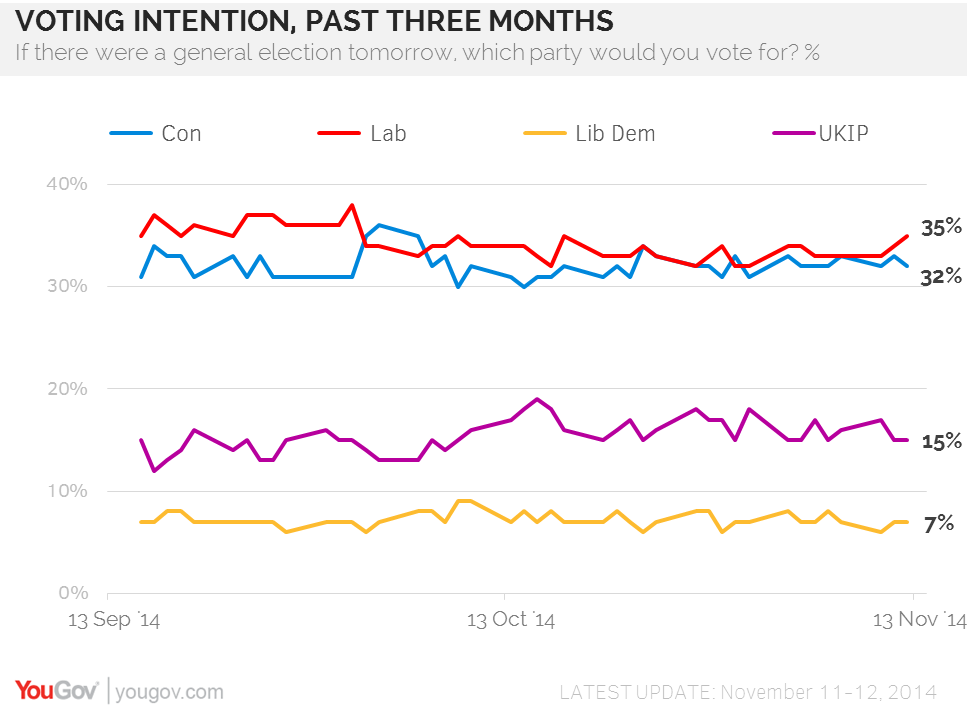
Tory lead didnt last long, was all the negative stuff about Milliband over last weekend. Whats more they have what they want 35% of the poll.....
Latest YouGov / The Sun results 12th November - Con 32%, Lab 35%, LD 7%, UKIP 15%; APP -25
UKIP STILL polling highly, bring on Rochester, lets see Davy thrashed
Latest YouGov / The Sun results 12th November - Con 32%, Lab 35%, LD 7%, UKIP 15%; APP -25
UKIP STILL polling highly, bring on Rochester, lets see Davy thrashed
cynic
- 13 Nov 2014 15:20
- 50166 of 81564
it's been certain from the outset that the tories would get whacked at rochester
however, sticky my old friend, do read post 50158 about the undeniable trend
however, sticky my old friend, do read post 50158 about the undeniable trend
goldfinger
- 13 Nov 2014 15:26
- 50167 of 81564
Yep the trend goes one way then the other, just wait until after Rochester.
Im not a betting man and wouldnt bet on any outcome for the GE at the moment, like chucking money down the drain.
Im not a betting man and wouldnt bet on any outcome for the GE at the moment, like chucking money down the drain.
Fred1new
- 13 Nov 2014 15:28
- 50168 of 81564
Just for interest and to simplify for Sinner and Hazyone!
cynic
- 13 Nov 2014 15:47
- 50169 of 81564
fred - you might just as sensibly have posted the MORI polls over the last 3 months ...... the trend over say the last 6 months is the important bit!
it wasn't so long ago that 38/39% voting for labour was being touted around
i'm not making a song and dance about it, but rather just pointing out the obvious
it wasn't so long ago that 38/39% voting for labour was being touted around
i'm not making a song and dance about it, but rather just pointing out the obvious
Fred1new
- 13 Nov 2014 15:50
- 50170 of 81564
Manuel.
What odds are you offering on Ed and Wavy Dave?
What odds are you offering on Ed and Wavy Dave?
cynic
- 13 Nov 2014 15:58
- 50171 of 81564
crikey! i haven't the faintest idea ..... to be honest, i wouldn't want to put money on either of them (or their successors) as i think they're both awful in their own ways
| About MoneyAM | Ts and Cs | Privacy Policy | Investment Warning | Content Standards | Corporate Solutions | Advertise With Us | Site Map | © 2026 MoneyAM |
Register now for FREE
Share Prices,
Stock Quotes,
Charts, Bulletin Boards, Indices, Watchlists, Portfolio, Market News, Research
or see our Premium Services including Level 2, Terminal and much more.
 Follow us on Twitter