

| Home | Log In | Register | Our Services | My Account | Contact | Help |
You are NOT currently logged in
Register now or login to post to this thread.
THE TALK TO YOURSELF THREAD. (NOWT)
goldfinger

 - 09 Jun 2005 12:25


Thought Id start this one going because its rather dead on this board at the moment and I suppose all my usual muckers are either at the Stella tennis event watching Dim Tim (lose again) or at Henly Regatta eating cucumber sandwiches (they wish,...NOT).
Anyway please feel free to just talk to yourself blast away and let it go on any company or subject you wish. Just wish Id thought of this one before.
cheers GF.
Anyway please feel free to just talk to yourself blast away and let it go on any company or subject you wish. Just wish Id thought of this one before.
cheers GF.
ExecLine
 - 17 Jun 2015 22:47
- 60832 of 81564
- 17 Jun 2015 22:47
- 60832 of 81564

Fred1new
- 18 Jun 2015 07:34
- 60833 of 81564

Fred1new
- 18 Jun 2015 07:37
- 60834 of 81564
MaxK - 18 Jun 2015 07:47 - 60835 of 81564

ExecLine
- 18 Jun 2015 10:53
- 60836 of 81564
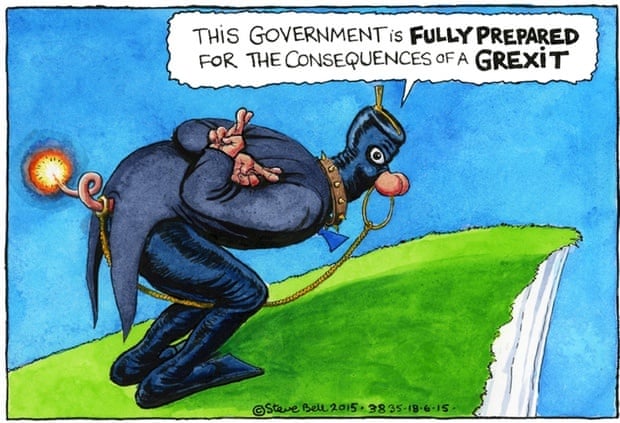
Obviously, everyone is just hanging around waiting for the Greek Exit to happen - or not.
From the Sydney Morning Herald:
Will leaving the euro break Greece or make it?
June 18, 2015 - 3:55PM
Nick Miller - Europe Correspondent
London: Less than a century ago, Europeans were literally walking across borders with suitcases full of money. Millions of Austro-Hungarian crowns were put in sacks and tied to horses or jammed into boxcars.
That is until they closed the borders and made it illegal.
Before the Grexit, there was the "Austrexit".
The last time a major currency broke up was in the days of the Austro-Hungarian Empire.
For an insight into the exit of Greece from the euro – how it could happen, and the chaos that may ensue, economist Michael Spencer dials back almost 100 years, to the wreckage of World War I.
With the breakup of the Austro-Hungarian Empire into Austria, Hungary and Czechoslovakia, so too the currency union broke down. Citizens were told they had to bring their old crowns to the post office, to be stamped and thereby turned into new, local currency.
But when you create a new currency, Mr Spencer explains, you get "massive cross-border flows of the old currency", as everyone tries to move their money to where it will be worth the most.
One estimate is that 6.5 billion crowns, equal to the entire estimated circulation in Hungary, were transferred out of Czechoslovakia and Austria (which faced unprecedented unemployment, huge debt payments and the problem of paying for a big civil service, leading to justified fears the new currency would quickly inflate).
In Czechoslovakia, as the currency separation began, borders were ordered closed and all postal communications abroad were suspended for two weeks. Heads of households were ordered to surrender all their crowns for stamping, and bank deposits were converted at a 1:1 rate. Half of the stamped currency was withheld by the government as a "forced loan".
In Austria, the government put controls on the sale of securities and stocks to the other states to prevent an influx of notes from Czechoslovakia.
A return to the drachma would dramatically raise the cost of imports.
For the record Mr Spencer, chief economist for Deutsche Bank Asia Pacific, is not saying Grexit will happen. They are "still of the view that a deal will get done in the next few days", making this all just hypothetical.
"The Greeks dislike austerity but they want to stay in the euro . . . If they put in place capital controls and people in Greece are trading IOUs or tax refund receipts or whatever people come up with . . . that's a scenario in which we think the Greek government loses its popular support. [Greek Prime Minister Alexis] Tsipras will do what he needs to do to avoid that outcome."
But nevertheless, Grexit is on the table, governments are making contingency plans and economists are imagining what it would look like.
'The Greeks dislike austerity but they want to stay in the euro' says Deutsche Bank economist Michael Spencer.
In 1994, Mr Spencer co-wrote a paper on the fragmentation of the Austro-Hungarian crown. He still sees it as the "key historical example of a currency union breakup".
Though things are different now. "Now of course you don't need to walk across the border, you just log onto your bank account with your security code and transfer money out of the country," Mr Spencer says. "There's nothing to stop someone in Greece taking their entire [bank] deposit, transferring it to a bank in France, then living off the ATM."
There will have to be strict controls on money to stop that happening – the Greek banking system has already lost 40 per cent of its deposits in three years. "It's going to be absolutely chaotic for a few weeks and the rest of Europe will look on in [horror]."
Should Greece leave the euro, domestic banks and financial markets would probably close to prevent capital flight.
And there is a lingering hangover.
"My reading of economic history is that when you've had these kinds of crises you don't wake up the next morning saying 'oh what a relief the currency's been devalued', you wake up thinking 'I am poorer, prices of everything that I want to import have gone up by 40 per cent'. Consumption collapses, imports collapse.
"It's entirely possible that a year later the economy is growing . . . but it could be years before Greeks feel that they are better off than they were before the devaluation."
A Greek exit from the euro 'wouldn't be a disaster, it would be a salvation', says economist Roger Bootle.
But other economists disagree.
In 2012, a team from Capital Economics led by Roger Bootle won a £250,000 ($508,000) prize for outlining the "smoothest process by which a member state could exit the Eurozone".
The model is highly technical, and envisions a "substantial default" of government debt. It proposes top-secret preparations, followed by a public announcement just three days ahead of the new currency being introduced.
Immediately after the announcement, domestic banks and financial markets close to prevent capital flight. There would be no "stamping" of euros into drachmas - instead all wages, prices and bank deposits are immediately converted to the new currency, and "non-cash" means of payment are used until the new money is printed.
Mr Bootle says his plan is not only possible, it's desirable.
"The main purpose of making such a change is to allow the exchange rate to fall. That should not be resisted by the Greek authorities, it's part of the solution," he says. He would expect the drachma to stabilise at more than half the value of the euro.
There is no escaping the need for capital controls and restrictions on the banks, to avoid "financial catastrophe", Mr Bootle says.
However he doesn't think the practical challenges of printing a new currency are particularly difficult. People can carry on using euros, or build up credit, or circulate IOUs. "It's a comparatively minor problem, a short-term thing," he says.
And the project as a whole is "eminently desirable", he says.
After the disruption to transactions, and the banking system, and the shock for Greeks as import prices shoot up, the economy would respond and start to recover (helped by a massive upsurge in tourism and a boost to local agriculture and manufacturing).
"I don't see any way, without this, that Greece can escape from the current mess," Mr Bootle says. "When people say to me 'oh wouldn't an exit from the euro cause a few problems', I want to know which planet they're living on. There's a question of what the alternatives are, and this does offer the prospect of a very real escape.
"It wouldn't be a disaster, it would be a salvation. In a year's time people will look back and say - why on Earth didn't we do that sooner?"
From the Sydney Morning Herald:
Will leaving the euro break Greece or make it?
June 18, 2015 - 3:55PM
Nick Miller - Europe Correspondent
London: Less than a century ago, Europeans were literally walking across borders with suitcases full of money. Millions of Austro-Hungarian crowns were put in sacks and tied to horses or jammed into boxcars.
That is until they closed the borders and made it illegal.
Before the Grexit, there was the "Austrexit".
The last time a major currency broke up was in the days of the Austro-Hungarian Empire.
For an insight into the exit of Greece from the euro – how it could happen, and the chaos that may ensue, economist Michael Spencer dials back almost 100 years, to the wreckage of World War I.
With the breakup of the Austro-Hungarian Empire into Austria, Hungary and Czechoslovakia, so too the currency union broke down. Citizens were told they had to bring their old crowns to the post office, to be stamped and thereby turned into new, local currency.
But when you create a new currency, Mr Spencer explains, you get "massive cross-border flows of the old currency", as everyone tries to move their money to where it will be worth the most.
One estimate is that 6.5 billion crowns, equal to the entire estimated circulation in Hungary, were transferred out of Czechoslovakia and Austria (which faced unprecedented unemployment, huge debt payments and the problem of paying for a big civil service, leading to justified fears the new currency would quickly inflate).
In Czechoslovakia, as the currency separation began, borders were ordered closed and all postal communications abroad were suspended for two weeks. Heads of households were ordered to surrender all their crowns for stamping, and bank deposits were converted at a 1:1 rate. Half of the stamped currency was withheld by the government as a "forced loan".
In Austria, the government put controls on the sale of securities and stocks to the other states to prevent an influx of notes from Czechoslovakia.
A return to the drachma would dramatically raise the cost of imports.
For the record Mr Spencer, chief economist for Deutsche Bank Asia Pacific, is not saying Grexit will happen. They are "still of the view that a deal will get done in the next few days", making this all just hypothetical.
"The Greeks dislike austerity but they want to stay in the euro . . . If they put in place capital controls and people in Greece are trading IOUs or tax refund receipts or whatever people come up with . . . that's a scenario in which we think the Greek government loses its popular support. [Greek Prime Minister Alexis] Tsipras will do what he needs to do to avoid that outcome."
But nevertheless, Grexit is on the table, governments are making contingency plans and economists are imagining what it would look like.
'The Greeks dislike austerity but they want to stay in the euro' says Deutsche Bank economist Michael Spencer.
In 1994, Mr Spencer co-wrote a paper on the fragmentation of the Austro-Hungarian crown. He still sees it as the "key historical example of a currency union breakup".
Though things are different now. "Now of course you don't need to walk across the border, you just log onto your bank account with your security code and transfer money out of the country," Mr Spencer says. "There's nothing to stop someone in Greece taking their entire [bank] deposit, transferring it to a bank in France, then living off the ATM."
There will have to be strict controls on money to stop that happening – the Greek banking system has already lost 40 per cent of its deposits in three years. "It's going to be absolutely chaotic for a few weeks and the rest of Europe will look on in [horror]."
Should Greece leave the euro, domestic banks and financial markets would probably close to prevent capital flight.
And there is a lingering hangover.
"My reading of economic history is that when you've had these kinds of crises you don't wake up the next morning saying 'oh what a relief the currency's been devalued', you wake up thinking 'I am poorer, prices of everything that I want to import have gone up by 40 per cent'. Consumption collapses, imports collapse.
"It's entirely possible that a year later the economy is growing . . . but it could be years before Greeks feel that they are better off than they were before the devaluation."
A Greek exit from the euro 'wouldn't be a disaster, it would be a salvation', says economist Roger Bootle.
But other economists disagree.
In 2012, a team from Capital Economics led by Roger Bootle won a £250,000 ($508,000) prize for outlining the "smoothest process by which a member state could exit the Eurozone".
The model is highly technical, and envisions a "substantial default" of government debt. It proposes top-secret preparations, followed by a public announcement just three days ahead of the new currency being introduced.
Immediately after the announcement, domestic banks and financial markets close to prevent capital flight. There would be no "stamping" of euros into drachmas - instead all wages, prices and bank deposits are immediately converted to the new currency, and "non-cash" means of payment are used until the new money is printed.
Mr Bootle says his plan is not only possible, it's desirable.
"The main purpose of making such a change is to allow the exchange rate to fall. That should not be resisted by the Greek authorities, it's part of the solution," he says. He would expect the drachma to stabilise at more than half the value of the euro.
There is no escaping the need for capital controls and restrictions on the banks, to avoid "financial catastrophe", Mr Bootle says.
However he doesn't think the practical challenges of printing a new currency are particularly difficult. People can carry on using euros, or build up credit, or circulate IOUs. "It's a comparatively minor problem, a short-term thing," he says.
And the project as a whole is "eminently desirable", he says.
After the disruption to transactions, and the banking system, and the shock for Greeks as import prices shoot up, the economy would respond and start to recover (helped by a massive upsurge in tourism and a boost to local agriculture and manufacturing).
"I don't see any way, without this, that Greece can escape from the current mess," Mr Bootle says. "When people say to me 'oh wouldn't an exit from the euro cause a few problems', I want to know which planet they're living on. There's a question of what the alternatives are, and this does offer the prospect of a very real escape.
"It wouldn't be a disaster, it would be a salvation. In a year's time people will look back and say - why on Earth didn't we do that sooner?"
cynic
- 18 Jun 2015 11:00
- 60837 of 81564
being a moderately cynical old chap, i'ld guess at an immediate outcome will be some last minute fudge which will convince no one and we'll all go through this same charade in a few months time
nevertheless, a kneejerk north for the markets will then ensue, but hard to determine whether that will have much substance
nevertheless, a kneejerk north for the markets will then ensue, but hard to determine whether that will have much substance
Haystack
- 18 Jun 2015 11:18
- 60838 of 81564
The EU has been rushing to allow more and more eastern European countries to join. This is a time bomb waiting to go off. Greece should never have been allowed into the EU and now we are letting in countries that are in even poorer shape. There should have been an extended period of stabilisation before expanding. It has become more of a political project than trade. Several countries have major EU ambitions leading to a federal United States of Europe with one Feurer at the helm.
hilary
- 18 Jun 2015 12:45
- 60839 of 81564
Fred1new
- 18 Jun 2015 12:45
- 60840 of 81564
Who was pushing for the expansion of the EU and why?
Ps.
Other than those on the outside!
Ps.
Other than those on the outside!
Fred1new
- 18 Jun 2015 17:18
- 60841 of 81564
C+P
Government must reveal how many died after being found ‘fit for work’, MP insists 18/06/2015
Vox Political welcomes the support of Labour’s Roger Godsiff in the campaign to persuade the Department for Work and Pensions to do the right thing
Note that, by the time you read this, the petition is likely to have topped 200,000 signatures. Have you added yours yet? Who knows how many it will contain if the DWP insists on taking this to the Information Tribunal?
Roger Godsiff (Lab Birmingham Hall Green) joined more than 120,000 people who have signed a petition to demand that the Government release the figures.
An official watchdog has also ordered it to explain how many people have died after going through a work-capability assessment which ruled they were fit to work.
This would mean the claimant was expected to start looking for a job or take part in training designed to prepare them for employment – and would face the prospect of losing benefits unless they comply.
Campaigner Mike Sivier used the Freedom of Information Act to ask how many people who died between November 2011 and May 2014 had been found “fit for work”, or told they could move towards getting work.
But the Department for Work and Pensions refused his request, saying it was already preparing to publish the information.
Mr Sivier appealed to Information Commissioner Christopher Graham, who ordered civil servants to publish the data within 35 days of his ruling on April 30.
But the Department has instead decided to appeal this ruling.
Source: Government must reveal how many died after being found ‘fit for work’, MP insists – Birmingham Mail
What is Cameron's cohorts hiding?
Government must reveal how many died after being found ‘fit for work’, MP insists 18/06/2015
Vox Political welcomes the support of Labour’s Roger Godsiff in the campaign to persuade the Department for Work and Pensions to do the right thing
Note that, by the time you read this, the petition is likely to have topped 200,000 signatures. Have you added yours yet? Who knows how many it will contain if the DWP insists on taking this to the Information Tribunal?
Roger Godsiff (Lab Birmingham Hall Green) joined more than 120,000 people who have signed a petition to demand that the Government release the figures.
An official watchdog has also ordered it to explain how many people have died after going through a work-capability assessment which ruled they were fit to work.
This would mean the claimant was expected to start looking for a job or take part in training designed to prepare them for employment – and would face the prospect of losing benefits unless they comply.
Campaigner Mike Sivier used the Freedom of Information Act to ask how many people who died between November 2011 and May 2014 had been found “fit for work”, or told they could move towards getting work.
But the Department for Work and Pensions refused his request, saying it was already preparing to publish the information.
Mr Sivier appealed to Information Commissioner Christopher Graham, who ordered civil servants to publish the data within 35 days of his ruling on April 30.
But the Department has instead decided to appeal this ruling.
Source: Government must reveal how many died after being found ‘fit for work’, MP insists – Birmingham Mail
What is Cameron's cohorts hiding?
Chris Carson
- 18 Jun 2015 18:04
- 60842 of 81564
Bollocks Fred, Labour came third deal with it. The Government are attempting to get people back to work. Are you calling the doctors, specialist etc inept who make these decisions? Department for Work and Pensions are asking the questions, it's the above who make the decision if someone is fit for work or not. Tragic people have died no denying that.
Haystack
- 18 Jun 2015 19:09
- 60843 of 81564
Unlikely that people have died as a result of the benefits changes.
Fred1new
- 19 Jun 2015 08:12
- 60844 of 81564
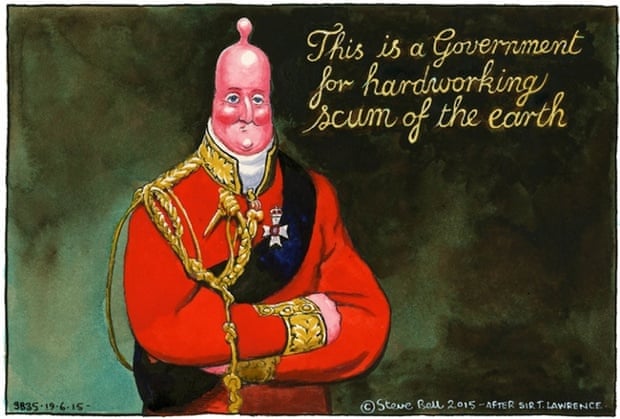
For the greenest U-tun ever!
A sad joke!

A sad joke!
MaxK - 19 Jun 2015 08:21 - 60845 of 81564
cynic
- 19 Jun 2015 08:23
- 60846 of 81564
fracking
has been used for years and years and years all over the world with, as far as i know, no serious incident of any kind such as those propounded by the "anti mob"
it is also worth noting that wytch farm in purbeck (dorset) is effectively invisible, yet has been pumping oil for a good many years
on the other hand ......
wind turbines
are truly ugly and highly visibly (unless you're in love with pylons straggling the highlands and similar) and, so i am led to believe, are actually quite noisy en masse - or at least they are when they actually function
in conclusion
and as usual, fred's nonsense is, as usual, exactly that
has been used for years and years and years all over the world with, as far as i know, no serious incident of any kind such as those propounded by the "anti mob"
it is also worth noting that wytch farm in purbeck (dorset) is effectively invisible, yet has been pumping oil for a good many years
on the other hand ......
wind turbines
are truly ugly and highly visibly (unless you're in love with pylons straggling the highlands and similar) and, so i am led to believe, are actually quite noisy en masse - or at least they are when they actually function
in conclusion
and as usual, fred's nonsense is, as usual, exactly that
required field - 19 Jun 2015 08:30 - 60847 of 81564
Wytch if that is the name is surrounded by conifers....
cynic
- 19 Jun 2015 08:35
- 60848 of 81564
exactly so, but the point is that these installations if properly managed are not necessarily a blot on the landscape
indeed, some of the french motorways are similarly well camouflaged and integrated into their surroundings, often with significant wetlands or similar created
indeed, some of the french motorways are similarly well camouflaged and integrated into their surroundings, often with significant wetlands or similar created
required field - 19 Jun 2015 08:38 - 60849 of 81564
You drive the A75 from Beziers up to Clermont Ferrand and don't do it in a rush....free (except for the bridge) and fantastic countryside.....pont de millau.....etc....the motorway is 900m to 1100m altitude all the way....amazing....
required field - 19 Jun 2015 08:47 - 60850 of 81564
Anyway.....oilrigs and nodding nellys really need vegetation around them.......
hilary
- 19 Jun 2015 08:54
- 60851 of 81564
The reason that stretch of road is free, required field, is because the Auvergne is one of the poorest areas of France. I believe the region receives state aid which they used to fund infrastructure work such as the A75.
The road is fun to drive in good conditions, but it can get very wet sometimes and be a bit scary at night.
The road is fun to drive in good conditions, but it can get very wet sometimes and be a bit scary at night.
| About MoneyAM | Ts and Cs | Privacy Policy | Investment Warning | Content Standards | Corporate Solutions | Advertise With Us | Site Map | © 2026 MoneyAM |
Register now for FREE
Share Prices,
Stock Quotes,
Charts, Bulletin Boards, Indices, Watchlists, Portfolio, Market News, Research
or see our Premium Services including Level 2, Terminal and much more.
 Follow us on Twitter