

| Home | Log In | Register | Our Services | My Account | Contact | Help |
You are NOT currently logged in
Register now or login to post to this thread.
THE TALK TO YOURSELF THREAD. (NOWT)
goldfinger

 - 09 Jun 2005 12:25


Thought Id start this one going because its rather dead on this board at the moment and I suppose all my usual muckers are either at the Stella tennis event watching Dim Tim (lose again) or at Henly Regatta eating cucumber sandwiches (they wish,...NOT).
Anyway please feel free to just talk to yourself blast away and let it go on any company or subject you wish. Just wish Id thought of this one before.
cheers GF.
Anyway please feel free to just talk to yourself blast away and let it go on any company or subject you wish. Just wish Id thought of this one before.
cheers GF.
Fred1new
- 02 Jul 2015 14:23
- 61194 of 81564
"Perhaps if the Greeks themselves had shown more willingness to tighten their belts and pay taxes due to the state, voters across Europe might not now be feeling such anger towards them."Which groups were the biggest tax evaders?
-=-====
-=-====
ExecLine
 - 02 Jul 2015 15:55
- 61195 of 81564
- 02 Jul 2015 15:55
- 61195 of 81564

From the BBC web site:
How I was de-radicalised
By Tim Mansel
BBC World Service, Aarhus
2 July 2015
From the section Magazine
It's become known as the Aarhus Model, a programme designed in Denmark's second city to dissuade young people from going to fight for al-Qaeda or Islamic State. Thirty travelled to Syria in 2013 but only two so far this year - and only one in 2014. Ahmed is one young man who was convinced, a few years ago, to draw back from the first step on a path that could have ended in jihad.
We meet in a large, loud, busy Turkish restaurant on the edge of the city, but we don't stay long. There are two of them - we'll call them Ahmed and Mahmoud - and what we have to talk about demands a measure of privacy. Mahmoud drives us to a large hotel, where we sit down in a quiet room.
Ahmed is 25, he says, born in Somalia, although he's lived in Denmark since he was six.
Ahmed then tells his story, describing an unexceptional childhood - he was a "normal kid" growing up in the Aarhus suburbs, who liked playing football, doing well in school, learning Danish fast. "Everything was good for me at that time," he says.
Then, when he was in his teens, his father announced that he was taking him on the Hajj, the pilgrimage to Mecca.
They call me a terrorist? I will give them a terrorist if they want that
"It was important for my father to get me more religious," he says.
"I didn't know much about my religion. It was like I had left it in Somalia. But my father said, you are a Muslim, you have a Muslim name. You have to know your history, your background and your religion."
So the family went to Mecca and Ahmed remembered returning to Denmark with a sense of relief.
"When we came back I was happy and I was a new person with a religious identity. I saw the world differently. I saw that it was important for a person to have a connection with his god, I saw that there was an afterlife."
But Ahmed's new faith got him into trouble at school. He abandoned jeans and T-shirts and took to wearing traditional Islamic dress. He became defensive and argumentative when the subject of religion came up. He acknowledges today that he could have handled things better, but at the time, he said, he responded aggressively because he felt he had a duty to defend his religion when he was being baited by his Danish classmates.
null
The suburbs of Aarhus include some of Denmark's poorest neighbourhoods
"They would say things like, 'You stone your women, you lash people who speak freely,' and I felt I had to defend my religion, but I didn't know how to debate properly and it went out not correctly."
Ahmed was shortly to discover exactly how "not correctly" it had come out.
He was out one evening when his father rang. "Where are you?" he demanded. "What have you done?" His father said the police had just knocked on the door and were looking for him.
"When I got home, he was shocked and angry. He told me that I had to go straight to the police station the following morning, and ask them what they wanted."
So Ahmed went to see the police and was amazed to discover that he'd been turned in by the principal of the school.
"The reason you are here," he was told, "is that your classmates are afraid, they think you are extremist and that you are capable of dangerous things. They think you have been radicalised in Saudi Arabia."
Ahmed grins as he remembers all this. But it wasn't funny at the time - he had a vision of being put on the next flight to Guantanamo. "I was shocked," he says "and I had no words to defend myself."
The police then told him they would need to search his home and that they would need the password to his email account and any other social media that he used.
"I gave them everything and they searched my house and it was very humiliating to watch. When they left I was shocked and I was angry," he says.
It got worse. All this had happened during the last week of school, and he had missed the end of year exams. The school, he told me, refused to allow him to sit them late.
"That gave me a punch in the face, and gave me the feeling this society is total racist," he says. "They call me a terrorist? I will give them a terrorist if they want that."
Ahmed smiles again as he recounts the story. It sounds foolish all these years later.
Ahmed then told everything to his friends at the mosque. They were sympathetic, he says, and invited him home. There were long discussions about the hypocrisy of the West in its dealings with Muslims and Muslim countries. They watched a lot of jihadi videos online. Ahmed remembers in particular those that featured Anwar al-Awlaki, the radical American cleric of Yemeni descent, who was killed in a drone strike in 2011.
"He would say things like, 'We are at war with the West, the West will kill all the Muslims around the world if we don't stand up to them,' and I was like, OK, and my friends were saying, 'Yeah, he's totally right.'"
Finally someone drew Ahmed aside and suggested that if he wanted to learn more about Islam and be respected as a Muslim, he should go to Pakistan. "He told me about a school there, where they have good teachers and where they teach Islam in the best way."
European militants who have gone to Syria/Iraq (estimates)
Country Per 1m inhabitants Total
Belgium 40 440
Denmark 27 100-150
Sweden 19 150-180
France 18 1200
Austria 17 100-150
Netherlands 14.5 200-250
Finland 13 50-70
Norway 12 60
UK 9.5 500-600
Germany 7.5 500-600
Source: ICSR (Jan 2015)
Ahmed says he told his father what he was planning. His father said he wouldn't try to stop him but advised him to finish high school first. Then the telephone rang.
It was the police and they wanted to invite Ahmed out for a cup of coffee.
He went, reluctantly.
"Something inside me said these people are never going to leave you alone, so why don't you see them face-to-face and just say your opinion. So I went to the meeting and they gave me some coffee and we talked and I was angry and I said, 'You know what, I'm going to Pakistan. It's not illegal. I can do what I want. When I get the money, when I've finished high school, that's where I'm going. Sayonara. See you later.'"
But the police had an offer. They wanted him to meet someone, another Muslim, they said, who could talk to him about his feelings and his anger in a way that they, the police could not.
Ahmed smiles again as he remembers his indignant reaction. What kind of Muslim could this be? Clearly a traitor.
This is how he met Mahmoud. And this is how he was introduced to what the world has now come to call the Aarhus Model.
The Aarhus Model
The model involves both prevention and cure. In some cases it offers young people returning from Syria the opportunity to reintegrate into Danish society, provided they've committed no offence abroad. In others, it provides mentoring for those intent on going to Syria, to persuade them not to travel.
Efforts to prevent radicalisation have been running since 2007. Preparations for dealing with events in Syria started in mid-2013.
An extensive network including parents, social workers, teachers, youth club workers, outreach workers and the police may raise the alarm about a young person who is being radicalised.
Individual counselling is provided for people who intend to travel to Syria, and in some cases a mentor is assigned. Parents of these people take part in self-help groups.
null
Ahmed says it took several months for him to relax. In the beginning he would frisk Mahmoud every time they met, because he wanted to check he wasn't wearing a microphone. He says their arguments were intense and he was frustrated that Mahmoud seemed to have a quiet, logical answer to everything. Ahmed says he asked his friends at the mosque for help, for arguments to defeat this "traitor who's working with the police".
"But then I started to take my hands down - you know in boxing you have your fists up high - and I said I have to listen to this guy, this guy never gives up.
"And he discussed with me in a logical way, in a way that I could understand that where I was going actually was dangerous.
"Mahmoud said, 'Yes, you were treated wrong, that's correct, but what you are doing is you are ruining your own life if you go to Pakistan.'"
This, said Ahmed, made sense to him. He wasn't being told that he couldn't be a Muslim. He was being told simply to be a good Muslim who doesn't hurt innocent people.
"You can still be a Muslim and have a prosperous future in Denmark. You can be an asset to society, not a liability," he remembers Mahmoud telling him.
Mahmoud is listening and nodding.
"Actually Ahmed has told me that a lot of times, that if we hadn't had those conversations, he thinks that he would be in Pakistan now," he says.
Ahmed graduated from high school and instead of going to Pakistan he went to university. He is about to graduate. He has also got married.
"I'm happy right now. I see my future in Denmark. I couldn't see that before because it was all dark," he says.
"And now that I'm actually finished with the programme. I hope that personally I'm going to be a mentor some day and help other people who have been in my situation."
How I was de-radicalised
By Tim Mansel
BBC World Service, Aarhus
2 July 2015
From the section Magazine
It's become known as the Aarhus Model, a programme designed in Denmark's second city to dissuade young people from going to fight for al-Qaeda or Islamic State. Thirty travelled to Syria in 2013 but only two so far this year - and only one in 2014. Ahmed is one young man who was convinced, a few years ago, to draw back from the first step on a path that could have ended in jihad.
We meet in a large, loud, busy Turkish restaurant on the edge of the city, but we don't stay long. There are two of them - we'll call them Ahmed and Mahmoud - and what we have to talk about demands a measure of privacy. Mahmoud drives us to a large hotel, where we sit down in a quiet room.
Ahmed is 25, he says, born in Somalia, although he's lived in Denmark since he was six.
Ahmed then tells his story, describing an unexceptional childhood - he was a "normal kid" growing up in the Aarhus suburbs, who liked playing football, doing well in school, learning Danish fast. "Everything was good for me at that time," he says.
Then, when he was in his teens, his father announced that he was taking him on the Hajj, the pilgrimage to Mecca.
They call me a terrorist? I will give them a terrorist if they want that
"It was important for my father to get me more religious," he says.
"I didn't know much about my religion. It was like I had left it in Somalia. But my father said, you are a Muslim, you have a Muslim name. You have to know your history, your background and your religion."
So the family went to Mecca and Ahmed remembered returning to Denmark with a sense of relief.
"When we came back I was happy and I was a new person with a religious identity. I saw the world differently. I saw that it was important for a person to have a connection with his god, I saw that there was an afterlife."
But Ahmed's new faith got him into trouble at school. He abandoned jeans and T-shirts and took to wearing traditional Islamic dress. He became defensive and argumentative when the subject of religion came up. He acknowledges today that he could have handled things better, but at the time, he said, he responded aggressively because he felt he had a duty to defend his religion when he was being baited by his Danish classmates.
null
The suburbs of Aarhus include some of Denmark's poorest neighbourhoods
"They would say things like, 'You stone your women, you lash people who speak freely,' and I felt I had to defend my religion, but I didn't know how to debate properly and it went out not correctly."
Ahmed was shortly to discover exactly how "not correctly" it had come out.
He was out one evening when his father rang. "Where are you?" he demanded. "What have you done?" His father said the police had just knocked on the door and were looking for him.
"When I got home, he was shocked and angry. He told me that I had to go straight to the police station the following morning, and ask them what they wanted."
So Ahmed went to see the police and was amazed to discover that he'd been turned in by the principal of the school.
"The reason you are here," he was told, "is that your classmates are afraid, they think you are extremist and that you are capable of dangerous things. They think you have been radicalised in Saudi Arabia."
Ahmed grins as he remembers all this. But it wasn't funny at the time - he had a vision of being put on the next flight to Guantanamo. "I was shocked," he says "and I had no words to defend myself."
The police then told him they would need to search his home and that they would need the password to his email account and any other social media that he used.
"I gave them everything and they searched my house and it was very humiliating to watch. When they left I was shocked and I was angry," he says.
It got worse. All this had happened during the last week of school, and he had missed the end of year exams. The school, he told me, refused to allow him to sit them late.
"That gave me a punch in the face, and gave me the feeling this society is total racist," he says. "They call me a terrorist? I will give them a terrorist if they want that."
Ahmed smiles again as he recounts the story. It sounds foolish all these years later.
Ahmed then told everything to his friends at the mosque. They were sympathetic, he says, and invited him home. There were long discussions about the hypocrisy of the West in its dealings with Muslims and Muslim countries. They watched a lot of jihadi videos online. Ahmed remembers in particular those that featured Anwar al-Awlaki, the radical American cleric of Yemeni descent, who was killed in a drone strike in 2011.
"He would say things like, 'We are at war with the West, the West will kill all the Muslims around the world if we don't stand up to them,' and I was like, OK, and my friends were saying, 'Yeah, he's totally right.'"
Finally someone drew Ahmed aside and suggested that if he wanted to learn more about Islam and be respected as a Muslim, he should go to Pakistan. "He told me about a school there, where they have good teachers and where they teach Islam in the best way."
European militants who have gone to Syria/Iraq (estimates)
Country Per 1m inhabitants Total
Belgium 40 440
Denmark 27 100-150
Sweden 19 150-180
France 18 1200
Austria 17 100-150
Netherlands 14.5 200-250
Finland 13 50-70
Norway 12 60
UK 9.5 500-600
Germany 7.5 500-600
Source: ICSR (Jan 2015)
Ahmed says he told his father what he was planning. His father said he wouldn't try to stop him but advised him to finish high school first. Then the telephone rang.
It was the police and they wanted to invite Ahmed out for a cup of coffee.
He went, reluctantly.
"Something inside me said these people are never going to leave you alone, so why don't you see them face-to-face and just say your opinion. So I went to the meeting and they gave me some coffee and we talked and I was angry and I said, 'You know what, I'm going to Pakistan. It's not illegal. I can do what I want. When I get the money, when I've finished high school, that's where I'm going. Sayonara. See you later.'"
But the police had an offer. They wanted him to meet someone, another Muslim, they said, who could talk to him about his feelings and his anger in a way that they, the police could not.
Ahmed smiles again as he remembers his indignant reaction. What kind of Muslim could this be? Clearly a traitor.
This is how he met Mahmoud. And this is how he was introduced to what the world has now come to call the Aarhus Model.
The Aarhus Model
The model involves both prevention and cure. In some cases it offers young people returning from Syria the opportunity to reintegrate into Danish society, provided they've committed no offence abroad. In others, it provides mentoring for those intent on going to Syria, to persuade them not to travel.
Efforts to prevent radicalisation have been running since 2007. Preparations for dealing with events in Syria started in mid-2013.
An extensive network including parents, social workers, teachers, youth club workers, outreach workers and the police may raise the alarm about a young person who is being radicalised.
Individual counselling is provided for people who intend to travel to Syria, and in some cases a mentor is assigned. Parents of these people take part in self-help groups.
null
Ahmed says it took several months for him to relax. In the beginning he would frisk Mahmoud every time they met, because he wanted to check he wasn't wearing a microphone. He says their arguments were intense and he was frustrated that Mahmoud seemed to have a quiet, logical answer to everything. Ahmed says he asked his friends at the mosque for help, for arguments to defeat this "traitor who's working with the police".
"But then I started to take my hands down - you know in boxing you have your fists up high - and I said I have to listen to this guy, this guy never gives up.
"And he discussed with me in a logical way, in a way that I could understand that where I was going actually was dangerous.
"Mahmoud said, 'Yes, you were treated wrong, that's correct, but what you are doing is you are ruining your own life if you go to Pakistan.'"
This, said Ahmed, made sense to him. He wasn't being told that he couldn't be a Muslim. He was being told simply to be a good Muslim who doesn't hurt innocent people.
"You can still be a Muslim and have a prosperous future in Denmark. You can be an asset to society, not a liability," he remembers Mahmoud telling him.
Mahmoud is listening and nodding.
"Actually Ahmed has told me that a lot of times, that if we hadn't had those conversations, he thinks that he would be in Pakistan now," he says.
Ahmed graduated from high school and instead of going to Pakistan he went to university. He is about to graduate. He has also got married.
"I'm happy right now. I see my future in Denmark. I couldn't see that before because it was all dark," he says.
"And now that I'm actually finished with the programme. I hope that personally I'm going to be a mentor some day and help other people who have been in my situation."
Fred1new
- 02 Jul 2015 16:52
- 61196 of 81564
.
Fred1new
- 02 Jul 2015 16:52
- 61197 of 81564
Exec,
For Manuel's sake, would you put a little more detailed in your postings.
Perhaps a cartoon or two.
For Manuel's sake, would you put a little more detailed in your postings.
Perhaps a cartoon or two.
MaxK - 02 Jul 2015 18:11 - 61198 of 81564
IMF says Greece needs extra €50bn in funds and debt relief
International lender issues strong message to Europe by warning that Athens’ debts are unsustainable and it needs 20-year grace period on debt repayments
Larry Elliott Economics editor
Thursday 2 July 2015 16.20 BST
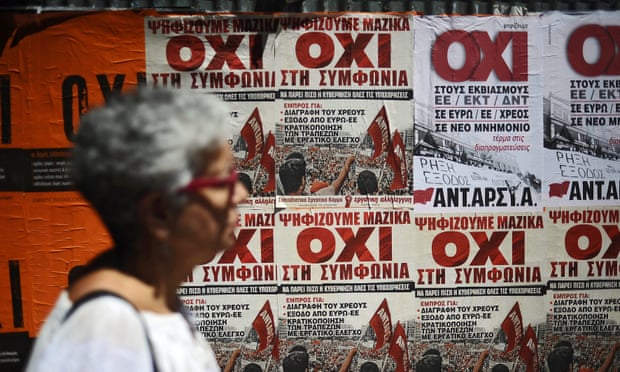
The International Monetary Fund has electrified the referendum debate in Greece after it conceded that the crisis-ridden country needs €50bn (£35bn or $55bn) of extra funds over the next three years and large-scale debt relief to create “a breathing space” and stabilise the economy.
With three days to go before a knife-edge referendum, the IMF revealed a deep split with Europe as it warned that Greece’s debts were “unsustainable”.
Fund officials said they would not be prepared to put a proposal for a third Greek bailout package to the Washington-based organisation’s board unless it included both a commitment to economic reform and debt relief.
According to the IMF, Greece should have a 20-year grace period before making any debt repayments and that final payments should not take place until 2055.
The IMF’s analysis will be seized upon by Alexis Tsipras, the Greek prime minister, who has been insisting that he will only agree to tough new austerity measures if Greece is granted debt relief.
More: http://www.theguardian.com/business/2015/jul/02/imf-greece-needs-extra-50bn-euros
International lender issues strong message to Europe by warning that Athens’ debts are unsustainable and it needs 20-year grace period on debt repayments
Larry Elliott Economics editor
Thursday 2 July 2015 16.20 BST
The International Monetary Fund has electrified the referendum debate in Greece after it conceded that the crisis-ridden country needs €50bn (£35bn or $55bn) of extra funds over the next three years and large-scale debt relief to create “a breathing space” and stabilise the economy.
With three days to go before a knife-edge referendum, the IMF revealed a deep split with Europe as it warned that Greece’s debts were “unsustainable”.
Fund officials said they would not be prepared to put a proposal for a third Greek bailout package to the Washington-based organisation’s board unless it included both a commitment to economic reform and debt relief.
According to the IMF, Greece should have a 20-year grace period before making any debt repayments and that final payments should not take place until 2055.
The IMF’s analysis will be seized upon by Alexis Tsipras, the Greek prime minister, who has been insisting that he will only agree to tough new austerity measures if Greece is granted debt relief.
More: http://www.theguardian.com/business/2015/jul/02/imf-greece-needs-extra-50bn-euros
ExecLine
- 02 Jul 2015 21:54
- 61199 of 81564
dreamcatcher
- 02 Jul 2015 23:21
- 61200 of 81564
I was in a large country house today that the Gilby Family owned from the early 1900's.
Found myself in the wine cellar. Firstly I never knew that they produced wine . I knew they produced spirits. Pulled out about 15 bottles that I presume had been their since the early 1900's.
You learn something every day -
Sir Walter Gilbey, 1st Baronet DL (2 May 1831 – 12 November 1914) was an English wine-merchant and philanthropist.
He was born at Bishop's Stortford, Hertfordshire to parents Henry and Elizabeth Gilbey. His father, the owner (and frequently the driver) of the daily coach between Bishop's Stortford and London, died when he was eleven years old, and young Gilbey was shortly afterwards placed in the office of an estate agent at Tring, subsequently obtaining a clerkship in a firm of parliamentary agents in London.
On the outbreak of the Crimean War, Walter Gilbey and his younger brother, Alfred, volunteered for civilian service at the front, and were employed at a convalescent hospital on the Dardanelles. Returning to London on the declaration of peace, Walter and Alfred Gilbey, on the advice of their eldest brother Henry Gilbey who was a wholesale wine-merchant, they started in the retail wine and spirits trade, such as the local London style gin.

Found myself in the wine cellar. Firstly I never knew that they produced wine . I knew they produced spirits. Pulled out about 15 bottles that I presume had been their since the early 1900's.
You learn something every day -
Sir Walter Gilbey, 1st Baronet DL (2 May 1831 – 12 November 1914) was an English wine-merchant and philanthropist.
He was born at Bishop's Stortford, Hertfordshire to parents Henry and Elizabeth Gilbey. His father, the owner (and frequently the driver) of the daily coach between Bishop's Stortford and London, died when he was eleven years old, and young Gilbey was shortly afterwards placed in the office of an estate agent at Tring, subsequently obtaining a clerkship in a firm of parliamentary agents in London.
On the outbreak of the Crimean War, Walter Gilbey and his younger brother, Alfred, volunteered for civilian service at the front, and were employed at a convalescent hospital on the Dardanelles. Returning to London on the declaration of peace, Walter and Alfred Gilbey, on the advice of their eldest brother Henry Gilbey who was a wholesale wine-merchant, they started in the retail wine and spirits trade, such as the local London style gin.
Fred1new
- 03 Jul 2015 07:55
- 61201 of 81564
We are all safe now. Cameron found a war to run to.

Fred1new
- 03 Jul 2015 07:58
- 61202 of 81564
We are all equal, unless you come from Eton or come from the shires!

What more can I do to provoke devolution!
What more can I do to provoke devolution!
jimmy b
- 03 Jul 2015 08:50
- 61203 of 81564
Fred ,, war criminal !!!!!!!!

TANKER - 03 Jul 2015 09:21 - 61204 of 81564
jimmy and a liar a crook a war criminal and thinks he is a god he should be hung
MaxK - 03 Jul 2015 09:21 - 61205 of 81564
Christine Lagarde attack on Greece backfires as she pays no tax
Christine Lagarde, the International Monetary Fund managing director who provoked an angry reaction from the Greek people after telling them to pay their taxes, does not pay tax on her own salary, it has emerged.

By Philip Aldrick, Economics Editor
7:04PM BST 29 May 2012
Ms Lagarde was forced to publish an embarrassing climbdown on her Facebook page over the weekend after being bombarded by hundreds of Greek people who felt insulted by her suggestion that the country’s crisis was partly due to “all these people in Greece who are trying to escape tax”.
However, on Tuesday she had to admit that her $467,940 (£300,000) annual salary and $83,760 of additional allowances are entirely tax-free as the IMF is an international organisation.
An IMF spokesman said: “Salaries, like those in most international organizations, are paid on a lower, net of tax basis to ensure equal pay for equal work regardless of nationality.”
He added that Ms Lagarde, 56, does pay all other “taxes levied on her, including local and property taxes in the US and France”.
Ms Lagarde earns more than President Barack Obama and David Cameron, both of whom pay taxes.
http://www.telegraph.co.uk/finance/economics/9298501/Christine-Lagarde-attack-on-Greece-backfires-as-she-pays-no-tax.html
Fred1new
- 03 Jul 2015 09:22
- 61206 of 81564
No problem.
Yes!
So was Maggie and the murder of the Belgrano!
Yes!
So was Maggie and the murder of the Belgrano!
cynic
- 03 Jul 2015 09:29
- 61207 of 81564
i'm certainly a strong supporter of fred's
cynic
- 03 Jul 2015 09:31
- 61208 of 81564
at least when he calls for the return of GF
at least GF's interesting and even occasionally moderately entertaining, in absolute contrast to fred who is neither
at least GF's interesting and even occasionally moderately entertaining, in absolute contrast to fred who is neither
2517GEORGE
- 03 Jul 2015 11:09
- 61209 of 81564
I see Baler Boy has a sideline---------------he is running in the 2 o'clock at Doncaster today.
2517
2517
ExecLine
- 03 Jul 2015 13:43
- 61210 of 81564
In Greece, particularly in the vicinity of the ATMs, there's a lot of this about:

So much so, that apparently a few people, and the number of them is growing, are turning to using Bitcoin as a currency. Bitcoin is 'international'.
So much so, that apparently a few people, and the number of them is growing, are turning to using Bitcoin as a currency. Bitcoin is 'international'.
ExecLine
- 03 Jul 2015 13:47
- 61211 of 81564
"Hey! This will be a bloody good time to re-do the review," say the Bank of England.
Cash in bank accounts will only be guaranteed up to a limit of £75,000 from January 1, 2016, the Bank of England has said, down from the current limit of £85,000.
The guarantee is used by savers when a bank or building society collapses. The level of deposits covered by the scheme was increased in several stages through the financial crisis to reassure savers their money was safe, in a bid to avoid bank runs. This is the first time the level of protection has been cut since the credit crunch.
The Treasury-backed but industry-funded Financial Services Compensation Scheme refunds those who lose money, and the cash is later recouped from the rest of the banking industry. Savers called on the protection when Bradford & Bingley failed, and when the Icelandic banks crashed.
Britain's deposit guarantee is set in line with the €100,000 guarantee for depositors across the European Union, a limit set in 2010. But the Government reviews this level every five years, and the present strength of the pound against the euro means €100,000 translates more closely to £75,000.
Cash in bank accounts will only be guaranteed up to a limit of £75,000 from January 1, 2016, the Bank of England has said, down from the current limit of £85,000.
The guarantee is used by savers when a bank or building society collapses. The level of deposits covered by the scheme was increased in several stages through the financial crisis to reassure savers their money was safe, in a bid to avoid bank runs. This is the first time the level of protection has been cut since the credit crunch.
The Treasury-backed but industry-funded Financial Services Compensation Scheme refunds those who lose money, and the cash is later recouped from the rest of the banking industry. Savers called on the protection when Bradford & Bingley failed, and when the Icelandic banks crashed.
Britain's deposit guarantee is set in line with the €100,000 guarantee for depositors across the European Union, a limit set in 2010. But the Government reviews this level every five years, and the present strength of the pound against the euro means €100,000 translates more closely to £75,000.
Haystack
- 03 Jul 2015 14:10
- 61212 of 81564
There is a report that 50,000 tourists a day are cancelling holidays in Greece. That is 65% of their tourism.
An interesting side effect of their banking crisis is that transferring money abroad is banned under capital controls. This means that Greek travellers in other countries are stranded. The use of their debit/credit cards is classed as transferring abroad. A honeymoon couple in NY cannot buy food. Greeks in US hospitals cannot pay their bills. Greek business people have no access to funds outside Greece.
An interesting side effect of their banking crisis is that transferring money abroad is banned under capital controls. This means that Greek travellers in other countries are stranded. The use of their debit/credit cards is classed as transferring abroad. A honeymoon couple in NY cannot buy food. Greeks in US hospitals cannot pay their bills. Greek business people have no access to funds outside Greece.
jimmy b
- 03 Jul 2015 14:14
- 61213 of 81564
It's a sad state of affairs ,as well as all the immigrants landing on Kos ,the Greeks who own cafe's and small hotels etc must be wondering where to go from here.
| About MoneyAM | Ts and Cs | Privacy Policy | Investment Warning | Content Standards | Corporate Solutions | Advertise With Us | Site Map | © 2026 MoneyAM |
Register now for FREE
Share Prices,
Stock Quotes,
Charts, Bulletin Boards, Indices, Watchlists, Portfolio, Market News, Research
or see our Premium Services including Level 2, Terminal and much more.
 Follow us on Twitter