

| Home | Log In | Register | Our Services | My Account | Contact | Help |
You are NOT currently logged in
Register now or login to post to this thread.
THE TALK TO YOURSELF THREAD. (NOWT)
goldfinger

 - 09 Jun 2005 12:25


Thought Id start this one going because its rather dead on this board at the moment and I suppose all my usual muckers are either at the Stella tennis event watching Dim Tim (lose again) or at Henly Regatta eating cucumber sandwiches (they wish,...NOT).
Anyway please feel free to just talk to yourself blast away and let it go on any company or subject you wish. Just wish Id thought of this one before.
cheers GF.
Anyway please feel free to just talk to yourself blast away and let it go on any company or subject you wish. Just wish Id thought of this one before.
cheers GF.
cynic
- 13 Nov 2015 17:48
- 64483 of 81564
i doubt you'ld get as far as that stage in proceedings - sure as hell i wouldn't even if i was 45 years younger
Fred1new
- 13 Nov 2015 17:55
- 64484 of 81564
JB.
To me, there doesn't seem much difference in mindset between you and J.J..
You may have got on well to-gether.
=-=-==-
Oh, what a lovely war comes to mind.
To me, there doesn't seem much difference in mindset between you and J.J..
You may have got on well to-gether.
=-=-==-
Oh, what a lovely war comes to mind.
cynic
- 13 Nov 2015 18:04
- 64485 of 81564
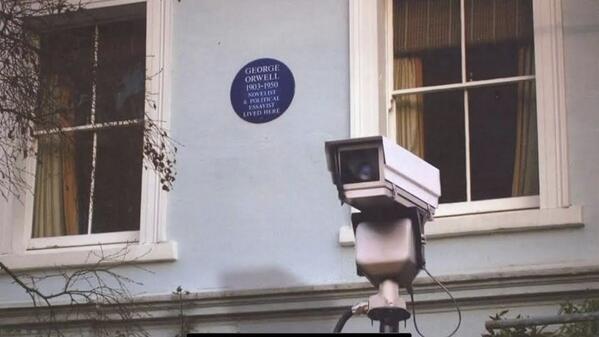
Fred - no idea how to post pix here, but find on the net the one of where george orwell lived (blue plaque) .... it's make you (and others) chuckle
MaxK - 13 Nov 2015 18:22 - 64486 of 81564
cynic
- 13 Nov 2015 18:24
- 64487 of 81564
that one indeed :-)
Haystack
- 13 Nov 2015 18:47
- 64488 of 81564
My first wife was at Aberdeen university with Orwell's son and is God Mother to his son.
Haystack
- 13 Nov 2015 18:52
- 64489 of 81564
There are 2 Orwell plaques. One is in Kentish Town and the other is in Portobello Rd area.
Haystack
- 13 Nov 2015 18:53
- 64490 of 81564
The CCTV camera is fake. Here is the same house and you can see there is no camera

MaxK - 13 Nov 2015 19:38 - 64491 of 81564
I thought it looked contrived...no one would put a pan, tilt and zoom camera, mast etc so close to a private dwelling....the tree would make it a bit pointless as well.
Haystack
- 13 Nov 2015 21:58
- 64492 of 81564
Major iincident iin Paris.
Shootings at multiple locations. Possible suicide bomb at Stade France where French/Germany match. Reports of dismembered body found at match. Hostages taken at pop concert venue.
Current count is 18 dead.
Shootings at multiple locations. Possible suicide bomb at Stade France where French/Germany match. Reports of dismembered body found at match. Hostages taken at pop concert venue.
Current count is 18 dead.
Haystack
- 13 Nov 2015 22:07
- 64493 of 81564
French news now saying at least 26 dead. NotherFrench news agency says 35.
Haystack
- 13 Nov 2015 23:14
- 64494 of 81564
http://news.sky.com/story/1587369/jihadi-jez-under-fire-from-his-own-side
'Jihadi Jez' Under Fire From His Own Side
His critics are now calling him "Jihadi Jez". That’s because Jeremy Corbyn said it would have been better to put Mohammed Emwazi on trial instead of killing him.
The backlash against the Labour leader’s comments has ranged from fury to ridicule. And that’s just among Labour MPs and party supporters.
'Jihadi Jez' Under Fire From His Own Side
His critics are now calling him "Jihadi Jez". That’s because Jeremy Corbyn said it would have been better to put Mohammed Emwazi on trial instead of killing him.
The backlash against the Labour leader’s comments has ranged from fury to ridicule. And that’s just among Labour MPs and party supporters.
Haystack
- 13 Nov 2015 23:23
- 64495 of 81564
After Paris, will people be so keen to take in more immigrants into UK?
ExecLine
 - 13 Nov 2015 23:48
- 64496 of 81564
- 13 Nov 2015 23:48
- 64496 of 81564

7 different Paris locations have been attacked thus far, obviously by ISIL terrorists and obviously in sympathy or 'to do with' with the killing of 'Jahadi John'.
Suicide bombers, hostages being shot one by one, utter carnage with bodies everywhere.
5 explosions at the concert hall, multiple explosions at the football stadium.
"Open door" invitations throughout Paris for people who don't want to travel about on the underground or to travel back home.
This is obviously one hell of an organised massive terrorist attack and on just one city.
The news coming out of France is still, understandably, painting a fragmented and confusing picture. Here is what we know so far:
A state of emergency has been declared across France, after several dozen people were killed in terrorist attacks around Paris. The number of casualties cannot yet be confirmed, though at least 49 people are so far thought to have died.
Shootings took place in a number of locations around the capital, including at least two restaurants and the Bataclan concert hall, with further explosions – reported to be two suicide attacks and a bombing – outside the Stade de France, where the national side were playing Germany in a football match.
About 100 people have reportedly been taken hostage at Bataclan in the 11th arrondissement, in what is thought to be a coordinated attack. Explosions have been heard at the concert hall, along with reports of mass shootings inside.
French president François Hollande has ordered the closing of the country’s borders to prevent the escape of the attackers, who have so far not been apprehended.
Hollande said there were “unprecedented terror attacks under way in Paris” and authorities have warned residents to stay inside.
Other cities everywhere should be on major alert for the same sort of thing happening to them. The safest place to be for most people is going to be 'home' this Saturday and the cost to businesses everywhere is going to be massive. Since this is pretty much uncontrollable, markets everywhere could well crash on Monday, IMHO.
Suicide bombers, hostages being shot one by one, utter carnage with bodies everywhere.
5 explosions at the concert hall, multiple explosions at the football stadium.
"Open door" invitations throughout Paris for people who don't want to travel about on the underground or to travel back home.
This is obviously one hell of an organised massive terrorist attack and on just one city.
The news coming out of France is still, understandably, painting a fragmented and confusing picture. Here is what we know so far:
A state of emergency has been declared across France, after several dozen people were killed in terrorist attacks around Paris. The number of casualties cannot yet be confirmed, though at least 49 people are so far thought to have died.
Shootings took place in a number of locations around the capital, including at least two restaurants and the Bataclan concert hall, with further explosions – reported to be two suicide attacks and a bombing – outside the Stade de France, where the national side were playing Germany in a football match.
About 100 people have reportedly been taken hostage at Bataclan in the 11th arrondissement, in what is thought to be a coordinated attack. Explosions have been heard at the concert hall, along with reports of mass shootings inside.
French president François Hollande has ordered the closing of the country’s borders to prevent the escape of the attackers, who have so far not been apprehended.
Hollande said there were “unprecedented terror attacks under way in Paris” and authorities have warned residents to stay inside.
Other cities everywhere should be on major alert for the same sort of thing happening to them. The safest place to be for most people is going to be 'home' this Saturday and the cost to businesses everywhere is going to be massive. Since this is pretty much uncontrollable, markets everywhere could well crash on Monday, IMHO.
Haystack
- 13 Nov 2015 23:54
- 64497 of 81564
Taxis operating for free
ExecLine
- 13 Nov 2015 23:59
- 64498 of 81564
Perhaps it's now time we atheists started a war against 'religions everywhere' and particularly trashed the idea in the head which Islamic terrorists seem to hold dear, namely, "that life begins when you die - particularly if you fight in a Holy War"?
ExecLine
- 14 Nov 2015 00:04
- 64499 of 81564
I'll start....
MaxK - 14 Nov 2015 00:08 - 64500 of 81564
Gone this week? Paris??
Angela Merkel's future under scrutiny for the first time as German asylum process criticised
A popular talk show the possibility of a coup against the German chancellor after her own party made implicit criticisms of her policy
 http://www.telegraph.co.uk/news/worldnews/europe/germany/angela-merkel/11994337/Angela-Merkels-future-under-scrutiny-for-the-first-time-as-German-asylum-process-criticised.html
Angela Merkel's future under scrutiny for the first time as German asylum process criticised
A popular talk show the possibility of a coup against the German chancellor after her own party made implicit criticisms of her policy
http://www.telegraph.co.uk/news/worldnews/europe/germany/angela-merkel/11994337/Angela-Merkels-future-under-scrutiny-for-the-first-time-as-German-asylum-process-criticised.html
Chris Carson
- 14 Nov 2015 03:01
- 64501 of 81564
Islamic State: Can its savagery be explained?
9 September 2014
From the section Middle East
This article as can be seen above was posted on BBC News online over twelve months ago. Perhaps Jeremy Corbyn and his batty followers should volunteer to have a nice cosy chat with them and point out the error of their ways.
Since the sudden appearance of the extremist Sunni Islamic State (IS), the group has seized headlines with a shocking level of blood-letting and cruelty - but can its savagery be explained, asks Fawaz A Gerges.
Islamic State has become synonymous with viciousness - beheadings, crucifixions, stonings, massacres, burying victims alive and religious and ethnic cleansing.
While such savagery might seem senseless to the vast majority of civilised human beings, for IS it is a rational choice. It is a conscious decision to terrorise enemies and impress and co-opt new recruits.
IS adheres to a doctrine of total war without limits and constraints - no such thing, for instance, as arbitration or compromise when it comes to settling disputes with even Sunni Islamist rivals. Unlike its parent organisation, al-Qaeda, IS pays no lip service to theology to justify its crimes.
The violence has its roots in what can be identified as two earlier waves, though the scale and intensity of IS' brutality far exceeds either.
The first wave, led by disciples of Sayyid Qutb - a radical Egyptian Islamist regarded as the master theoretician of modern jihadism - targeted pro-Western secular Arab regimes or what they called the "near enemy", and, on balance, showed restraint in the use of political violence.
Beginning with the assassination of Egyptian President Anwar Sadat in 1980, this Islamist insurgency dissipated by the end of the 1990s. It had cost some 2,000 lives and saw a large number of militants head to Afghanistan to battle a new global enemy - the Soviet Union.
'Killing machine'
The Afghan jihad against the Soviets gave birth to a second wave, with a specific target - the "far enemy", or the United States and, to a lesser extent, Europe.
It was spearheaded by a wealthy Saudi turned revolutionary, Osama Bin Laden.
Bin Laden went to great lengths to rationalise al-Qaeda's attack on the US on 11 September 2001, calling it "defensive jihad", or retaliation against perceived US domination of Muslim societies.
Conscious of the importance of winning hearts and minds, Bin Laden sold his message to Muslims and even Americans as self-defence, not aggression.
This kind of justification, however, carries no weight with IS leader Abu Bakr al-Baghdadi, who cannot care less what the world thinks of his blood-letting.
In fact, he and his cohorts revel in displaying barbarity and coming across as savage.
In contrast to the first two waves, IS actually stresses violent action over theology and theory, and has produced no repertoire of ideas to sustain and nourish its social base. It is a killing machine powered by blood and iron.
Going beyond Bin Laden's doctrine that "when people see a strong horse and a weak horse, by nature they will like the strong horse", al-Baghdadi's "victory through terrorism" signals to friends and foes that IS is a winning horse. Get out of the way or you will be crushed; join our caravan and make history.
Increasing evidence shows that over the past few months, hundreds, if not thousands, of diehard former Islamist enemies of IS, such as the al-Nusra Front and the Islamic Front, answered al-Baghdadi's call.
'Shock-and-awe'
IS' sophisticated outreach campaign appeals to disaffected and deluded young Sunnis worldwide because it is seen as a powerful vanguard that delivers victory and salvation.
Far from abhorring the group's brutality, young recruits are attracted by its shock-and-awe tactics against the enemies of Islam.
Its exploits on the battlefield - especially capturing huge swathes of territory in Syria and Iraq, and establishing a caliphate - resonate near and far. Nothing succeeds like success, and IS' recent military gains have brought it a recruitment bonanza.
Muslim men living in Western countries join IS and other extremist groups because they feel part of a greater mission - to resurrect a lost idealised type of caliphate and be part of a tight-knit community with a potent identity.
Initially, many young men from London, Berlin and Paris and elsewhere migrate to the lands of jihad to defend persecuted co-religionists, but they end up in the clutches of IS, doing its evil deeds, such as beheading innocent civilians.
The drivers behind IS' unrestrained extremism can be traced to its origins with al-Qaeda in Iraq, led by Abu Musab al-Zarqawi, who was killed by the Americans in 2006.
Not unlike its predecessor, IS is nourished on an anti-Shia diet and visceral hatred of minorities in general, portraying itself as the spearhead of Sunni Arabs in the fight against sectarian-based regimes in Baghdad and Damascus.
Al-Zarqawi and al-Baghdadi view Shias as infidels, a fifth column in the heart of Islam that must be wiped out - a genocidal worldview.
Following in the footsteps of al-Zarqawi, al-Baghdadi ignored repeated pleas by his mentor Ayman al-Zawahiri, head of al-Qaeda, and other top militants to avoid indiscriminate killing of Shia and, instead, to attack the Shia-dominated and Alawite regimes in Iraq and Syria.
Sights on US?
By exploiting the deepening Sunni-Shia rift in Iraq and the sectarian civil war in Syria, al-Baghdadi has built a powerful base of support among rebellious Sunnis and has blended his group into local communities.
He also restructured his military network and co-opted experienced officers of Saddam Hussein's disbanded army who turned IS into a professional sectarian fighting force.
IS has so far consistently focused on the Shia and not the "far enemy". The struggle against the US and Europe is distant, not a priority; it has to await liberation at home.
At the height of Israeli bombings of Gaza in August, militants on social media criticised IS for killing Muslims while doing nothing to help the Palestinians.
IS retorted by saying the struggle against the Shia takes priority over everything else.
Now that the US and Europe have joined the conflict against IS, the group will use all its assets in retaliation, including further beheading of hostages. There is also a growing likelihood that it will attack soft diplomatic targets in the Middle East.
While it might want to stage a spectacular operation on the American or European homeland, it is doubtful that IS currently has the capabilities to carry out complex attacks like 9/11.
A few months ago, in response to chatter by his followers, al-Baghdadi acknowledged that his organisation was not equipped to attack the Americans at home.
He said though that he wished the US would deploy boots on the ground so that IS could directly engage the Americans - and kill them.
Fawaz A Gerges holds the Emirates Chair in Contemporary Middle Eastern Studies at the London School of Economics and Political Science. He is author of several books, including Journey of the Jihadist: Inside Muslim Militancy.
9 September 2014
From the section Middle East
This article as can be seen above was posted on BBC News online over twelve months ago. Perhaps Jeremy Corbyn and his batty followers should volunteer to have a nice cosy chat with them and point out the error of their ways.
Since the sudden appearance of the extremist Sunni Islamic State (IS), the group has seized headlines with a shocking level of blood-letting and cruelty - but can its savagery be explained, asks Fawaz A Gerges.
Islamic State has become synonymous with viciousness - beheadings, crucifixions, stonings, massacres, burying victims alive and religious and ethnic cleansing.
While such savagery might seem senseless to the vast majority of civilised human beings, for IS it is a rational choice. It is a conscious decision to terrorise enemies and impress and co-opt new recruits.
IS adheres to a doctrine of total war without limits and constraints - no such thing, for instance, as arbitration or compromise when it comes to settling disputes with even Sunni Islamist rivals. Unlike its parent organisation, al-Qaeda, IS pays no lip service to theology to justify its crimes.
The violence has its roots in what can be identified as two earlier waves, though the scale and intensity of IS' brutality far exceeds either.
The first wave, led by disciples of Sayyid Qutb - a radical Egyptian Islamist regarded as the master theoretician of modern jihadism - targeted pro-Western secular Arab regimes or what they called the "near enemy", and, on balance, showed restraint in the use of political violence.
Beginning with the assassination of Egyptian President Anwar Sadat in 1980, this Islamist insurgency dissipated by the end of the 1990s. It had cost some 2,000 lives and saw a large number of militants head to Afghanistan to battle a new global enemy - the Soviet Union.
'Killing machine'
The Afghan jihad against the Soviets gave birth to a second wave, with a specific target - the "far enemy", or the United States and, to a lesser extent, Europe.
It was spearheaded by a wealthy Saudi turned revolutionary, Osama Bin Laden.
Bin Laden went to great lengths to rationalise al-Qaeda's attack on the US on 11 September 2001, calling it "defensive jihad", or retaliation against perceived US domination of Muslim societies.
Conscious of the importance of winning hearts and minds, Bin Laden sold his message to Muslims and even Americans as self-defence, not aggression.
This kind of justification, however, carries no weight with IS leader Abu Bakr al-Baghdadi, who cannot care less what the world thinks of his blood-letting.
In fact, he and his cohorts revel in displaying barbarity and coming across as savage.
In contrast to the first two waves, IS actually stresses violent action over theology and theory, and has produced no repertoire of ideas to sustain and nourish its social base. It is a killing machine powered by blood and iron.
Going beyond Bin Laden's doctrine that "when people see a strong horse and a weak horse, by nature they will like the strong horse", al-Baghdadi's "victory through terrorism" signals to friends and foes that IS is a winning horse. Get out of the way or you will be crushed; join our caravan and make history.
Increasing evidence shows that over the past few months, hundreds, if not thousands, of diehard former Islamist enemies of IS, such as the al-Nusra Front and the Islamic Front, answered al-Baghdadi's call.
'Shock-and-awe'
IS' sophisticated outreach campaign appeals to disaffected and deluded young Sunnis worldwide because it is seen as a powerful vanguard that delivers victory and salvation.
Far from abhorring the group's brutality, young recruits are attracted by its shock-and-awe tactics against the enemies of Islam.
Its exploits on the battlefield - especially capturing huge swathes of territory in Syria and Iraq, and establishing a caliphate - resonate near and far. Nothing succeeds like success, and IS' recent military gains have brought it a recruitment bonanza.
Muslim men living in Western countries join IS and other extremist groups because they feel part of a greater mission - to resurrect a lost idealised type of caliphate and be part of a tight-knit community with a potent identity.
Initially, many young men from London, Berlin and Paris and elsewhere migrate to the lands of jihad to defend persecuted co-religionists, but they end up in the clutches of IS, doing its evil deeds, such as beheading innocent civilians.
The drivers behind IS' unrestrained extremism can be traced to its origins with al-Qaeda in Iraq, led by Abu Musab al-Zarqawi, who was killed by the Americans in 2006.
Not unlike its predecessor, IS is nourished on an anti-Shia diet and visceral hatred of minorities in general, portraying itself as the spearhead of Sunni Arabs in the fight against sectarian-based regimes in Baghdad and Damascus.
Al-Zarqawi and al-Baghdadi view Shias as infidels, a fifth column in the heart of Islam that must be wiped out - a genocidal worldview.
Following in the footsteps of al-Zarqawi, al-Baghdadi ignored repeated pleas by his mentor Ayman al-Zawahiri, head of al-Qaeda, and other top militants to avoid indiscriminate killing of Shia and, instead, to attack the Shia-dominated and Alawite regimes in Iraq and Syria.
Sights on US?
By exploiting the deepening Sunni-Shia rift in Iraq and the sectarian civil war in Syria, al-Baghdadi has built a powerful base of support among rebellious Sunnis and has blended his group into local communities.
He also restructured his military network and co-opted experienced officers of Saddam Hussein's disbanded army who turned IS into a professional sectarian fighting force.
IS has so far consistently focused on the Shia and not the "far enemy". The struggle against the US and Europe is distant, not a priority; it has to await liberation at home.
At the height of Israeli bombings of Gaza in August, militants on social media criticised IS for killing Muslims while doing nothing to help the Palestinians.
IS retorted by saying the struggle against the Shia takes priority over everything else.
Now that the US and Europe have joined the conflict against IS, the group will use all its assets in retaliation, including further beheading of hostages. There is also a growing likelihood that it will attack soft diplomatic targets in the Middle East.
While it might want to stage a spectacular operation on the American or European homeland, it is doubtful that IS currently has the capabilities to carry out complex attacks like 9/11.
A few months ago, in response to chatter by his followers, al-Baghdadi acknowledged that his organisation was not equipped to attack the Americans at home.
He said though that he wished the US would deploy boots on the ground so that IS could directly engage the Americans - and kill them.
Fawaz A Gerges holds the Emirates Chair in Contemporary Middle Eastern Studies at the London School of Economics and Political Science. He is author of several books, including Journey of the Jihadist: Inside Muslim Militancy.
cynic
- 14 Nov 2015 07:49
- 64502 of 81564
where's FRED when you want to hear a voice of reason?
| About MoneyAM | Ts and Cs | Privacy Policy | Investment Warning | Content Standards | Corporate Solutions | Advertise With Us | Site Map | © 2026 MoneyAM |
Register now for FREE
Share Prices,
Stock Quotes,
Charts, Bulletin Boards, Indices, Watchlists, Portfolio, Market News, Research
or see our Premium Services including Level 2, Terminal and much more.
 Follow us on Twitter