

| Home | Log In | Register | Our Services | My Account | Contact | Help |
You are NOT currently logged in
Register now or login to post to this thread.
THE TALK TO YOURSELF THREAD. (NOWT)
goldfinger

 - 09 Jun 2005 12:25


Thought Id start this one going because its rather dead on this board at the moment and I suppose all my usual muckers are either at the Stella tennis event watching Dim Tim (lose again) or at Henly Regatta eating cucumber sandwiches (they wish,...NOT).
Anyway please feel free to just talk to yourself blast away and let it go on any company or subject you wish. Just wish Id thought of this one before.
cheers GF.
Anyway please feel free to just talk to yourself blast away and let it go on any company or subject you wish. Just wish Id thought of this one before.
cheers GF.
iturama - 06 Aug 2016 16:12 - 72983 of 81564
But who's shoes?
Chris Carson
- 06 Aug 2016 20:04
- 72984 of 81564
Forget shoes iturama, good hips (wide) would be my preference and thighs that squeeze, not break like twigs i.e. the above. Personality that makes you laugh and ok big nipples if that floats your boat :0) Forget super models.
ExecLine
 - 06 Aug 2016 20:14
- 72985 of 81564
- 06 Aug 2016 20:14
- 72985 of 81564

Adam Peaty absolutely smashes the competition in his '100m Breast Stroke' Heat whilst creating a new World Record of 57.55 secs.
My daughter knows him quite well and she says he tells people it is his intention to create a new world record every time he swims.
So 'watch this space', eh?
My daughter knows him quite well and she says he tells people it is his intention to create a new world record every time he swims.
So 'watch this space', eh?
jimmy b
- 06 Aug 2016 22:00
- 72986 of 81564
Do you mean like this Chris ? you did say big hips and thighs that sqeeze.

Chris Carson
- 06 Aug 2016 22:17
- 72987 of 81564
Nahhh Jimmy she would break my back.:0) I'm talking real ladies with a brain. But preferably with big nipples as she is quoting Shakespeare. Oooops think I'm in big trouble with our female posters. No sense of humour?
cynic
- 07 Aug 2016 17:19
- 72988 of 81564
like diane abbott perhaps
Fred1new
- 07 Aug 2016 17:51
- 72989 of 81564
I thought it was a photo of your wife.
But didn't like to comment!
But didn't like to comment!
iturama - 08 Aug 2016 09:26 - 72990 of 81564

You guys don't appreciate eye candy when you see it... :-)
Now this is what I call a trophy girl friend.
Fred1new
- 08 Aug 2016 09:35
- 72991 of 81564
It,
Well if it turns you on, so be it.
Well if it turns you on, so be it.
VICTIM - 08 Aug 2016 09:37 - 72992 of 81564
Do these Tatooists work by the metre .
jimmy b
- 08 Aug 2016 09:40
- 72993 of 81564
I feel sick .
cynic
- 08 Aug 2016 10:02
- 72994 of 81564
not my idea of the erotic it must be said, but there's an awful lot of songs in praise of women with big thighs and bums, from quite early blues numbers through to queen
Haystack
- 08 Aug 2016 13:13
- 72995 of 81564
Difficult to decide which view is worse
ExecLine
- 08 Aug 2016 16:10
- 72996 of 81564
Fred1new
- 08 Aug 2016 17:51
- 72997 of 81564
Didn't think you or the waiter could count!
8-)
8-)
ExecLine
- 08 Aug 2016 19:07
- 72998 of 81564
Come on guys, lets see you admit to some of these 20% and 30% scores.
:-)
:-)
Haystack
- 08 Aug 2016 19:48
- 72999 of 81564
72%
A couple looked dubious. Our moon is now technically a planet.
A couple looked dubious. Our moon is now technically a planet.
MaxK - 09 Aug 2016 00:10 - 73000 of 81564

ExecLine
- 09 Aug 2016 10:39
- 73001 of 81564
I read the following with curious interest:
From: http://www.bbc.co.uk/news/business-36854292
Where in the world is my data and how secure is it?
By Rob Crossley
Technology of Business reporter
9 August 2016
When Max Schrems, an Austrian privacy activist, requested to see his personal data that Facebook stored on its servers, he was mailed a CD-ROM containing a 1,222-page document.
That file, which would stretch nearly a quarter of a mile if printed and laid end-to-end, offered a glimpse into Facebook's appetite for the private details of its 1.65 billion users.
The information included phone numbers and email addresses of Mr Schrems' friends and family; a history of all the devices he used to log in to the service; all the events he had been invited to; everyone he had "friended" (and subsequently de-friended); and an archive of his private messages.
It even included transcripts of messages he'd deleted.
But Mr Schrems, who says he only used Facebook occasionally over a three-year period, believes a sizeable chunk of information was withheld from him.
(Max Schrems has so far filed two lawsuits against Facebook’s privacy policies)
He received data records for about 50 categories, but believes there are more than 100, he tells the BBC.
"They withheld my facial recognition data, which is a technology that can identify me through my pictures. They don't disclose tracking information either, which is the even creepier stuff they do - things like whether you've read a webpage about a sports car and how long you read it for."
Facebook can even track non-members' internet usage through the use of cookies place on their machines, as a recent legal decision in Belgium confirmed.
Facebook can even track non-members' internet usage
Mr Schrems' experience vividly illustrates the challenges we face in a digital age full of messaging apps, social networks, tailored search engines, email clients, and banking apps, all collecting personal data about us and storing it, somewhere, in the cloud.
But where is all this data exactly, how is it being used, and how secure is it?
The Big Four
More than half of the world's rentable cloud storage is controlled by four major corporations. Amazon is by far the biggest, with about a third of the market share and 13 massive data centres in the US, three in South America, five in Europe, 11 spread across Asia, and three in Australia.
The next three biggest providers are Microsoft, IBM and Google, and each of them adopts a similar global pattern of server farms.
(Prof Dan Svantesson says having data stored in multiple jurisdictions can cause legal issues)
These major public cloud providers habitually duplicate user data across their networks. It means that information uploaded to the cloud in, say, the UK or the US, is likely to be transferred at some point to servers in major cities around the world, from Sydney to Shanghai.
The problem with this, says Prof Dan Svantesson, an internet law specialist at Bond University, Australia, is that "there is always a risk that the country your data goes to doesn't have the same level of protection [as your own].
"If your data ends up in another country, it can be unclear who has access to it, be it network providers or law enforcement," he says.
Benjamin Caudill, a cybersecurity consultant at Rhino Security Labs in Seattle, also has concerns about how this data is distributed.
(Benjamin Caudill believes major cloud providers don’t always know where all your data is stored)
"No-one really quite knows how the sausage is made," says Mr Caudill, whose work includes testing firms' defences though "ethical hacking".
"It's very difficult to understand where your data is stored. A lot of times the companies themselves aren't sure where all the data could reside."
He says a client of his, who was using Microsoft's Azure cloud service, fell victim to a hack - all data and back-ups were deleted.
Google data centre pipes
Image copyrightGETTY IMAGES
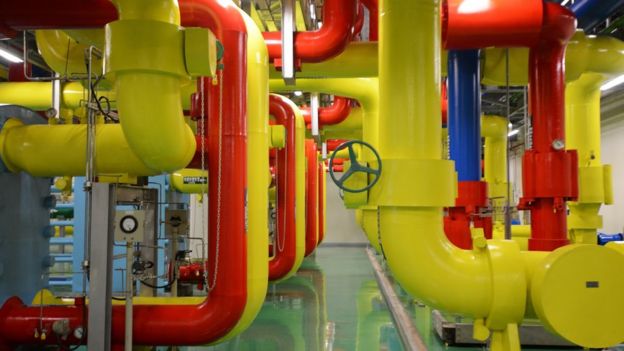
Google's data centre in Taiwan is not all computer servers - a lot of cooling is needed too
But after some digging, it emerged that a portion of the lost data had been stored elsewhere on Azure's servers. While that was a relief to Mr Caudill's client, the apparent random nature of data placement across Microsoft's servers didn't fill him with confidence.
"No-one really knows how secure the cloud services are from the major providers," says Mr Caudill, who suspects that "both Amazon and Azure have had major security compromises at some point."
Security breach?
For their part, all the big public cloud providers say security is a priority.
At Google's server facility in South Carolina, for example, guards patrol the doors and employ biometric iris scanners at the entrances to the inner sanctum. Underfloor laser beams detect intruders.
But none would say they've never had security breaches.
Google data centre FinlandImage copyrightGOOGLE
Image caption
Google's data centre in Finland underlines the sheer scale of such facilities
A Microsoft spokesperson told the BBC: "Microsoft has a customer commitment to help safeguard customer data and empower them to make decisions about that data. We recommend customers visit the Microsoft Trust Center to learn more about how their data is managed and kept secure."
Amazon emphasises that customers "retain ownership and control of their content. They choose which location to store their data and it doesn't move unless the customer decides to move it."
This ability to choose which region your data is stored in is proving increasingly popular with firms, particularly in the European Union where the new stringent General Data Protection Regulation is due to come into force in 2018.
Post at your peril
But we consumers often don't have this luxury.
"The data of your Gmail account is absolutely on more than one server. It's absolutely in more than one country," says Prof Svantesson.
But why should we care?
Is duplication of data across multiple sites make hacking more or less likely?
The more of our data that's out there scattered throughout the world, the more vulnerable it is to hackers, argues Mr Caudill - a supposition borne out by the fact that identity fraud is on the rise.
As people continue to upload their digital information online, into a marsh of territorial legal complexities and undisclosed national security protocols, Prof Svantesson offers some practical advice - which many people still do not follow.
"I would suggest never putting anything sensitive on the cloud, such as credit card information, or personal images that you don't want others to see.
"Some things you should just leave to yourself," he advises.
From: http://www.bbc.co.uk/news/business-36854292
Where in the world is my data and how secure is it?
By Rob Crossley
Technology of Business reporter
9 August 2016
When Max Schrems, an Austrian privacy activist, requested to see his personal data that Facebook stored on its servers, he was mailed a CD-ROM containing a 1,222-page document.
That file, which would stretch nearly a quarter of a mile if printed and laid end-to-end, offered a glimpse into Facebook's appetite for the private details of its 1.65 billion users.
The information included phone numbers and email addresses of Mr Schrems' friends and family; a history of all the devices he used to log in to the service; all the events he had been invited to; everyone he had "friended" (and subsequently de-friended); and an archive of his private messages.
It even included transcripts of messages he'd deleted.
But Mr Schrems, who says he only used Facebook occasionally over a three-year period, believes a sizeable chunk of information was withheld from him.
(Max Schrems has so far filed two lawsuits against Facebook’s privacy policies)
He received data records for about 50 categories, but believes there are more than 100, he tells the BBC.
"They withheld my facial recognition data, which is a technology that can identify me through my pictures. They don't disclose tracking information either, which is the even creepier stuff they do - things like whether you've read a webpage about a sports car and how long you read it for."
Facebook can even track non-members' internet usage through the use of cookies place on their machines, as a recent legal decision in Belgium confirmed.
Facebook can even track non-members' internet usage
Mr Schrems' experience vividly illustrates the challenges we face in a digital age full of messaging apps, social networks, tailored search engines, email clients, and banking apps, all collecting personal data about us and storing it, somewhere, in the cloud.
But where is all this data exactly, how is it being used, and how secure is it?
The Big Four
More than half of the world's rentable cloud storage is controlled by four major corporations. Amazon is by far the biggest, with about a third of the market share and 13 massive data centres in the US, three in South America, five in Europe, 11 spread across Asia, and three in Australia.
The next three biggest providers are Microsoft, IBM and Google, and each of them adopts a similar global pattern of server farms.
(Prof Dan Svantesson says having data stored in multiple jurisdictions can cause legal issues)
These major public cloud providers habitually duplicate user data across their networks. It means that information uploaded to the cloud in, say, the UK or the US, is likely to be transferred at some point to servers in major cities around the world, from Sydney to Shanghai.
The problem with this, says Prof Dan Svantesson, an internet law specialist at Bond University, Australia, is that "there is always a risk that the country your data goes to doesn't have the same level of protection [as your own].
"If your data ends up in another country, it can be unclear who has access to it, be it network providers or law enforcement," he says.
Benjamin Caudill, a cybersecurity consultant at Rhino Security Labs in Seattle, also has concerns about how this data is distributed.
(Benjamin Caudill believes major cloud providers don’t always know where all your data is stored)
"No-one really quite knows how the sausage is made," says Mr Caudill, whose work includes testing firms' defences though "ethical hacking".
"It's very difficult to understand where your data is stored. A lot of times the companies themselves aren't sure where all the data could reside."
He says a client of his, who was using Microsoft's Azure cloud service, fell victim to a hack - all data and back-ups were deleted.
Google data centre pipes
Image copyrightGETTY IMAGES
Google's data centre in Taiwan is not all computer servers - a lot of cooling is needed too
But after some digging, it emerged that a portion of the lost data had been stored elsewhere on Azure's servers. While that was a relief to Mr Caudill's client, the apparent random nature of data placement across Microsoft's servers didn't fill him with confidence.
"No-one really knows how secure the cloud services are from the major providers," says Mr Caudill, who suspects that "both Amazon and Azure have had major security compromises at some point."
Security breach?
For their part, all the big public cloud providers say security is a priority.
At Google's server facility in South Carolina, for example, guards patrol the doors and employ biometric iris scanners at the entrances to the inner sanctum. Underfloor laser beams detect intruders.
But none would say they've never had security breaches.
Google data centre FinlandImage copyrightGOOGLE
Image caption
Google's data centre in Finland underlines the sheer scale of such facilities
A Microsoft spokesperson told the BBC: "Microsoft has a customer commitment to help safeguard customer data and empower them to make decisions about that data. We recommend customers visit the Microsoft Trust Center to learn more about how their data is managed and kept secure."
Amazon emphasises that customers "retain ownership and control of their content. They choose which location to store their data and it doesn't move unless the customer decides to move it."
This ability to choose which region your data is stored in is proving increasingly popular with firms, particularly in the European Union where the new stringent General Data Protection Regulation is due to come into force in 2018.
Post at your peril
But we consumers often don't have this luxury.
"The data of your Gmail account is absolutely on more than one server. It's absolutely in more than one country," says Prof Svantesson.
But why should we care?
Is duplication of data across multiple sites make hacking more or less likely?
The more of our data that's out there scattered throughout the world, the more vulnerable it is to hackers, argues Mr Caudill - a supposition borne out by the fact that identity fraud is on the rise.
As people continue to upload their digital information online, into a marsh of territorial legal complexities and undisclosed national security protocols, Prof Svantesson offers some practical advice - which many people still do not follow.
"I would suggest never putting anything sensitive on the cloud, such as credit card information, or personal images that you don't want others to see.
"Some things you should just leave to yourself," he advises.
aldwickk
- 09 Aug 2016 12:10
- 73002 of 81564
Europe[edit]
Macmillan worked with states outside the European Economic Community (EEC) to form the European Free Trade Association (EFTA), which from 3 May 1960 established a free-trade area. Macmillan also saw the value of rapprochement with the EEC, to which his government sought belated entry, but Britain's application was vetoed by French president Charles de Gaulle on 29 January 1963. De Gaulle was always strongly opposed to British entry for many reasons. He sensed the British were inevitably closely linked to the Americans. He saw the EEC as a continental arrangement primarily between France and Germany, and if Britain joined France's role would diminish.[1
Macmillan worked with states outside the European Economic Community (EEC) to form the European Free Trade Association (EFTA), which from 3 May 1960 established a free-trade area. Macmillan also saw the value of rapprochement with the EEC, to which his government sought belated entry, but Britain's application was vetoed by French president Charles de Gaulle on 29 January 1963. De Gaulle was always strongly opposed to British entry for many reasons. He sensed the British were inevitably closely linked to the Americans. He saw the EEC as a continental arrangement primarily between France and Germany, and if Britain joined France's role would diminish.[1
| About MoneyAM | Ts and Cs | Privacy Policy | Investment Warning | Content Standards | Corporate Solutions | Advertise With Us | Site Map | © 2026 MoneyAM |
Register now for FREE
Share Prices,
Stock Quotes,
Charts, Bulletin Boards, Indices, Watchlists, Portfolio, Market News, Research
or see our Premium Services including Level 2, Terminal and much more.
 Follow us on Twitter