

| Home | Log In | Register | Our Services | My Account | Contact | Help |
You are NOT currently logged in
Register now or login to post to this thread.
THE TALK TO YOURSELF THREAD. (NOWT)
goldfinger

 - 09 Jun 2005 12:25


Thought Id start this one going because its rather dead on this board at the moment and I suppose all my usual muckers are either at the Stella tennis event watching Dim Tim (lose again) or at Henly Regatta eating cucumber sandwiches (they wish,...NOT).
Anyway please feel free to just talk to yourself blast away and let it go on any company or subject you wish. Just wish Id thought of this one before.
cheers GF.
Anyway please feel free to just talk to yourself blast away and let it go on any company or subject you wish. Just wish Id thought of this one before.
cheers GF.
dreamcatcher
- 17 Nov 2013 20:51
- 32904 of 81564
If he off loads BHS, I wonder if he will be sniffing round Marks. He will then turn its clothes into no more than you would see in a market.(cheap and nasty) Hmmmmm
cynic
- 17 Nov 2013 20:51
- 32905 of 81564
i agree that it really does stick in the throat, but like i said above ......
pretty much a rhetorical question, where does one draw the line, or ultimately, is it (not) just a personal choice provided that the law is obeyed?
pretty much a rhetorical question, where does one draw the line, or ultimately, is it (not) just a personal choice provided that the law is obeyed?
dreamcatcher
- 17 Nov 2013 20:54
- 32906 of 81564
If you and I lol filtered off in excess of £1bn,would there not be an investigation, no of course not. :-))
MaxK - 17 Nov 2013 20:56 - 32907 of 81564
Cast Iron Dave moved the goalposts after the last election vis €uro in or out.
Do you seriously believe he will hold a ref is he gets back in?
Do you seriously believe he will hold a ref is he gets back in?
goldfinger
- 17 Nov 2013 21:00
- 32908 of 81564
cynic - 17 Nov 2013 20:25 - 32904 of 32905
income tax contribution
i was amazed to read that the top 1% of income tax payers contribute 30% of total income tax revenue, and i see no reason to doubt that analysis.................ends
Look at it another way /turn it on its head, why on earth are you trying to pay less tax when you are raking in all that money, money you couldnt possibly ever spend in a life time.
Its called GREED.
Another fact FTSE 100 bosses are now on a multiple of 74 times over the small business sole proprietor which also is just above the Naional average wage. The multiple back in 2006 was just 8.!!!!!!!!!!!!!!!!!!
income tax contribution
i was amazed to read that the top 1% of income tax payers contribute 30% of total income tax revenue, and i see no reason to doubt that analysis.................ends
Look at it another way /turn it on its head, why on earth are you trying to pay less tax when you are raking in all that money, money you couldnt possibly ever spend in a life time.
Its called GREED.
Another fact FTSE 100 bosses are now on a multiple of 74 times over the small business sole proprietor which also is just above the Naional average wage. The multiple back in 2006 was just 8.!!!!!!!!!!!!!!!!!!
dreamcatcher
- 17 Nov 2013 21:01
- 32909 of 81564
No different of the story I remember about the Swedish pop Group that went by the name of Abba. At one time they were earning more than Volvo and to avoid paying tax were paid in potatoes. (no its not April 1 ) must of saved huge tax revenues some how. lol
Stan
- 17 Nov 2013 21:03
- 32910 of 81564
So... yet again, why do you lot persistently vote for them?
dreamcatcher
- 17 Nov 2013 21:04
- 32911 of 81564
Agree you will not spend it all, but it gives a huge sense of financial security, and your wealth can be passed on to family members to give them a good start in life. Your health is just as important.
dreamcatcher
- 17 Nov 2013 21:04
- 32912 of 81564
Shut up Stan. :-))
MaxK - 17 Nov 2013 21:12 - 32913 of 81564
Moonboot sums it up nicely!
It's business that really rules us now
Lobbying is the least of it: corporate interests have captured the entire democratic process. No wonder so many have given up on politics
George Monbiot
The Guardian, Monday 11 November 2013 20.31 GMT
http://www.theguardian.com/commentisfree/2013/nov/11/business-rules-lobbying-corporate-interests
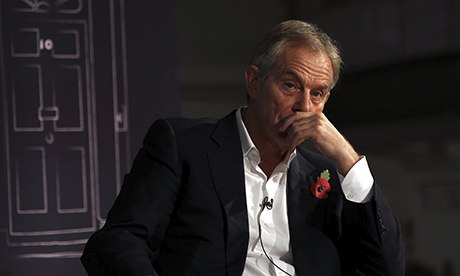
‘Tony Blair and Gordon Brown purged the party of any residue of opposition to corporations and the people who run them. That's what New Labour was all about.' Photograph: Sean Dempsey/PA
It's the reason for the collapse of democratic choice. It's the source of our growing disillusionment with politics. It's the great unmentionable. Corporate power. The media will scarcely whisper its name. It is howlingly absent from parliamentary debates. Until we name it and confront it, politics is a waste of time.
The political role of business corporations is generally interpreted as that of lobbyists, seeking to influence government policy. In reality they belong on the inside. They are part of the nexus of power that creates policy. They face no significant resistance, from either government or opposition, as their interests have now been woven into the fabric of all three main political parties in Britain.
Most of the scandals that leave people in despair about politics arise from this source. On Monday, for instance, the Guardian revealed that the government's subsidy system for gas-burning power stations is being designed by an executive from the Dublin-based company ESB International, who has been seconded into the Department of Energy. What does ESB do? Oh, it builds gas-burning power stations.
On the same day we learned that a government minister, Nick Boles, has privately assured the gambling company Ladbrokes that it needn't worry about attempts by local authorities to stop the spread of betting shops. His new law will prevent councils from taking action.
Last week we discovered that G4S's contract to run immigration removal centres will be expanded, even though all further business with the state was supposed to be frozen while allegations of fraud were investigated.
Every week we learn that systemic failures on the part of government contractors are no barrier to obtaining further work, that the promise of efficiency, improvements and value for money delivered by outsourcing and privatisation have failed to materialise.
The monitoring which was meant to keep these companies honest is haphazard, the penalties almost nonexistent, the rewards can be stupendous, dizzying, corrupting. Yet none of this deters the government. Since 2008, the outsourcing of public services has doubled, to £20bn. It is due to rise to £100bn by 2015.
This policy becomes explicable only when you recognise where power really lies. The role of the self-hating state is to deliver itself to big business. In doing so it creates a tollbooth economy: a system of corporate turnpikes, operated by companies with effective monopolies.
It's hardly surprising that the lobbying bill – now stalled by the House of Lords – offered almost no checks on the power of corporate lobbyists, while hog-tying the charities who criticise them. But it's not just that ministers are not discouraged from hobnobbing with corporate executives: they are now obliged to do so.
Thanks to an initiative by Lord Green, large companies have ministerial "buddies", who have to meet them when the companies request it. There were 698 of these meetings during the first 18 months of the scheme, called by corporations these ministers are supposed be regulating. Lord Green, by the way, is currently a government trade minister. Before that he was chairman of HSBC, presiding over the bank while it laundered vast amounts of money stashed by Mexican drugs barons. Ministers, lobbyists – can you tell them apart?
That the words corporate power seldom feature in the corporate press is not altogether surprising. It's more disturbing to see those parts of the media that are not owned by Rupert Murdoch or Lord Rothermere acting as if they are.
For example, for five days every week the BBC's Today programme starts with a business report in which only insiders are interviewed. They are treated with a deference otherwise reserved for God on Thought for the Day. There's even a slot called Friday Boss, in which the programme's usual rules of engagement are set aside and its reporters grovel before the corporate idol. Imagine the outcry if Today had a segment called Friday Trade Unionist or Friday Corporate Critic.
This, in my view, is a much graver breach of BBC guidelines than giving unchallenged airtime to one political party but not others, as the bosses are the people who possess real power – those, in other words, whom the BBC has the greatest duty to accost. Research conducted by the Cardiff school of journalism shows business representatives now receive 11% of airtime on the BBC's 6 o'clock news (this has risen from 7% in 2007), while trade unionists receive 0.6% (which has fallen from 1.4%). Balance? Impartiality? The BBC puts a match to its principles every day.
And where, beyond the Green party, Plaid Cymru, a few ageing Labour backbenchers, is the political resistance? After the article I wrote last week, about the grave threat the transatlantic trade and investment partnership presents to parliamentary sovereignty and democratic choice, several correspondents asked me what response there has been from the Labour party. It's easy to answer: nothing.
Tony Blair and Gordon Brown purged the party of any residue of opposition to corporations and the people who run them. That's what New Labour was all about. Now opposition MPs stare mutely as their powers are given away to a system of offshore arbitration panels run by corporate lawyers.
Since Blair, parliament operates much as Congress in the United States does: the lefthand glove puppet argues with the righthand glove puppet, but neither side will turn around to face the corporate capital that controls almost all our politics. This is why the assertion that parliamentary democracy has been reduced to a self-important farce has resonated so widely over the past fortnight.
So I don't blame people for giving up on politics. I haven't given up yet, but I find it ever harder to explain why. When a state-corporate nexus of power has bypassed democracy and made a mockery of the voting process, when an unreformed political funding system ensures that parties can be bought and sold, when politicians of the three main parties stand and watch as public services are divvied up by a grubby cabal of privateers, what is left of this system that inspires us to participate?
Twitter: @georgemonbiot A fully referenced version of this article can be found at monbiot.com
It's business that really rules us now
Lobbying is the least of it: corporate interests have captured the entire democratic process. No wonder so many have given up on politics
George Monbiot
The Guardian, Monday 11 November 2013 20.31 GMT
http://www.theguardian.com/commentisfree/2013/nov/11/business-rules-lobbying-corporate-interests
‘Tony Blair and Gordon Brown purged the party of any residue of opposition to corporations and the people who run them. That's what New Labour was all about.' Photograph: Sean Dempsey/PA
It's the reason for the collapse of democratic choice. It's the source of our growing disillusionment with politics. It's the great unmentionable. Corporate power. The media will scarcely whisper its name. It is howlingly absent from parliamentary debates. Until we name it and confront it, politics is a waste of time.
The political role of business corporations is generally interpreted as that of lobbyists, seeking to influence government policy. In reality they belong on the inside. They are part of the nexus of power that creates policy. They face no significant resistance, from either government or opposition, as their interests have now been woven into the fabric of all three main political parties in Britain.
Most of the scandals that leave people in despair about politics arise from this source. On Monday, for instance, the Guardian revealed that the government's subsidy system for gas-burning power stations is being designed by an executive from the Dublin-based company ESB International, who has been seconded into the Department of Energy. What does ESB do? Oh, it builds gas-burning power stations.
On the same day we learned that a government minister, Nick Boles, has privately assured the gambling company Ladbrokes that it needn't worry about attempts by local authorities to stop the spread of betting shops. His new law will prevent councils from taking action.
Last week we discovered that G4S's contract to run immigration removal centres will be expanded, even though all further business with the state was supposed to be frozen while allegations of fraud were investigated.
Every week we learn that systemic failures on the part of government contractors are no barrier to obtaining further work, that the promise of efficiency, improvements and value for money delivered by outsourcing and privatisation have failed to materialise.
The monitoring which was meant to keep these companies honest is haphazard, the penalties almost nonexistent, the rewards can be stupendous, dizzying, corrupting. Yet none of this deters the government. Since 2008, the outsourcing of public services has doubled, to £20bn. It is due to rise to £100bn by 2015.
This policy becomes explicable only when you recognise where power really lies. The role of the self-hating state is to deliver itself to big business. In doing so it creates a tollbooth economy: a system of corporate turnpikes, operated by companies with effective monopolies.
It's hardly surprising that the lobbying bill – now stalled by the House of Lords – offered almost no checks on the power of corporate lobbyists, while hog-tying the charities who criticise them. But it's not just that ministers are not discouraged from hobnobbing with corporate executives: they are now obliged to do so.
Thanks to an initiative by Lord Green, large companies have ministerial "buddies", who have to meet them when the companies request it. There were 698 of these meetings during the first 18 months of the scheme, called by corporations these ministers are supposed be regulating. Lord Green, by the way, is currently a government trade minister. Before that he was chairman of HSBC, presiding over the bank while it laundered vast amounts of money stashed by Mexican drugs barons. Ministers, lobbyists – can you tell them apart?
That the words corporate power seldom feature in the corporate press is not altogether surprising. It's more disturbing to see those parts of the media that are not owned by Rupert Murdoch or Lord Rothermere acting as if they are.
For example, for five days every week the BBC's Today programme starts with a business report in which only insiders are interviewed. They are treated with a deference otherwise reserved for God on Thought for the Day. There's even a slot called Friday Boss, in which the programme's usual rules of engagement are set aside and its reporters grovel before the corporate idol. Imagine the outcry if Today had a segment called Friday Trade Unionist or Friday Corporate Critic.
This, in my view, is a much graver breach of BBC guidelines than giving unchallenged airtime to one political party but not others, as the bosses are the people who possess real power – those, in other words, whom the BBC has the greatest duty to accost. Research conducted by the Cardiff school of journalism shows business representatives now receive 11% of airtime on the BBC's 6 o'clock news (this has risen from 7% in 2007), while trade unionists receive 0.6% (which has fallen from 1.4%). Balance? Impartiality? The BBC puts a match to its principles every day.
And where, beyond the Green party, Plaid Cymru, a few ageing Labour backbenchers, is the political resistance? After the article I wrote last week, about the grave threat the transatlantic trade and investment partnership presents to parliamentary sovereignty and democratic choice, several correspondents asked me what response there has been from the Labour party. It's easy to answer: nothing.
Tony Blair and Gordon Brown purged the party of any residue of opposition to corporations and the people who run them. That's what New Labour was all about. Now opposition MPs stare mutely as their powers are given away to a system of offshore arbitration panels run by corporate lawyers.
Since Blair, parliament operates much as Congress in the United States does: the lefthand glove puppet argues with the righthand glove puppet, but neither side will turn around to face the corporate capital that controls almost all our politics. This is why the assertion that parliamentary democracy has been reduced to a self-important farce has resonated so widely over the past fortnight.
So I don't blame people for giving up on politics. I haven't given up yet, but I find it ever harder to explain why. When a state-corporate nexus of power has bypassed democracy and made a mockery of the voting process, when an unreformed political funding system ensures that parties can be bought and sold, when politicians of the three main parties stand and watch as public services are divvied up by a grubby cabal of privateers, what is left of this system that inspires us to participate?
Twitter: @georgemonbiot A fully referenced version of this article can be found at monbiot.com
cynic
- 17 Nov 2013 21:45
- 32914 of 81564
sticky - that was neither the point nor the question nor anything else really .... however, don't tell me that you don't avoid tax at least to some extent, as it would simply not be credible
that being so .....
that being so .....
goldfinger
- 17 Nov 2013 22:51
- 32915 of 81564
I agree cyners on Spread bets but certainly dont go out to avoid tax or evade tax. Just think about it, my profession accountant.(semi retired)
Can you imagine how my prof bodies would come down hard on me and suspend me. Would stop me from practising, not that I do anymore but I do the odd job and still pay the prof annual fees just in case.
Ive seen it happen.
Can you imagine how my prof bodies would come down hard on me and suspend me. Would stop me from practising, not that I do anymore but I do the odd job and still pay the prof annual fees just in case.
Ive seen it happen.
cynic
- 18 Nov 2013 07:16
- 32916 of 81564
it's certainly a personal choice, but i see nothing nothing at all immoral or untoward in taking sensible action to lessen one's IHT or income tax liabilities
obviously, there have always been some pretty aggressive measures on the market, but again i agree, to follow those courses is most assuredly asking for trouble and HMRC investigation
obviously, there have always been some pretty aggressive measures on the market, but again i agree, to follow those courses is most assuredly asking for trouble and HMRC investigation
Stan
- 18 Nov 2013 07:39
- 32917 of 81564
The evasion or avoidance by people who ship their money abroad (In one way or another) to avoid paying taxes in this Country that they would normally do so is wrong on a number of important levels for the rest of the people in this Country. If you don't get that or don't want to get that...It then that says more about you then anything else.
cynic
- 18 Nov 2013 08:09
- 32918 of 81564
stan - for once read what i wrote instead of imagining same .... it would also do you good to get through your head the difference between evasion and avoidance
what others wish to do with their money is entirely their call, even giving it to battersea dogs home or unite, the former at least being more useful .... if the law allows people to avoid tax by moving assets abroad - they may then get whacked in that country, but no matter - then it's fair comment that perhaps the law should be changed, but i'm afraid that fighting it on moral grounds is just plain silly
by the way, all my own assets are uk registered and effectively based here .... unlike a good many here, i don't even have a second home of any kind or house(s) to let abroad
what others wish to do with their money is entirely their call, even giving it to battersea dogs home or unite, the former at least being more useful .... if the law allows people to avoid tax by moving assets abroad - they may then get whacked in that country, but no matter - then it's fair comment that perhaps the law should be changed, but i'm afraid that fighting it on moral grounds is just plain silly
by the way, all my own assets are uk registered and effectively based here .... unlike a good many here, i don't even have a second home of any kind or house(s) to let abroad
Stan
- 18 Nov 2013 08:20
- 32919 of 81564
It's an economic point of back sliding and scrounging off the rest. As I say if you don't get that or don't want to get that then it just goes to show what a very greedy and very selfish individual you are... Now get back to work.
cynic
- 18 Nov 2013 08:23
- 32920 of 81564
now read what i wrote you idiot, or better still, take off your blinkers first
Stan
- 18 Nov 2013 08:31
- 32921 of 81564
Insults will get you no where, now get back to work... and get back to work now!
MaxK - 18 Nov 2013 08:40 - 32922 of 81564
We should be humbly thanking the super-rich, not bashing them
As well as creating jobs and giving to charity, the wealthy should be hailed as Tax Heroes

London, the city with the most multimillionaires in the world
Boris Johnson
By Boris Johnson
9:19PM GMT 17 Nov 2013
http://www.telegraph.co.uk/comment/columnists/borisjohnson/10456202/We-should-be-humbly-thanking-the-super-rich-not-bashing-them.html
The great thing about being Mayor of London is you get to meet all sorts. It is my duty to stick up for every put-upon minority in the city – from the homeless to Irish travellers to ex-gang members to disgraced former MPs. After five years of slog, I have a fair idea where everyone is coming from.
But there is one minority that I still behold with a benign bewilderment, and that is the very, very rich. I mean people who have so much money they can fly by private jet, and who have gin palaces moored in Puerto Banus, and who give their kids McLaren supercars for their 18th birthdays and scour the pages of the FT’s “How to Spend It” magazine for jewel-encrusted Cartier collars for their dogs.
I am thinking of the type of people who never wear the same shirt twice, even though they shop in Jermyn Street, and who have other people almost everywhere to do their bidding: people to drive their cars and people to pick up their socks and people to rub their temples with eau de cologne and people to bid for the Munch etching at Christie’s.
Please don’t get me wrong. I neither resent nor disapprove of such zillionaires; quite the reverse. I just wonder, a bit, what it is like to be so stonkingly rich, and I wonder – as the rest of us have wondered down the ages – whether you can really expect to be any happier for having so much dosh.
I suspect that the answer, as Solon pointed out to Croesus, is not really, frankly; or no happier than the man with just enough to live on. If that is the case, and it really is true that having stupendous sums of money is very far from the same as being happy, then surely we should stop bashing the rich.
On the contrary, the latest data suggest that we should be offering them humble and hearty thanks. It is through their restless concupiscent energy and sheer wealth-creating dynamism that we pay for an ever-growing proportion of public services. The top one per cent of earners now pay 29.8 per cent of all the income tax and National Insurance received by the Treasury. In 1979 – when Labour had a top marginal rate of 83 per cent tax after Denis Healey had earlier vowed to squeeze the rich until the pips squeaked – the top one per cent paid only 11 per cent of income tax. Now, the top 0.1 per cent – about 29,000 people – pay an amazing 14.1 per cent of all taxes.
Nor, of course, is that the end of their contribution to the wider good. These types of people are always the first target of the charity fund-raisers, whether they are looking for a new church roof or a children’s cancer ward. These are the people who put bread on the tables of families who – if the rich didn’t invest in supercars and employ eau de cologne-dabbers – might otherwise find themselves without a breadwinner. And yet they are brow-beaten and bullied and threatened with new taxes, by everyone from the Archbishop of Canterbury to Nick Clegg.
The rich are resented, not so much for being rich, but for getting ever richer than the middle classes – and the trouble is that the gap is growing the whole time, and especially has done over the past 20 years. It is hard to say exactly why this is, but I will hazard a guess. Of all the self-made super-rich tycoons I have met, most belong to the following three fairly exclusive categories of human being:
(1) They tend to be well above average, if not outstanding, in their powers of mathematical, scientific or at least logical reasoning. (2) They have a great deal of energy, confidence, risk-taking instinct and a desire to make money. (3) They have had the good fortune – by luck or birth – to be able to exploit these talents.
So we are talking about the intersecting set in what are already three small-ish sets of people. It is easy to see how, in an ever more efficient and globalised economy, they are able to amass ever greater fortunes.
The answer is surely not to try to stop them or curb them or punish them – but to widen those intersecting circles that they inhabit. There are kids everywhere who have a natural, if undiscovered, flair for mathematics and the mental arithmetic that business needs. They just don’t have the education to bring out that talent – which is why Michael Gove, the Education Secretary, is so right to be conducting his revolution in schools.
There are loads of kids with the chutzpah to be kings of the deal, and there are plenty of businesses that could be the billion-pound companies of the future but are currently being held back – either by the weediness of the venture capital industry in this country, or else by something as simple as excessive business rates – the single biggest issue that is raised with me by London businesses.
There is no point in wasting any more moral or mental energy in being jealous of the very rich. They are no happier than anyone else; they just have more money. We shouldn’t bother ourselves about why they want all this money, or why it is nicer to have a bath with gold taps. How does it hurt me, with my 20-year-old Toyota, if somebody else has a swish Mercedes? We both get stuck in the same traffic.
We should be helping all those who can to join the ranks of the super-rich, and we should stop any bashing or moaning or preaching or bitching and simply give thanks for the prodigious sums of money that they are contributing to the tax revenues of this country, and that enable us to look after our sick and our elderly and to build roads, railways and schools.
Indeed, it is possible, as the American economist Art Laffer pointed out, that they might contribute even more if we cut their rates of tax; but it is time we recognised the heroic contribution they already make. In fact, we should stop publishing rich lists in favour of an annual list of the top 100 Tax Heroes, with automatic knighthoods for the top 10.
As well as creating jobs and giving to charity, the wealthy should be hailed as Tax Heroes
London, the city with the most multimillionaires in the world
Boris Johnson
By Boris Johnson
9:19PM GMT 17 Nov 2013
http://www.telegraph.co.uk/comment/columnists/borisjohnson/10456202/We-should-be-humbly-thanking-the-super-rich-not-bashing-them.html
The great thing about being Mayor of London is you get to meet all sorts. It is my duty to stick up for every put-upon minority in the city – from the homeless to Irish travellers to ex-gang members to disgraced former MPs. After five years of slog, I have a fair idea where everyone is coming from.
But there is one minority that I still behold with a benign bewilderment, and that is the very, very rich. I mean people who have so much money they can fly by private jet, and who have gin palaces moored in Puerto Banus, and who give their kids McLaren supercars for their 18th birthdays and scour the pages of the FT’s “How to Spend It” magazine for jewel-encrusted Cartier collars for their dogs.
I am thinking of the type of people who never wear the same shirt twice, even though they shop in Jermyn Street, and who have other people almost everywhere to do their bidding: people to drive their cars and people to pick up their socks and people to rub their temples with eau de cologne and people to bid for the Munch etching at Christie’s.
Please don’t get me wrong. I neither resent nor disapprove of such zillionaires; quite the reverse. I just wonder, a bit, what it is like to be so stonkingly rich, and I wonder – as the rest of us have wondered down the ages – whether you can really expect to be any happier for having so much dosh.
I suspect that the answer, as Solon pointed out to Croesus, is not really, frankly; or no happier than the man with just enough to live on. If that is the case, and it really is true that having stupendous sums of money is very far from the same as being happy, then surely we should stop bashing the rich.
On the contrary, the latest data suggest that we should be offering them humble and hearty thanks. It is through their restless concupiscent energy and sheer wealth-creating dynamism that we pay for an ever-growing proportion of public services. The top one per cent of earners now pay 29.8 per cent of all the income tax and National Insurance received by the Treasury. In 1979 – when Labour had a top marginal rate of 83 per cent tax after Denis Healey had earlier vowed to squeeze the rich until the pips squeaked – the top one per cent paid only 11 per cent of income tax. Now, the top 0.1 per cent – about 29,000 people – pay an amazing 14.1 per cent of all taxes.
Nor, of course, is that the end of their contribution to the wider good. These types of people are always the first target of the charity fund-raisers, whether they are looking for a new church roof or a children’s cancer ward. These are the people who put bread on the tables of families who – if the rich didn’t invest in supercars and employ eau de cologne-dabbers – might otherwise find themselves without a breadwinner. And yet they are brow-beaten and bullied and threatened with new taxes, by everyone from the Archbishop of Canterbury to Nick Clegg.
The rich are resented, not so much for being rich, but for getting ever richer than the middle classes – and the trouble is that the gap is growing the whole time, and especially has done over the past 20 years. It is hard to say exactly why this is, but I will hazard a guess. Of all the self-made super-rich tycoons I have met, most belong to the following three fairly exclusive categories of human being:
(1) They tend to be well above average, if not outstanding, in their powers of mathematical, scientific or at least logical reasoning. (2) They have a great deal of energy, confidence, risk-taking instinct and a desire to make money. (3) They have had the good fortune – by luck or birth – to be able to exploit these talents.
So we are talking about the intersecting set in what are already three small-ish sets of people. It is easy to see how, in an ever more efficient and globalised economy, they are able to amass ever greater fortunes.
The answer is surely not to try to stop them or curb them or punish them – but to widen those intersecting circles that they inhabit. There are kids everywhere who have a natural, if undiscovered, flair for mathematics and the mental arithmetic that business needs. They just don’t have the education to bring out that talent – which is why Michael Gove, the Education Secretary, is so right to be conducting his revolution in schools.
There are loads of kids with the chutzpah to be kings of the deal, and there are plenty of businesses that could be the billion-pound companies of the future but are currently being held back – either by the weediness of the venture capital industry in this country, or else by something as simple as excessive business rates – the single biggest issue that is raised with me by London businesses.
There is no point in wasting any more moral or mental energy in being jealous of the very rich. They are no happier than anyone else; they just have more money. We shouldn’t bother ourselves about why they want all this money, or why it is nicer to have a bath with gold taps. How does it hurt me, with my 20-year-old Toyota, if somebody else has a swish Mercedes? We both get stuck in the same traffic.
We should be helping all those who can to join the ranks of the super-rich, and we should stop any bashing or moaning or preaching or bitching and simply give thanks for the prodigious sums of money that they are contributing to the tax revenues of this country, and that enable us to look after our sick and our elderly and to build roads, railways and schools.
Indeed, it is possible, as the American economist Art Laffer pointed out, that they might contribute even more if we cut their rates of tax; but it is time we recognised the heroic contribution they already make. In fact, we should stop publishing rich lists in favour of an annual list of the top 100 Tax Heroes, with automatic knighthoods for the top 10.
Stan
- 18 Nov 2013 08:42
- 32923 of 81564
"As well as creating jobs and giving to charity, the wealthy should be hailed as Tax Heroes"... Oh no not that old line again -):
| About MoneyAM | Ts and Cs | Privacy Policy | Investment Warning | Content Standards | Corporate Solutions | Advertise With Us | Site Map | © 2026 MoneyAM |
Register now for FREE
Share Prices,
Stock Quotes,
Charts, Bulletin Boards, Indices, Watchlists, Portfolio, Market News, Research
or see our Premium Services including Level 2, Terminal and much more.
 Follow us on Twitter