

| Home | Log In | Register | Our Services | My Account | Contact | Help |
You are NOT currently logged in
Register now or login to post to this thread.
THE TALK TO YOURSELF THREAD. (NOWT)
goldfinger

 - 09 Jun 2005 12:25


Thought Id start this one going because its rather dead on this board at the moment and I suppose all my usual muckers are either at the Stella tennis event watching Dim Tim (lose again) or at Henly Regatta eating cucumber sandwiches (they wish,...NOT).
Anyway please feel free to just talk to yourself blast away and let it go on any company or subject you wish. Just wish Id thought of this one before.
cheers GF.
Anyway please feel free to just talk to yourself blast away and let it go on any company or subject you wish. Just wish Id thought of this one before.
cheers GF.
cynic
- 05 Nov 2014 17:05
- 49372 of 81564
that is exactly what i thought too MrT, which makes one wonder why the french allow the existence of sangatte, as many of these people got there via italy and the like
Haystack
- 05 Nov 2014 17:10
- 49373 of 81564
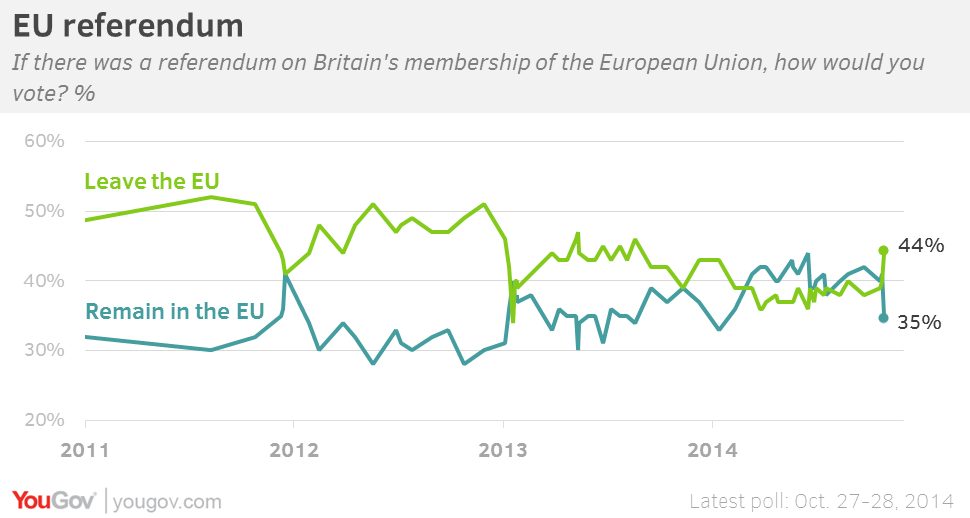
This is 6 days ago. As you can see the in/out vote is up and down and NOT your 65% for out.
http://yougov.co.uk/news/2014/10/30/voters-shift-sharply-against-eu-membership/
The remarkable thing about our EU referendum tracker is how much it moves. Within the last year we've had a ten-point lead for staying in, and a ten-point lead for leaving.
A week ago 41 per cent said they would vote to stay in, and 40 per cent said they would leave. Exclusively for Red Box, YouGov asked the question just four days later, and those numbers have moved to 35 per cent and 44 per cent, a 9 per cent lead for "out".
http://yougov.co.uk/news/2014/10/30/voters-shift-sharply-against-eu-membership/
The remarkable thing about our EU referendum tracker is how much it moves. Within the last year we've had a ten-point lead for staying in, and a ten-point lead for leaving.
A week ago 41 per cent said they would vote to stay in, and 40 per cent said they would leave. Exclusively for Red Box, YouGov asked the question just four days later, and those numbers have moved to 35 per cent and 44 per cent, a 9 per cent lead for "out".
aldwickk
- 05 Nov 2014 17:13
- 49374 of 81564
Johnny Foreigner doesn't play by the rules , we should know that by now. Even the German's don't follow the rules now [ rules that must be obeyed ]
hilary
 - 05 Nov 2014 17:36
- 49375 of 81564
- 05 Nov 2014 17:36
- 49375 of 81564

Haystack,
The wording of that survey in your chart above is too ambiguous imo, as it doesn't explain what question will be asked of the electorate in a referendum.
There was an article in The Economist around the time of the Scottish referendum which explained how the wording of a question can affect the outcome. If the Scots had been asked 'Do you think Scotland should leave the UK' (which is what Salmond wanted), it would have resulted in a higher yes vote than the actual question of 'Should Scotland leave the UK' (which is what Cameron told them they had to have). As an example, if a surgeon tells his patients there's a 95% survival rate from an operation, more people will have the op than if the surgeon tells them there's a 5% mortality rate.
Conducting a poll to ask folks how they would vote, without telling them what the exact question is, will produce an inaccurate outcome.
The wording of that survey in your chart above is too ambiguous imo, as it doesn't explain what question will be asked of the electorate in a referendum.
There was an article in The Economist around the time of the Scottish referendum which explained how the wording of a question can affect the outcome. If the Scots had been asked 'Do you think Scotland should leave the UK' (which is what Salmond wanted), it would have resulted in a higher yes vote than the actual question of 'Should Scotland leave the UK' (which is what Cameron told them they had to have). As an example, if a surgeon tells his patients there's a 95% survival rate from an operation, more people will have the op than if the surgeon tells them there's a 5% mortality rate.
Conducting a poll to ask folks how they would vote, without telling them what the exact question is, will produce an inaccurate outcome.
MaxK - 05 Nov 2014 17:42 - 49376 of 81564
€U in out question: YES or NO
Choose one option:
YES .. I would like to remain in the €U
NO ... I would like the Gov to make the decision for me
Choose one option:
YES .. I would like to remain in the €U
NO ... I would like the Gov to make the decision for me
Haystack
- 05 Nov 2014 17:42
- 49377 of 81564
True. However, it is still clear that sentiment is changing all the time and the public might well vote to stay in.
goldfinger
- 05 Nov 2014 18:14
- 49378 of 81564
TANKER Cyners, when I said we should give help to immigrants get a home I was meaning within the system I had drawn up earlier on.
So essential workers under my system would get help, not que jump.
Eg , that bloke on the news last week who was a fruit farmer, said without immigrants he
couldnt run his business. OK some of these fruit farmers 'put them up' themselves in lodgings but a lot dont.
Cant think that we'd have many essential workers anyway.
So essential workers under my system would get help, not que jump.
Eg , that bloke on the news last week who was a fruit farmer, said without immigrants he
couldnt run his business. OK some of these fruit farmers 'put them up' themselves in lodgings but a lot dont.
Cant think that we'd have many essential workers anyway.
goldfinger
- 05 Nov 2014 18:16
- 49379 of 81564
Wonder if the chuckle brothers will be out tonight to create a mass spat again. Hope not.
I for one will be watching the football.
I for one will be watching the football.
goldfinger
- 05 Nov 2014 18:18
- 49380 of 81564
Labour lead at 2
by YouGov in Politics and Voting intention
Wed November 5, 2014 6 a.m. GMT
Latest YouGov / The Sun results 4th November - Con 32%, Lab 34%, LD 7%, UKIP 15%
by YouGov in Politics and Voting intention
Wed November 5, 2014 6 a.m. GMT
Latest YouGov / The Sun results 4th November - Con 32%, Lab 34%, LD 7%, UKIP 15%
goldfinger
- 05 Nov 2014 18:25
- 49381 of 81564
This is how the ‘annual tax statement’ SHOULD have appeared........5/11/2014
We all owe a debt of thanks to Richard Murphy, over at Tax Research UK. He has broken down the information in George Osborne’s misleading ‘annual tax statement’ into its component parts and then put a new version together, under categories that more accurately describe the spending concerned.
Then he turned the information into a handy pie chart – similar to Osborne’s but with one major change:
This version is accurate.

Let’s just compare it with Osborne’s…

Big difference!
The most interesting to Vox Political is the perception gap between Mr Murphy’s calculation of the total proportion of tax spent on unemployment benefits – 0.67 per cent – and Osborne’s ‘Welfare’ heading, which constitutes 24 per cent of spending.
Talk to most people about ‘Welfare’ and they’ll think you mean unemployment benefits – so the Osborne chart will make them think that government spending on the unemployed is no less than 16 times as much as is in fact the case.
When a government minister exaggerates the facts by that much, he might as well come out and admit that he’s lying to the people.
Mr Murphy wrote: “This is the statement George Osborne would not want you to see because it makes clear that subsidies, allowances and reliefs extend right across the UK economy. And they do not, by any means, appear to go to those who necessarily need them most. The view he has presented on this issue has been partial, to say the least, and frankly deeply misleading at best.”
He wrote: “Add together the cost of subsidies to banks, the subsidy to pensions and the subsidy to savings (call them together the subsidy to the City of London) and they cost £103.4bn a year – more than the cost of education in the UK.
“It’s also no wonder house prices are so distorted when the implicit tax subsidy for home ownership is £12.6 billion a year.”
He also pointed out that unemployment benefits cost only half the amount used to subsidise personal savings and investments.
For full details of Mr Murphy’s calculations, visit his article on the Tax Research UK site.
Mr Murphy tweeted yesterday: “Almost every commentator now agrees that Osborne is going to spend a fortune sending out tax statements that are wrong. Why not cancel now?”
He won’t unless he’s forced to; he has a political agenda to follow.
That is why Vox Political launched a petition to achieve just that.
If you haven’t already, please visit the petition on the Change.org website, sign it, and share it with your friends.
While you’re at it, feel free to share the infographic, created to support the petition:
We all owe a debt of thanks to Richard Murphy, over at Tax Research UK. He has broken down the information in George Osborne’s misleading ‘annual tax statement’ into its component parts and then put a new version together, under categories that more accurately describe the spending concerned.
Then he turned the information into a handy pie chart – similar to Osborne’s but with one major change:
This version is accurate.
Let’s just compare it with Osborne’s…
Big difference!
The most interesting to Vox Political is the perception gap between Mr Murphy’s calculation of the total proportion of tax spent on unemployment benefits – 0.67 per cent – and Osborne’s ‘Welfare’ heading, which constitutes 24 per cent of spending.
Talk to most people about ‘Welfare’ and they’ll think you mean unemployment benefits – so the Osborne chart will make them think that government spending on the unemployed is no less than 16 times as much as is in fact the case.
When a government minister exaggerates the facts by that much, he might as well come out and admit that he’s lying to the people.
Mr Murphy wrote: “This is the statement George Osborne would not want you to see because it makes clear that subsidies, allowances and reliefs extend right across the UK economy. And they do not, by any means, appear to go to those who necessarily need them most. The view he has presented on this issue has been partial, to say the least, and frankly deeply misleading at best.”
He wrote: “Add together the cost of subsidies to banks, the subsidy to pensions and the subsidy to savings (call them together the subsidy to the City of London) and they cost £103.4bn a year – more than the cost of education in the UK.
“It’s also no wonder house prices are so distorted when the implicit tax subsidy for home ownership is £12.6 billion a year.”
He also pointed out that unemployment benefits cost only half the amount used to subsidise personal savings and investments.
For full details of Mr Murphy’s calculations, visit his article on the Tax Research UK site.
Mr Murphy tweeted yesterday: “Almost every commentator now agrees that Osborne is going to spend a fortune sending out tax statements that are wrong. Why not cancel now?”
He won’t unless he’s forced to; he has a political agenda to follow.
That is why Vox Political launched a petition to achieve just that.
If you haven’t already, please visit the petition on the Change.org website, sign it, and share it with your friends.
While you’re at it, feel free to share the infographic, created to support the petition:
goldfinger
- 05 Nov 2014 18:28
- 49382 of 81564
Anyone received theres yet? I havent anyway Im not going to open it Ill put it in a post box and write return to lying sender on it.
cynic
- 05 Nov 2014 18:58
- 49383 of 81564
MaxK - 05 Nov 2014 17:42 - 49379 of 49385
€U in out question: YES or NO
Choose one option:
YES .. I would like to remain in the €U
NO ... I would like the Gov to make the decision for me
=============
but there is a 3rd and very important option ......
REFERENDUM ....having heard the arguments for and against, do you think the voters should make the decision as to whether we stay in or get out?
I know i'ld vote for a referendum every time, as i can then listen and make up my own mind and not have politicians do it either way
€U in out question: YES or NO
Choose one option:
YES .. I would like to remain in the €U
NO ... I would like the Gov to make the decision for me
=============
but there is a 3rd and very important option ......
REFERENDUM ....having heard the arguments for and against, do you think the voters should make the decision as to whether we stay in or get out?
I know i'ld vote for a referendum every time, as i can then listen and make up my own mind and not have politicians do it either way
Fred1new
- 05 Nov 2014 19:26
- 49384 of 81564
And not swayed by media interpretation!
MaxK - 05 Nov 2014 19:32 - 49385 of 81564
Another end of the world story/scare up in smoke....
Ebola in Africa: This is how much of the continent is really affected

Ignorance and confusion have surrounded the crisis in West Africa
Antonia Molloy Author Biography
Tuesday 04 November 2014
Ebola is an on-going health crisis – but in many instances fears have escalated out of context.
In response, British chemist Anthony England has created a map of Africa for the “geographically challenged”, which clearly highlights the three West African countries severely affected by Ebola.
Guinea, Sierra Leone and Liberia are coloured in red, green and blue, while the rest of the continent remains blank with the slogan “No Ebola” stamped across it.
The map also defines exactly what is meant by “No Ebola”. That is “no current confirmed patients” and “no current confirmed infectious outbreak”. So, for example, while Mali reported a case it is still not included in the graphic because the two-year-old victim tragically died from the disease.
In short, only “problem countries” are shown.

More: http://www.independent.co.uk/news/world/africa/ebola-in-africa-this-is-how-much-of-the-continent-is-really-affected-9838206.html
Ebola in Africa: This is how much of the continent is really affected
Ignorance and confusion have surrounded the crisis in West Africa
Antonia Molloy Author Biography
Tuesday 04 November 2014
Ebola is an on-going health crisis – but in many instances fears have escalated out of context.
In response, British chemist Anthony England has created a map of Africa for the “geographically challenged”, which clearly highlights the three West African countries severely affected by Ebola.
Guinea, Sierra Leone and Liberia are coloured in red, green and blue, while the rest of the continent remains blank with the slogan “No Ebola” stamped across it.
The map also defines exactly what is meant by “No Ebola”. That is “no current confirmed patients” and “no current confirmed infectious outbreak”. So, for example, while Mali reported a case it is still not included in the graphic because the two-year-old victim tragically died from the disease.
In short, only “problem countries” are shown.
More: http://www.independent.co.uk/news/world/africa/ebola-in-africa-this-is-how-much-of-the-continent-is-really-affected-9838206.html
Chris Carson
- 05 Nov 2014 20:49
- 49386 of 81564
Guy Fawkes, Islamists, converts, and terrorism: some things never change
The gunpowder plotter was a convert to Catholicism - and even now, religious terrorists are often drawn from the zeal-filled ranks of the converted
Illustration showing Guy Fawkes and his fellow conspirators
Illustration showing Guy Fawkes and his fellow conspirators Photo: Classic Image / Alamy
By Dominic Selwood
3:04PM GMT 05 Nov 2014
It is the 5th of November once more, which can only mean it is time to burn Guy Fawkes again (and Pope Paul V, for those in Lewes marching under their traditional “no popery” banners). But, as the faggots are kindled tonight, it is worth remembering who Guy “Guido” Fawkes really was.
Despite a popular belief that Fawkes was an Italian extremist, the fact is he was an entirely home-grown terrorist from the Stonegate area of York. He was baptised into the Church of England in 1570 at the beautiful St Michael-le-Belfrey by York Minster, but when his mother was widowed and married into a staunchly recusant family from the West Riding, Fawkes converted to Catholicism.
In his early twenties, he sold up his land and went to fight for his new faith in Spain’s war against the Protestant Netherlands. According to a school friend, he became “highly skilled in matters of war”, yet remained devout, calm, “pleasant of approach and cheerful of manner, opposed to quarrels and strife … loyal to his friends”.
However, back in England, a group of extremists planning revolution desperately needed military skill. After careful enquiry, they made a beeline for Fawkes, whom they persuaded to lend his nerve and knowhow to their cause. The mastermind was Robert Catesby, a hothead who had grown angry at the treatment of England’s old Catholic families under Elizabeth I and had no faith that things would improve under James I. Having failed to persuade the Spanish to invade, Catesby’s new plan was simple: to bomb the Lords chamber at the opening of Parliament, kill the King and his most prominent courtiers, then stage a revolution.
However, one of the plotters sent a warning letter to Lord Monteagle, a Catholic peer: “I would advyse you … to devise some excuse to shift youer attendance at this parliament, for God and man hath concurred to punishe the wickedness of this tyme”. Unfortunately for the plotters, Lord Monteagle took the letter straight to court, triggering an immediate search of the vault under the Lords’ chamber. In no time, the royal guard found Fawkes, matches, a watch, and 35 kegs of explosives.
Related Articles
Thousands of people are expected to converge on the East Sussex town of Lewes to see the effigy of the former Scottish first minister Alex Salmond set alight on a bonfire
English town burns effigy of Alex Salmond on bonfire night
05 Nov 2014
It’s a shame that every night is fireworks night
05 Nov 2014
9 things you never knew about Guy Fawkes
05 Nov 2014
'Witchmarks' to ward off evil spirits discovered at National Trust house
05 Nov 2014
The go-to label for style-conscious women
Sponsored by FedEx
Despite Fawkes’s fortitude under torture — which left a deep impact on all — the game was up. Although he insisted he was “John Johnson”, they eventually found his real name. Separately, the other conspirators were rapidly unveiled, along with the enormity of their plot, which would likely have killed not only the King and his closest advisers, but everyone in the Lords that evening. Despite our obsession with burning Fawkes, he was actually sentenced to be hanged, drawn, and quartered, although he escaped the harrowing punishment by leaping off the high scaffold in Westminster’s Old Palace Yard and breaking his neck.
King James I, whom the gunpowder plotters meant to kill
The story is fascinating for many reasons, not least because Fawkes was a convert to Catholicism, and it is an age-old adage that converts are often among the most militant. And there are striking parallels today, where the same dynamic is again at work. One of the murderers of Fusilier Drummer Lee Rigby in Woolwich in 2013 was a convert, as was the fanatic who killed a Canadian soldier earlier this month. A former Taliban recruiter in the West, who now works for the Canadian government, has also weighed in, highlighting that today’s Islamist extremists specifically target converts — they often know little about the religion and their enthusiasm can easily be subverted. No one should therefore have been surprised this summer when two jihadis from Birmingham who spent eight months fighting in Syria had bought Islam for Dummies and The Koran for Dummies as their airport reading,
Although Guy Fawkes was a minor figure in Catesby’s bomb plot, history has made him its poster boy. King James I’s triumphant 5th of November “Gunpowder Plot Day” bonfire celebrations have remained enduringly popular, and Fawkes has been promoted to the central protagonist. But when we incinerate Fawkes again tonight, it is worth seeing him in context, and reflecting on the tide of young converts of all faiths who are perennially sucked into extremism.
If I was being responsible, I would end by adding that the good people of Lewes should probably now stop burning an effigy of Pope Paul V every year and put away their “no popery” banners. These are yesterday’s sentiments, and have no role in modern Britain. (If it was happening in Northern Ireland, it would doubtless be banned immediately.) But then, speaking as a deeply fuzzy and laissez-faire English Catholic, pope-burning is a colourful, historic, and faintly hilarious English tradition, and we are losing far too much of our cultural identity nowadays. So, to all of you in Lewes tonight: burn on! and let’s be thankful that these days we can laugh about it all over a mulled wine or two and a few sparklers.
Haystack
- 05 Nov 2014 21:40
- 49387 of 81564
http://order-order.com/2014/11/05/new-statesman-turns-on-ed/
The New Statesman was the only publication to endorse Ed Miliband for the Labour leadership in 2010. Today the magazine turns its back on Ed, arguing “that since then Miliband has failed to find an authentic voice to connect with the electorate”. Jason Cowley writes in this week’s editorial:
“Miliband is very much an old-style Hampstead socialist. He doesn’t really understand the lower middle class or material aspiration. He doesn’t understand Essex Man or Woman. Politics for him must seem at times like an extended PPE seminar: elevated talk about political economy and the good society…
Miliband does not have a compelling personal story to tell the electorate, as Thatcher did about her remarkable journey from the grocer’s shop in Grantham and the values that sustained her along the way or Alan Johnson does about his rise from an impoverished childhood in west London. I went to Oxford to study PPE, worked for Gordon Brown, became a cabinet minister and then leader of the party does not quite do it. None of this would matter were Miliband in manner and approach not so much the product of this narrow background…
Miliband is losing the support of the left (to the SNP, to the Greens) without having formed a broader coalition of a kind that defined the early Blair-Brown years. Most damaging, I think, is that he seldom seems optimistic about the country he wishes to lead. Miliband speaks too often of struggle and failure, of people as victims – and it’s true that life is difficult for many. But a nation also wants to feel good about itself and to know in which direction it is moving.”
Usually reliable as a loyal mouthpiece for Labour’s rapid rebuttals, today’s Staggers cover story from George Eaton has some source quotes of a less helpful kind:
“Morale has never been lower,” one shadow cabinet minister told me [ . . . ] No MP I have spoken to has argued that the Labour leader’s parlous ratings aren’t a problem or dismissed them as a “Westminster bubble issue”. “We’re all very, very concerned. The reality is that whilst we don’t have a presidential system, people are thinking increasingly about who they want to be the prime minister,” one shadow minister said. He went on to describe a “sobering moment” in which a voter told him: “You’ve been a fantastic MP, but I’m not going to vote for you. Because Ed’s not prime ministerial…
One senior MP suggested that Miliband should abandon Westminster, save for Prime Minister’s Questions, and go on a rolling tour of marginal constituencies. “The 200 to 400 voters in key seats who say on the doorstep that he’s the problem, he could win them round by talking to them.” But he doubted whether Miliband had the will to do so. “His confidence has gone. It’s like a light’s gone out,” he lamented.
The New Statesman was the only publication to endorse Ed Miliband for the Labour leadership in 2010. Today the magazine turns its back on Ed, arguing “that since then Miliband has failed to find an authentic voice to connect with the electorate”. Jason Cowley writes in this week’s editorial:
“Miliband is very much an old-style Hampstead socialist. He doesn’t really understand the lower middle class or material aspiration. He doesn’t understand Essex Man or Woman. Politics for him must seem at times like an extended PPE seminar: elevated talk about political economy and the good society…
Miliband does not have a compelling personal story to tell the electorate, as Thatcher did about her remarkable journey from the grocer’s shop in Grantham and the values that sustained her along the way or Alan Johnson does about his rise from an impoverished childhood in west London. I went to Oxford to study PPE, worked for Gordon Brown, became a cabinet minister and then leader of the party does not quite do it. None of this would matter were Miliband in manner and approach not so much the product of this narrow background…
Miliband is losing the support of the left (to the SNP, to the Greens) without having formed a broader coalition of a kind that defined the early Blair-Brown years. Most damaging, I think, is that he seldom seems optimistic about the country he wishes to lead. Miliband speaks too often of struggle and failure, of people as victims – and it’s true that life is difficult for many. But a nation also wants to feel good about itself and to know in which direction it is moving.”
Usually reliable as a loyal mouthpiece for Labour’s rapid rebuttals, today’s Staggers cover story from George Eaton has some source quotes of a less helpful kind:
“Morale has never been lower,” one shadow cabinet minister told me [ . . . ] No MP I have spoken to has argued that the Labour leader’s parlous ratings aren’t a problem or dismissed them as a “Westminster bubble issue”. “We’re all very, very concerned. The reality is that whilst we don’t have a presidential system, people are thinking increasingly about who they want to be the prime minister,” one shadow minister said. He went on to describe a “sobering moment” in which a voter told him: “You’ve been a fantastic MP, but I’m not going to vote for you. Because Ed’s not prime ministerial…
One senior MP suggested that Miliband should abandon Westminster, save for Prime Minister’s Questions, and go on a rolling tour of marginal constituencies. “The 200 to 400 voters in key seats who say on the doorstep that he’s the problem, he could win them round by talking to them.” But he doubted whether Miliband had the will to do so. “His confidence has gone. It’s like a light’s gone out,” he lamented.
required field - 05 Nov 2014 22:13 - 49388 of 81564
The danger is that Ebola mutates into something else......mankind must be on its guard as to nature's ruthlessness essence as to radificalized species (that includes ourselves)....
Chris Carson
- 05 Nov 2014 23:48
- 49389 of 81564
by TOM PETERKIN
Published on the
05 November
2014
22:19
Tweet
Print this
Sponsored by
Country Living Fair
A pithy tweet was posted yesterday by the Stirling University Scottish Socialist Party. “Scottish Labour is still the party of the left,” it said. “Lamont left, Sarwar left, Darling left. Nothing left.”
It was a biting comment on the state of a Scottish Labour Party which this week was reeling from yet more dispiriting opinion poll findings.
An Ipsos MORI poll which had predicted an apocalyptic outcome for Scottish Labour at Westminster went on to reveal that 57 per cent of Scots said they would vote for the SNP in Holyrood’s constituency seats. With Labour polling just 23 per cent, these are troubled times for the party that once regarded political control of Scotland as an inevitability.
All is not lost for Labour, however. If this leadership contest can reinvigorate Labour, a recovery may take hold. While the main focus will be on the main contest between Jim Murphy, Sarah Boyack and Neil Findlay, it is worth keeping an eye on the race for the deputy leadership.
Pressure was put on Anas Sarwar to quit the deputy leadership – the gentle arm-twisting was to ease Murphy’s bid for the top job. As Sarwar and Murphy are both MPs, it would have sent the wrong message to have both the leader and deputy leader of Scottish Labour looking after the party from Westminster.
ExecLine
- 05 Nov 2014 23:57
- 49390 of 81564
Mr Carson
You are the crappiest 'Copy and Paster' on MoneyAM. :-(
Do us all a favour - use the posting 'Edit' facility - or maybe even the 'Delete' key on your keyboard - and Delete/get rid of some of those unsightly blank spaces in your posts.
Please!
You are just bashing 'anything' down in an 'anyhow fashion'!
You are the crappiest 'Copy and Paster' on MoneyAM. :-(
Do us all a favour - use the posting 'Edit' facility - or maybe even the 'Delete' key on your keyboard - and Delete/get rid of some of those unsightly blank spaces in your posts.
Please!
You are just bashing 'anything' down in an 'anyhow fashion'!
Chris Carson
- 06 Nov 2014 00:07
- 49391 of 81564
No sense of humour Exec that's your trouble :0)
Ok point taken. Nice looking trade by the way on STJ
Ok point taken. Nice looking trade by the way on STJ
| About MoneyAM | Ts and Cs | Privacy Policy | Investment Warning | Content Standards | Corporate Solutions | Advertise With Us | Site Map | © 2026 MoneyAM |
Register now for FREE
Share Prices,
Stock Quotes,
Charts, Bulletin Boards, Indices, Watchlists, Portfolio, Market News, Research
or see our Premium Services including Level 2, Terminal and much more.
 Follow us on Twitter