

| Home | Log In | Register | Our Services | My Account | Contact | Help |
You are NOT currently logged in
Register now or login to post to this thread.
THE TALK TO YOURSELF THREAD. (NOWT)
goldfinger

 - 09 Jun 2005 12:25


Thought Id start this one going because its rather dead on this board at the moment and I suppose all my usual muckers are either at the Stella tennis event watching Dim Tim (lose again) or at Henly Regatta eating cucumber sandwiches (they wish,...NOT).
Anyway please feel free to just talk to yourself blast away and let it go on any company or subject you wish. Just wish Id thought of this one before.
cheers GF.
Anyway please feel free to just talk to yourself blast away and let it go on any company or subject you wish. Just wish Id thought of this one before.
cheers GF.
ExecLine
 - 10 Apr 2015 15:11
- 58465 of 81564
- 10 Apr 2015 15:11
- 58465 of 81564

Our local Ambulance men are pretty stressed out and don't appear to be very happy.
From my local rag:
Eight in 10 staff at ambulance service covering Northamptonshire have considered quitting due to stress, claims union

EMAS vehicles at Mereway ambulance station
Northampton Chronicle
Francesca Gosling
12:06Friday 10 April 2015
More than half of staff at the ambulance service covering Northamptonshire say stress levels are so high it affects how they do their job, a survey suggests.
The questionnaire, conducted by the union unison among staff in key departments at East Midlands Ambulance Service (EMAS), revealed that eight in 10 respondents had considered leaving their job because of stress.
Unison said other responses showed three quarters of union members had sleeping problems (77.19 per cent) and more than two thirds (68.42 per cent) experienced irritability and mood swings as result of stress due to pressures from staff shortages, long hours and shift over-runs.
Out of those who reported stress-related problems, just under half (49.17 per cent) said they had had an affect on how well they were able to do their job at some point.
Another area of pressure highlighted by the survey was an increased emphasis on meeting time targets for dealing with patients, with one participant commenting: “There is a lot of bullying from managers on frontline staff regarding targets.”
One person, who previously worked as an army combat medic in Afghanistan, said: “I was less stressed and treated with more respect by my previous employer.”
Another commented: “I am just coping at the moment, but given the opportunity (i.e. the same pay) I would rather be cleaning toilets than this job.”
Lee Goddard, Unison branch secretary for EMAS, said: “Staff were asked if they felt that the EMAS NHS Trust supports a good work life balance and 73 per cent who responded said that they did not agree with this statement.
“Sue Noyes, CEO of EMAS since 2013, has introduced a Listening into Action (LIA) scheme, which involves a forum to listen to staff, but still staff do not feel as a whole that they are being listened to and heard.
“Unless staff views, opinions, health and wellbeing are seriously looked at and actions put in place, it is Unisons’ opinion that sooner or later it will be our staff that will be the patients at the very least.”
He explained that recent figures show that, on average, at least one member of frontline staff leaves the trust every eight days and said: “I would urge the trust to look at the roles of the staff and the current targets and restraints they face before it is too late for the trust, staff and ultimately the patients.”
A spokeswoman for EMAS responded: “The health and wellbeing of our colleagues is an absolute priority.
“It is recognised nationally that the role of ambulance crews can be physcially demanding, and that for frontline crews and Emergency Operations Centre colleagues the traumatic incidents responded to can cause increased levels of stress.”
The trust’s board last week approved a new ‘people’ strategy which, they said, will “see us invest further in the recruitment and development of colleagues” in order to respond appropriately to the “ever-increasing demand on the NHS and our service.”
Support services offered to staff include a ‘Peer 2 Peer’ scheme, which involves 80 staff members trained to provide a supportive network that allows colleagues struggling to cope with tragic incidents to discuss their feelings.
There is also a measure to train pastoral care workers in a similar way, but with the added capacity to talk to staff about their spiritual and religious needs.
The EMAS spokesman added: “We also provide support through the PAM Assist 24/7 confidential phone line, occupational health services, and EMAS chaplaincy support.”
From my local rag:
Eight in 10 staff at ambulance service covering Northamptonshire have considered quitting due to stress, claims union
EMAS vehicles at Mereway ambulance station
Northampton Chronicle
Francesca Gosling
12:06Friday 10 April 2015
More than half of staff at the ambulance service covering Northamptonshire say stress levels are so high it affects how they do their job, a survey suggests.
The questionnaire, conducted by the union unison among staff in key departments at East Midlands Ambulance Service (EMAS), revealed that eight in 10 respondents had considered leaving their job because of stress.
Unison said other responses showed three quarters of union members had sleeping problems (77.19 per cent) and more than two thirds (68.42 per cent) experienced irritability and mood swings as result of stress due to pressures from staff shortages, long hours and shift over-runs.
Out of those who reported stress-related problems, just under half (49.17 per cent) said they had had an affect on how well they were able to do their job at some point.
Another area of pressure highlighted by the survey was an increased emphasis on meeting time targets for dealing with patients, with one participant commenting: “There is a lot of bullying from managers on frontline staff regarding targets.”
One person, who previously worked as an army combat medic in Afghanistan, said: “I was less stressed and treated with more respect by my previous employer.”
Another commented: “I am just coping at the moment, but given the opportunity (i.e. the same pay) I would rather be cleaning toilets than this job.”
Lee Goddard, Unison branch secretary for EMAS, said: “Staff were asked if they felt that the EMAS NHS Trust supports a good work life balance and 73 per cent who responded said that they did not agree with this statement.
“Sue Noyes, CEO of EMAS since 2013, has introduced a Listening into Action (LIA) scheme, which involves a forum to listen to staff, but still staff do not feel as a whole that they are being listened to and heard.
“Unless staff views, opinions, health and wellbeing are seriously looked at and actions put in place, it is Unisons’ opinion that sooner or later it will be our staff that will be the patients at the very least.”
He explained that recent figures show that, on average, at least one member of frontline staff leaves the trust every eight days and said: “I would urge the trust to look at the roles of the staff and the current targets and restraints they face before it is too late for the trust, staff and ultimately the patients.”
A spokeswoman for EMAS responded: “The health and wellbeing of our colleagues is an absolute priority.
“It is recognised nationally that the role of ambulance crews can be physcially demanding, and that for frontline crews and Emergency Operations Centre colleagues the traumatic incidents responded to can cause increased levels of stress.”
The trust’s board last week approved a new ‘people’ strategy which, they said, will “see us invest further in the recruitment and development of colleagues” in order to respond appropriately to the “ever-increasing demand on the NHS and our service.”
Support services offered to staff include a ‘Peer 2 Peer’ scheme, which involves 80 staff members trained to provide a supportive network that allows colleagues struggling to cope with tragic incidents to discuss their feelings.
There is also a measure to train pastoral care workers in a similar way, but with the added capacity to talk to staff about their spiritual and religious needs.
The EMAS spokesman added: “We also provide support through the PAM Assist 24/7 confidential phone line, occupational health services, and EMAS chaplaincy support.”
cynic
- 10 Apr 2015 15:24
- 58466 of 81564
EL - i'm sure you're right about ambulance staff, paramedics etc etc being in very stressful jobs, and i also suspect that some of the management is pretty crappy too .... unfortunately, i recollect UNISON are one of the more militant unions so would never ever come across with an unbiased view
Fred1new
- 10 Apr 2015 15:58
- 58467 of 81564
On the other hand if Unison had been more militant the working conditions of ambulance crews may be better than they appear to be.
Fred1new
- 10 Apr 2015 16:13
- 58468 of 81564
I have to admit the tory campaign so far reminds me of the obvious bribery and attempts to corrupt which one sees in second rate Banana republics.
The other parties are a little better and have in general the moral high ground.
But who was the tory spokeswoman on Question time last night.
I thought she represented Bing Crosby perfectly.
The four other panellists at least appeared honest and intellectually were head and shoulders above her.
She represented the tory party at its best.
==-=-=-=-=
I know, she must be a friend of Haze's at Party Headquarters.
The other parties are a little better and have in general the moral high ground.
But who was the tory spokeswoman on Question time last night.
I thought she represented Bing Crosby perfectly.
The four other panellists at least appeared honest and intellectually were head and shoulders above her.
She represented the tory party at its best.
==-=-=-=-=
I know, she must be a friend of Haze's at Party Headquarters.
Chris Carson
- 10 Apr 2015 16:55
- 58469 of 81564
The Wallace and Grommet episode on TV last weekend was brilliant. Should be renamed THE TWO ED's.
MaxK - 10 Apr 2015 18:17 - 58470 of 81564
Fred1new
- 11 Apr 2015 08:00
- 58471 of 81564
Fred1new
- 11 Apr 2015 08:04
- 58472 of 81564
?another Non-dom!
MaxK - 11 Apr 2015 09:06 - 58473 of 81564

Chris Carson
- 11 Apr 2015 09:38
- 58474 of 81564
David Starkey: why Ed Miliband is 'poison' and David Cameron 'muddle-headed'
The millionaire historian pulls no punches in his scathing assessment of the current political class - and tells Matthew Stadlen about Britain's racial and gender divides, and why he won't be marrying his partner
By Matthew Stadlen8:30PM BST 10 Apr 2015
David Starkey is on typically combative form. The millionaire historian says he views the forthcoming General Election with “a degree of modified despair”. But faced with the prospect of an Ed Miliband government, he’ll be voting Tory.
"Especially after our last experience of what a Labour government did, I cannot possibly see how anybody could vote for him.”
He regards Miliband as “poison”, and does not spare him.
“He is a man of high ambition and low talent – the worst possible combination. His whole language at the moment is soak the rich, hate the rich. It’s snide, it’s mean-spirited and, of course, it defies the truth that economies depend on the intelligent, the entrepreneurial, those who were created with money. One may not like it, one may disapprove of it, but all the nice things that we want come essentially from their abilities.
“Labour – like the Tories – have excluded any increases in the principal forms of taxation, the broad line of income tax or the broad line of VAT. We’re being utterly and profoundly dishonest. We’re saying that you can have all the goodies of the welfare state if only you screw a little bit more money out of a few multi-millionaires and ordinary people won’t be affected by it. The truth is that a welfare state of necessity imposes high levels of taxation on ordinary folk.”
The smell of class warfare is nastier on the Labour side, Starkey insists, but the “dishonesty is at least equal” on the Tory side. “We have, in percentage terms, one of the highest peacetime debts we’ve ever had. We are borrowing the equivalent of the cost of the NHS every year. It is totally unsustainable.”
David Cameron and George Osborne between them, Starkey argues, have demonstrated some tactical skill, but a complete absence of strategic thinking. “There have been some areas like education reform and some of the welfare reforms which have been intelligent and possibly far reaching in effect. But all this has been purchased at the cost of not asking big, radical questions.”
The deficit, he says, should have been reduced “much more”. But the Prime Minister and Chancellor failed to embark on a radical reappraisal of what the state does, given that the Britain they inherited was “bust”. Instead, in a “muddle-headed and sentimental” way they vowed to protect the NHS, education and overseas aid causing “wildly asymmetric cuts”.
Firing on all cylinders now, he turns to defence, claiming that the Armed Forces have been turned into a “mockery”, while the police are being cut back “at exactly the moment when there’s a serious risk of the increase of domestic terrorism. Aspects of local government are being squeezed to the point at which you might as well not bother with a town hall.”
Should the Tories win next month and hold a referendum on the EU, Starkey will probably vote to leave. “We have a very large trade deficit with Europe, we have a decent trade balance with the rest of the world. Is Europe going to cut off its nose to spite its face? It seems to me so infinitely unlikely. There’s no risk.
"There would be a risk if we were running a German-style trade surplus with Europe. But we’re not. The problem of our leaving Europe is a problem for the Germans and not us.”
So far, so Starkey. But he’s on a roll. Overall, he isn’t impressed by the British political talent currently on offer. “I don’t see anybody around with any prime ministerial qualifications at all.
"Remember, real talent has left politics – for very good reasons. For most of British history a career in politics, a career in what was quaintly called public service, was the height of ambition. It was that which brought you until relatively recently very substantial financial returns. It also brought you enormous returns of prestige. It offered of course, because of empire and so on, the ability to operate upon a world stage. We’re a shrunken country.”
Starkey himself was brought up in a council house, the son of a junior foreman and a cleaner. He was born with two club feet that required numerous and “exceedingly painful” operations, thanks to experimental surgery that had been pioneered with injured airmen.
Grammar-school educated, he graduated with a first from Cambridge in history. These days he divides his time between the houses he shares with his partner of 21 years in London and Kent. They are neither married nor civilly partnered because, he says, “I see no reason apart from tax considerations – which we haven’t yet dealt with – why a gay relationship should be the subject of public rules”.
He turned 70 in January and his 11th book is on Magna Carta to mark its 800th anniversary. His aim was to explain its development from a revolutionary document in 1215 that King John only sealed under duress, to a significantly more conservative version after his death in 1216, through “a process of radical re-editing”, and then to the final compromise of 1225.
The process by which agreement between the monarchy and the barons was reached, he believes, was an archetype for future English political change.
“We have the oldest functioning political system in Europe and it goes back directly to Magna Carta,” he says. “There is a continuous line of constitutional and political development from Magna Carta. There have been interruptions to it, but it has never been ruptured. In other words, there’s never been a real revolution.”
A hero of his book is William Marshall, a powerful earl and loyal to the crown, who helped to reissue Magna Carta in 1216 on behalf of John’s successor, the nine-year-old Henry III. “The reason Magna Carta becomes entrenched is because he gets rid of all the difficult politically contentious bits, he keeps the good bits, and he delivers something that a King can accept and that the nobles can accept. It’s a brilliant piece of political compromise.”
• ALLISON PEARSON: We must listen to inconvenient truths about race
By 1225, says Starkey, “all” the people – not just the barons and the elite of “free men” – are included explicitly as beneficiaries of the rights to be extended by the monarchy in return for a grant of general taxation.
What emerges from the story of the Magna Carta, too, is that England was invaded – at the invitation of the barons – by Louis VIII of France. He is only bribed to leave after John’s death. “For most of the Middle Ages, we are part of a completely cross-channel culture. The channel is a link between two ill-divided twins. If events had turned out very slightly differently in 1216, there would have been a dual monarchy. Had John lived, Louis would almost certainly have defeated him.”
We have, says Starkey, exaggerated our immunity from invasion. “Every major dynastic change of the Middle Ages, the great coups that we read about, are all the result of either foreign sponsorship or direct foreign invasion. So we’ve mythologised this wonderful island story, girt with the silver sea and whatever.”
Starkey, of course, is known as much for forthright views as he is for his historical expertise. In 2011, just after the London riots, he courted controversy by claiming on Newsnight that “the whites have become black”, in reference to what he observed as the negative influence of one strand of black culture on some white people.
Today, and at the risk of causing further offence, Starkey argues that there is a black propensity to violence in this country.
“It would appear so. Well, if you look at the statistics – indeed! If you look at mugging, shootings and stabbings. The figures I’m afraid are unchallengeable,” he says. One of the reasons, he maintains, is cultural. “You have an endorsement of types of violence. You have particular sorts of family breakdown.”
Instead of the Martin Luther King approach – “he advocated that the way to black equality was through pride and peace” – America, he says, “went very quickly into the direction of the very different sorts of leader who effectively espoused the opposite of that. They espoused victimhood and violence. And I think to a dangerous extent that has happened in this country. With all the praise that’s lavished on [Baroness] Doreen Lawrence [mother of the murdered teenager Stephen Lawrence], she’s constantly treating blacks as victims.
“All forms of liberation – and I speak as gay and I was in all this when it wasn’t fashionable, when you didn’t get your CBE for being a prominent poofter, when there were actual penalties for doing it – all of them depend upon you taking control. About you refusing to be victim. And I find it very, very sad the way there is now this perpetual procession of people – group after group – wanting to assume the status of victim. It’s catastrophic.”
Starkey doesn’t stop there. “I was born quite seriously disabled. The constant way in which far too many people with physical and mental disability… again, it’s presented perpetually as victims rather than saying, ‘You have this problem, you’ve got to go out and master it.’ Freedom can only come from inside. The whole cry of Islamophobia, it’s trying to make Muslims into victims and therefore somehow privileged and exempt.”
Would he describe himself as racist? “The term has become totally without meaning,” he retorts. “I think there are cultural differences, there are all sorts of differences. It’s very odd, isn’t it? We’re on the one hand told there are no genetic differences between races and yet on the other hand it is very striking how different, more or less, racial groups seem to perform athletically, intellectually, commercially, whatever. Who knows? I don’t know. I’m not a geneticist.”
A frequent panellist on Question Time, Starkey during one appearance seemed to imply that women like to think with their hearts. So does he see himself as sexist? “I just recognise gender differences. We are biologically different, and in many ways we’re emotionally different. Of course we are. And it’s rather a good thing. There’s overwhelming psychological evidence. It’s not for nothing that on the whole women have not been soldiers.
“The genders are different. And the whole thing is not just the result of wicked gender grooming. It’s not simply societal. It is the result of biology. Obviously.”
He claims not to believe that men are more intelligent than women, but adds that “I think that the evidence suggests that there are different distributions of intelligence between men and women, that women tend to cluster more around the mean, men are either very, very bright or very thick.”
Starkey is a man who has built a career on calling it as he sees it. He seems to live life almost to bursting and doesn’t appear overly concerned that sometimes, what he says can, quite literally, take other people’s breath away.
• Magna Carta by David Starkey is published by Hodder & Stoughton, priced £18.99. To order your copy for £16.99 plus p&p, call 0844 871 1514 or visit books.telegraph.co.uk
The millionaire historian pulls no punches in his scathing assessment of the current political class - and tells Matthew Stadlen about Britain's racial and gender divides, and why he won't be marrying his partner
By Matthew Stadlen8:30PM BST 10 Apr 2015
David Starkey is on typically combative form. The millionaire historian says he views the forthcoming General Election with “a degree of modified despair”. But faced with the prospect of an Ed Miliband government, he’ll be voting Tory.
"Especially after our last experience of what a Labour government did, I cannot possibly see how anybody could vote for him.”
He regards Miliband as “poison”, and does not spare him.
“He is a man of high ambition and low talent – the worst possible combination. His whole language at the moment is soak the rich, hate the rich. It’s snide, it’s mean-spirited and, of course, it defies the truth that economies depend on the intelligent, the entrepreneurial, those who were created with money. One may not like it, one may disapprove of it, but all the nice things that we want come essentially from their abilities.
“Labour – like the Tories – have excluded any increases in the principal forms of taxation, the broad line of income tax or the broad line of VAT. We’re being utterly and profoundly dishonest. We’re saying that you can have all the goodies of the welfare state if only you screw a little bit more money out of a few multi-millionaires and ordinary people won’t be affected by it. The truth is that a welfare state of necessity imposes high levels of taxation on ordinary folk.”
The smell of class warfare is nastier on the Labour side, Starkey insists, but the “dishonesty is at least equal” on the Tory side. “We have, in percentage terms, one of the highest peacetime debts we’ve ever had. We are borrowing the equivalent of the cost of the NHS every year. It is totally unsustainable.”
David Cameron and George Osborne between them, Starkey argues, have demonstrated some tactical skill, but a complete absence of strategic thinking. “There have been some areas like education reform and some of the welfare reforms which have been intelligent and possibly far reaching in effect. But all this has been purchased at the cost of not asking big, radical questions.”
The deficit, he says, should have been reduced “much more”. But the Prime Minister and Chancellor failed to embark on a radical reappraisal of what the state does, given that the Britain they inherited was “bust”. Instead, in a “muddle-headed and sentimental” way they vowed to protect the NHS, education and overseas aid causing “wildly asymmetric cuts”.
Firing on all cylinders now, he turns to defence, claiming that the Armed Forces have been turned into a “mockery”, while the police are being cut back “at exactly the moment when there’s a serious risk of the increase of domestic terrorism. Aspects of local government are being squeezed to the point at which you might as well not bother with a town hall.”
Should the Tories win next month and hold a referendum on the EU, Starkey will probably vote to leave. “We have a very large trade deficit with Europe, we have a decent trade balance with the rest of the world. Is Europe going to cut off its nose to spite its face? It seems to me so infinitely unlikely. There’s no risk.
"There would be a risk if we were running a German-style trade surplus with Europe. But we’re not. The problem of our leaving Europe is a problem for the Germans and not us.”
So far, so Starkey. But he’s on a roll. Overall, he isn’t impressed by the British political talent currently on offer. “I don’t see anybody around with any prime ministerial qualifications at all.
"Remember, real talent has left politics – for very good reasons. For most of British history a career in politics, a career in what was quaintly called public service, was the height of ambition. It was that which brought you until relatively recently very substantial financial returns. It also brought you enormous returns of prestige. It offered of course, because of empire and so on, the ability to operate upon a world stage. We’re a shrunken country.”
Starkey himself was brought up in a council house, the son of a junior foreman and a cleaner. He was born with two club feet that required numerous and “exceedingly painful” operations, thanks to experimental surgery that had been pioneered with injured airmen.
Grammar-school educated, he graduated with a first from Cambridge in history. These days he divides his time between the houses he shares with his partner of 21 years in London and Kent. They are neither married nor civilly partnered because, he says, “I see no reason apart from tax considerations – which we haven’t yet dealt with – why a gay relationship should be the subject of public rules”.
He turned 70 in January and his 11th book is on Magna Carta to mark its 800th anniversary. His aim was to explain its development from a revolutionary document in 1215 that King John only sealed under duress, to a significantly more conservative version after his death in 1216, through “a process of radical re-editing”, and then to the final compromise of 1225.
The process by which agreement between the monarchy and the barons was reached, he believes, was an archetype for future English political change.
“We have the oldest functioning political system in Europe and it goes back directly to Magna Carta,” he says. “There is a continuous line of constitutional and political development from Magna Carta. There have been interruptions to it, but it has never been ruptured. In other words, there’s never been a real revolution.”
A hero of his book is William Marshall, a powerful earl and loyal to the crown, who helped to reissue Magna Carta in 1216 on behalf of John’s successor, the nine-year-old Henry III. “The reason Magna Carta becomes entrenched is because he gets rid of all the difficult politically contentious bits, he keeps the good bits, and he delivers something that a King can accept and that the nobles can accept. It’s a brilliant piece of political compromise.”
• ALLISON PEARSON: We must listen to inconvenient truths about race
By 1225, says Starkey, “all” the people – not just the barons and the elite of “free men” – are included explicitly as beneficiaries of the rights to be extended by the monarchy in return for a grant of general taxation.
What emerges from the story of the Magna Carta, too, is that England was invaded – at the invitation of the barons – by Louis VIII of France. He is only bribed to leave after John’s death. “For most of the Middle Ages, we are part of a completely cross-channel culture. The channel is a link between two ill-divided twins. If events had turned out very slightly differently in 1216, there would have been a dual monarchy. Had John lived, Louis would almost certainly have defeated him.”
We have, says Starkey, exaggerated our immunity from invasion. “Every major dynastic change of the Middle Ages, the great coups that we read about, are all the result of either foreign sponsorship or direct foreign invasion. So we’ve mythologised this wonderful island story, girt with the silver sea and whatever.”
Starkey, of course, is known as much for forthright views as he is for his historical expertise. In 2011, just after the London riots, he courted controversy by claiming on Newsnight that “the whites have become black”, in reference to what he observed as the negative influence of one strand of black culture on some white people.
Today, and at the risk of causing further offence, Starkey argues that there is a black propensity to violence in this country.
“It would appear so. Well, if you look at the statistics – indeed! If you look at mugging, shootings and stabbings. The figures I’m afraid are unchallengeable,” he says. One of the reasons, he maintains, is cultural. “You have an endorsement of types of violence. You have particular sorts of family breakdown.”
Instead of the Martin Luther King approach – “he advocated that the way to black equality was through pride and peace” – America, he says, “went very quickly into the direction of the very different sorts of leader who effectively espoused the opposite of that. They espoused victimhood and violence. And I think to a dangerous extent that has happened in this country. With all the praise that’s lavished on [Baroness] Doreen Lawrence [mother of the murdered teenager Stephen Lawrence], she’s constantly treating blacks as victims.
“All forms of liberation – and I speak as gay and I was in all this when it wasn’t fashionable, when you didn’t get your CBE for being a prominent poofter, when there were actual penalties for doing it – all of them depend upon you taking control. About you refusing to be victim. And I find it very, very sad the way there is now this perpetual procession of people – group after group – wanting to assume the status of victim. It’s catastrophic.”
Starkey doesn’t stop there. “I was born quite seriously disabled. The constant way in which far too many people with physical and mental disability… again, it’s presented perpetually as victims rather than saying, ‘You have this problem, you’ve got to go out and master it.’ Freedom can only come from inside. The whole cry of Islamophobia, it’s trying to make Muslims into victims and therefore somehow privileged and exempt.”
Would he describe himself as racist? “The term has become totally without meaning,” he retorts. “I think there are cultural differences, there are all sorts of differences. It’s very odd, isn’t it? We’re on the one hand told there are no genetic differences between races and yet on the other hand it is very striking how different, more or less, racial groups seem to perform athletically, intellectually, commercially, whatever. Who knows? I don’t know. I’m not a geneticist.”
A frequent panellist on Question Time, Starkey during one appearance seemed to imply that women like to think with their hearts. So does he see himself as sexist? “I just recognise gender differences. We are biologically different, and in many ways we’re emotionally different. Of course we are. And it’s rather a good thing. There’s overwhelming psychological evidence. It’s not for nothing that on the whole women have not been soldiers.
“The genders are different. And the whole thing is not just the result of wicked gender grooming. It’s not simply societal. It is the result of biology. Obviously.”
He claims not to believe that men are more intelligent than women, but adds that “I think that the evidence suggests that there are different distributions of intelligence between men and women, that women tend to cluster more around the mean, men are either very, very bright or very thick.”
Starkey is a man who has built a career on calling it as he sees it. He seems to live life almost to bursting and doesn’t appear overly concerned that sometimes, what he says can, quite literally, take other people’s breath away.
• Magna Carta by David Starkey is published by Hodder & Stoughton, priced £18.99. To order your copy for £16.99 plus p&p, call 0844 871 1514 or visit books.telegraph.co.uk
Fred1new
- 11 Apr 2015 11:56
- 58475 of 81564
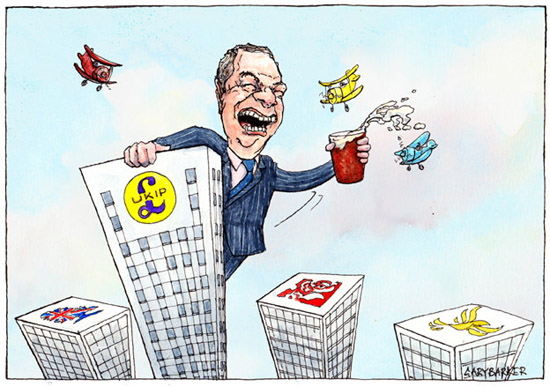
You preference is:
or reality when or if you wake up:
or reality when or if you wake up:
ExecLine
- 11 Apr 2015 12:58
- 58476 of 81564
This should make you all smile. I don't know how credible it is or even if it's true or not. Indeed, it might even be a spoof. But I think not.
Anyhow, it's an interview with Jeremy Clarkson's waiter, who refers to 'that night'. You might just even laugh at the waiter guy laughing.
Anyhow, it's an interview with Jeremy Clarkson's waiter, who refers to 'that night'. You might just even laugh at the waiter guy laughing.
ExecLine
- 11 Apr 2015 13:12
- 58477 of 81564
Even Hitler himself gets annoyed with Clarkson's sacking...
Fred1new
- 11 Apr 2015 18:30
- 58478 of 81564
Hazyone,
http://may2015.com/
FEATURED, NEED TO KNOW | Today
Election 2015: Betting markets now think Miliband is as likely to be PM as Cameron
After what can only be described as a torrid time for the Labour party on the betting markets over the last 3 months, something has changed.
Swiftly and suddenly, the market seems to have come to a new understanding of Labour’s chances of actually winning the election. Labour are still behind in terms of becoming the largest party, and sit at a dismal 2-4 per cent when it comes to the probability of winning a majority, but yesterday Ed Miliband briefly became favourite to be the next PM after the election.
http://may2015.com/
FEATURED, NEED TO KNOW | Today
Election 2015: Betting markets now think Miliband is as likely to be PM as Cameron
After what can only be described as a torrid time for the Labour party on the betting markets over the last 3 months, something has changed.
Swiftly and suddenly, the market seems to have come to a new understanding of Labour’s chances of actually winning the election. Labour are still behind in terms of becoming the largest party, and sit at a dismal 2-4 per cent when it comes to the probability of winning a majority, but yesterday Ed Miliband briefly became favourite to be the next PM after the election.
Fred1new
- 11 Apr 2015 18:31
- 58479 of 81564
Even better than I expected!
Seats after the election.
Labour 279
Conservative 265
SNP 54
Liberal Democrat 26
UKIP 3
Green 1
Others 4
Seats after the election.
Labour 279
Conservative 265
SNP 54
Liberal Democrat 26
UKIP 3
Green 1
Others 4
cynic
- 11 Apr 2015 18:34
- 58480 of 81564
am i not correct in thinking that New Statesman is more left-wing biased than the Guardian?
also
how can SNP win 54 seats when there are only 48 seats up for grabs in Scotland?
yet more from NS i take it, so in its own way, about as reliable as the Mail or Telegraph
========
even better than i expected .....
NS is decidedly on the far left of the labour party
also
how can SNP win 54 seats when there are only 48 seats up for grabs in Scotland?
yet more from NS i take it, so in its own way, about as reliable as the Mail or Telegraph
========
even better than i expected .....
NS is decidedly on the far left of the labour party
Haystack
- 11 Apr 2015 18:59
- 58481 of 81564
There are 59 seats in Scotland
2010 result
Labour 41 Seats 42.0%
Conservative 1 Seat 16.7%
Liberals 11 Seats 18.9%
SNP 6 Seats 19.9%
2010 result
Labour 41 Seats 42.0%
Conservative 1 Seat 16.7%
Liberals 11 Seats 18.9%
SNP 6 Seats 19.9%
cynic
- 11 Apr 2015 19:02
- 58482 of 81564
so they do, but not between 1708 and 1832 :-)
Fred1new
- 11 Apr 2015 22:35
- 58483 of 81564
Now it is a question of who is trustworthy?
-=--==-=
From Wicki,
The New Statesman is a British political and cultural magazine published weekly in London. Founded as a weekly review of politics and literature on 12 April 1913, connected with Sidney and Beatrice Webb, and other leading members of the socialist Fabian Society. The magazine has, according to its present self-description, a left-of-centre political position.[2]
The longest serving editor was Kingsley Martin (1930–60). The current editor is Jason Cowley, who assumed the post at the end of September 2008. In 29 May 2006 issue, then-editor John Kampfner stated that the New Statesman remained "true to its heritage of radical politics". The magazine has notably recognized and published new writers and critics, as well as encouraged major careers. Its contributors have included J M Keynes, Bertrand Russell, Virginia Woolf, Christopher Hitchens and Paul Johnson
==-=-=-=-=
To be honest I think I look at it a few times it as a student as my flat-mate was a public school boy and I think he "bought" it.
I may have read since then, but I will buy a copy of it on your recommendation!
I think the reports seem to have more truth in them than Cameron's, Osborne's and Fallon's failing campaign propaganda.
Perhaps, your faith is based on faith.
-=-=-=-=-=-=
8-)
-=--==-=
From Wicki,
The New Statesman is a British political and cultural magazine published weekly in London. Founded as a weekly review of politics and literature on 12 April 1913, connected with Sidney and Beatrice Webb, and other leading members of the socialist Fabian Society. The magazine has, according to its present self-description, a left-of-centre political position.[2]
The longest serving editor was Kingsley Martin (1930–60). The current editor is Jason Cowley, who assumed the post at the end of September 2008. In 29 May 2006 issue, then-editor John Kampfner stated that the New Statesman remained "true to its heritage of radical politics". The magazine has notably recognized and published new writers and critics, as well as encouraged major careers. Its contributors have included J M Keynes, Bertrand Russell, Virginia Woolf, Christopher Hitchens and Paul Johnson
==-=-=-=-=
To be honest I think I look at it a few times it as a student as my flat-mate was a public school boy and I think he "bought" it.
I may have read since then, but I will buy a copy of it on your recommendation!
I think the reports seem to have more truth in them than Cameron's, Osborne's and Fallon's failing campaign propaganda.
Perhaps, your faith is based on faith.
-=-=-=-=-=-=
8-)
Haystack
- 11 Apr 2015 22:56
- 58484 of 81564
http://news.sky.com/story/1463116/tory-poll-boost-as-ukip-fall-to-two-year-low
The Tories have gained three points to lead Labour in a new poll that puts UKIP on its lowest tally for two years.
The Opinium survey for the Observer has the Conservatives up three from a week ago on 36% - an apparent boost after several polls in recent days gave Labour a lead.

The Tories have gained three points to lead Labour in a new poll that puts UKIP on its lowest tally for two years.
The Opinium survey for the Observer has the Conservatives up three from a week ago on 36% - an apparent boost after several polls in recent days gave Labour a lead.
| About MoneyAM | Ts and Cs | Privacy Policy | Investment Warning | Content Standards | Corporate Solutions | Advertise With Us | Site Map | © 2026 MoneyAM |
Register now for FREE
Share Prices,
Stock Quotes,
Charts, Bulletin Boards, Indices, Watchlists, Portfolio, Market News, Research
or see our Premium Services including Level 2, Terminal and much more.
 Follow us on Twitter